

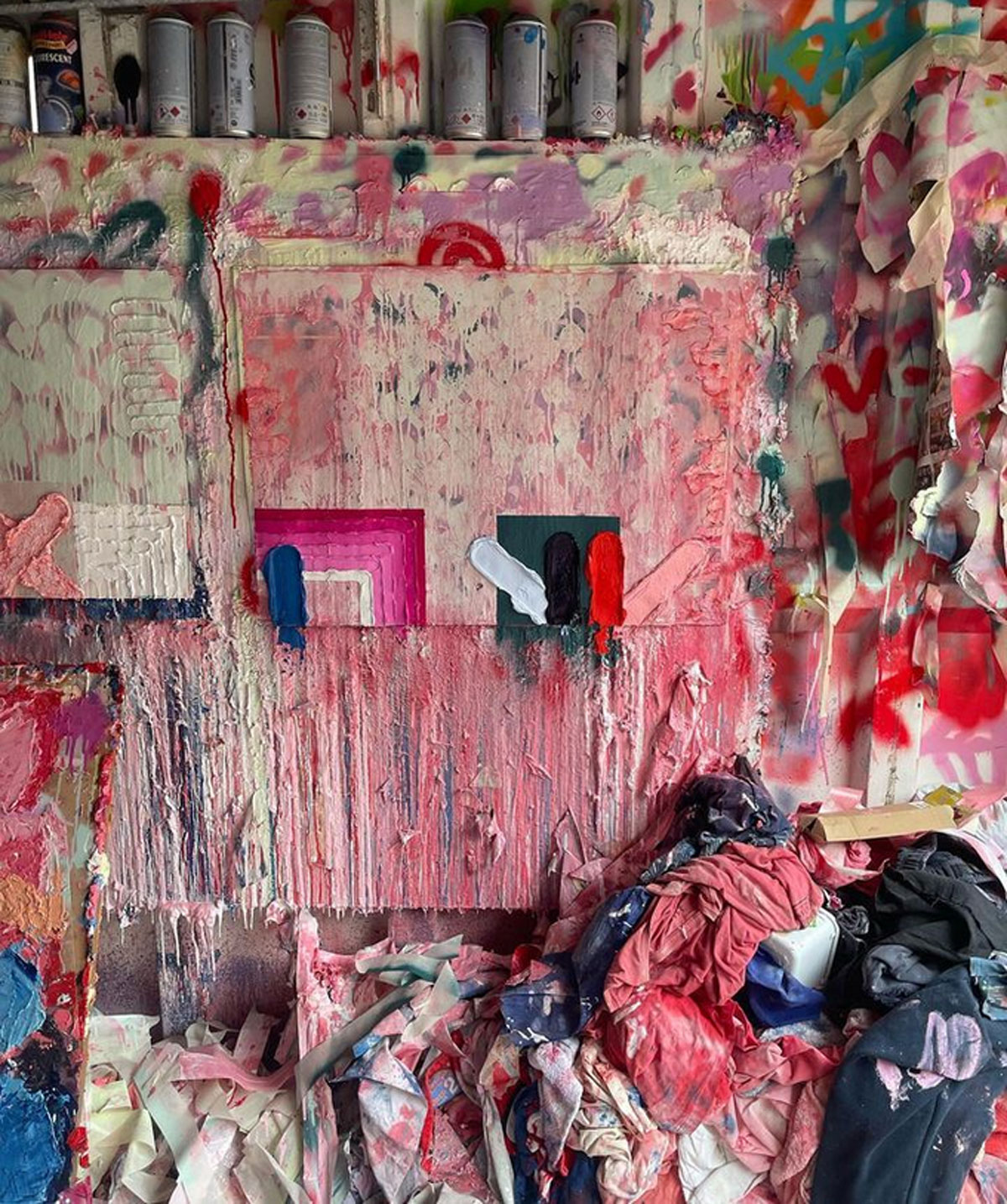
Five art things, on we go then and never mind the bliss or whatever we said last time, I guess this is Frieze week now, are we feeling the buzz that’s usually in the air? Will we find things a little less conservative than Frieze week was last year? Will there be any genuine alternatives or is that a thing of the past now? We’ll be out searching the galleries but then we always are….
On with the five art things thing, once again this is about this week and next and needing more (just more, nothing less) and yes you are right, I guess, for that is what we do now, guess, I guess we need to post another five. Here, for what any of this is worth are five more art things. Five art things, five more art things happening somewhere around right now (or any moment now). Five art shows to check out in the coming days as we repeat ourselves. We do aim to make this an (almost) weekly round up of recommended art events, five shows, exhibitions or things we rather think might be worth checking out. Mostly London things for that is where we currently operate and explore, and like we said last time, these five recommendations come with no claims that they are “the best five” or the “Top Five”, we’re not one of those annoying art websites that ignore most things whilst claiming to be covering everything and proclaiming this or that to be the “top seven things” or the “best things this weekend”. This Five Things thing is simply a regular list of five or so recommended art things happening now or coming up very soon that we think you might find as interesting as we think we will…
And we should add, that entry to these recommended exhibitions and events, unless otherwise stated, is free.

1: Julia Maddison and Mathew Tudor, Last Orders at Southgate Studios – 17th to 20th October with an opening on Thursday 17th from 6pm until 8pm – “Julia Maddison and Mathew Tudor create an immersive scrapbook of images (painted, printed, drawn, torn, found, forlorn) in this tiny corner room by the Regents Canal; a chaotic visual diary of a fictitious toper with a highly unreliable memory” so they say, they also say “In a slightly dubious, but not unpredictable, sequel to their 2022 exhibition, The Drinker’s Body, Julia Maddison and Mathew Tudor create an immersive scrapbook of images (painted, printed, drawn, torn, found, forlorn) in this tiny corner room by the Regents Canal; a chaotic visual diary of a fictitious toper with a highly unreliable memory”.
Southgate Studios is found at 2/4 Southgate Road, London, N1 3JJ. The space is open from 2pm to 6pm, Friday to Sunday

2: Laura Holmes, I am in Ostrich at D Contemporary – 18th Oct until 16th Nov 2024, with an opening on Friday 18th, 6 until 8pm – “D Contemporary is pleased to present I am an Ostrich, a solo exhibition by Laura Holmes (b. 2000, Norwich, UK). This marks the artist’s first solo exhibition with the gallery”.
“Holmes uses her practice to explore and investigate her relationship with painting itself. Her work unravels experiences, observations, objects, and memories, which she extends beyond the canvas. It’s a compulsion, kept in check by a set of rules, thoughts, and rituals surrounding painting. She makes paintings about the way that she makes paintings, but she makes her paintings as if they are sculptures. This is the only thing she can sustain enough interest in to propel her practice. She challenges painting. Laura has been gathering a list of experiences that have felt the same way that she intends for painting to feel. They felt how her paintings themselves could potentially feel like. Her paintings are an attempt to recreate the mood of these things and translate them all into a new coherent space.
Her paintings have become landscape adjacent. They are spaces.
‘I paint. I am an artist. I construct paintings as if they are sculptures or spaces. I excavate problems of painting.
Reach into my paintings please. I find joy in impossible aims. It’s fun to reach for the stars and then crash back to reality. With painting like this being such an inherently selfish activity, it needs a touch of the absurd. Painting is, and should be, fun(ny).
How can I make a show that feels the same as watching clouds? How do I construct paintings with a mood that’s the same as dancing in the street at midnight with music so loud the inside of
my head is quiet, or how it feels to cook without a recipe. How can painting be a soup, and how can that soup fall from the sky? What does that look like as painting? What mood does it have? Painting is like cooking. Painters are like chefs. I play with my food.
I am aiming to find whatever ‘painting beyond itself’ actually is; Painting that is better than my last. It’s a game to reassign meaning to this phrase. A puzzle with no real answers. The game of painting is limitless. I want my painting to possess space that is both internal and external to the canvas. Every tiny weave of canvas in Laura’s painting arena has been considered. She is
aiming to use the canvas to her advantage, to trick the eye, to paint iridescently, before methodically and metaphorically pushing her painting off a cliff. She ruins it so that she is faced with the challenge of saving it. Language is futile when collating the moods and experiences of this show into one thing. What I am aiming for is so individual and specific and intangible and impossible. I’ve just been calling it a feeling of ‘ostrich’. In this show, and whilst making these paintings, ‘I am in ostrich’
D Contemporary is found at 23 Grafton Street, London, W1S 4EY. The gallery is open Tuesdays to Saturdays, 10am until 5.30pm (Saturday 11pm until 4.30pm)

3: Theo Papandreopoulos, Carnyx at Pause/Frame – The show is open now and runs until 2nd November 2024, there’s an opening or a private view or whatever you want to call it on 17th Oct 6-9pm – looks like this might sound interesting –
“The sculpture and sound works in this exhibition interrogate the associations of historical symbolism, modern technology, and masculinity. By amalgamating natural and traditional elements, such as beetle horns and Japanese armour crests, with industrial materials like car parts and stainless steel, Papandreopoulos creates a multi-sensory experience that evokes both threat and intrigue. The accompanying sound works add another experiential dimension, translating the visual into sound, and reinforcing the perceptible substance of the concerns being dealt with.
The exhibition’s focus on speed, competition, and force underscores the underlying power dynamic that Papandreopoulos connects with the lineage of male animal males, who are as tiny as beetles and particularly salient in their mating rituals. The use of horns as a means of asserting dominance and securing mating partners points to the performativity of these instincts across species. The incorporation of technology probes how the expression of these instincts shaped and was shaped by scientific advancements.
Papandreopoulos’ sculptural and sound works are the culmination of a nearly yearlong interdisciplinary exploration into engineering principles, particularly those related to mechanical systems and sound transmission. Integrating engineering into the aesthetic and conceptual design required a complex synthesis of traditional and modern techniques. The creative process involved a rigorous iterative approach, beginning with sketches and digital renderings for most of the works. Subsequent research into materials and techniques involved consultation with engineers and mechanics, followed by countless trials and errors. The integration of contrasting materials, such as natural horns and industrial metals, posed significant challenges in terms of material handling, cutting, and fitting.
Specific challenges encountered during the fabrication process included achieving stability in the design of Goliath, acquiring the necessary car parts to make it perceptually hover above the floor, and ensuring surgical precision in the wiring of beetle horns to suspend them at the helm of the sculpture. Collaboration with metalworking specialists was crucial for creating other sections, such as the intricate wireframe helmet-like form around the fragile and delicate beetle horns.
Exhausthorn presented the most unexpected challenges due to its dual function as a sculpture and a musical instrument. The sound works required extensive research and experimentation to develop a functional instrument that aligned with the overall conceptual and aesthetic framework. The creation of this piece involved the lengthiest iterative process of experimentation and adjustment, with a primary focus on achieving the desired sound quality.
The final outcome of Papandreopoulos’ exploration is a cohesive set of works that offer a multidimensional experience, of spatially inclusive sculptures and evocative experimental sound works to create a unified installation”.
PAUSE/FRAME is at 194 The Broadway, Wimbledon, London, SW19 1RY, a new gallery in the Koppel Broadway building, Wimbledon. The show is open now and runs until 2nd November 2024, there’s an opening or a private view or whatever you want to call it on 17th Oct 6-9pm. The space is open Mon, Tue, Fri–Sun, 11am–5pm

4: Un Oeuf Is Un Oeuf at TJ Boulting – TJ Boulting have a group show called Un Oeuf Is Un Oeuf on right now and until 16 Nov 2024. We maybe should have mention is before the Sarah Lucas performance but hey, it all there. “Taking the egg as its starting point, it explores ideas that have inspired a myriad of artists from its mythology and symbolism to its aesthetics and form”.
Each artist featured, from historic to emerging, has found themselves drawn in some way to the potential of the egg, and expressed it across a variety of mediums, from painting to sculpture, photography and performance.
The main centrepiece, that already opened the show, is by renowned British artist Sarah Lucas, who has featured the egg several times in her work over the years, notably real fried eggs in her sculpture and photographic self-portraits. Here she presented her performance ‘1000 Eggs: For Women’ which will see women, those who identify as women and men dressed as women, invited to come to the gallery, on Tuesday 8 October 13.00 – 16.00, to throw 1000 eggs against the gallery wall to create a giant abstract painting. The egg throwing work has multiple references, incorporating performance, action painting and protest. It alludes to both egg as the traditional medium of painting, via egg tempura, as well as the symbol of women’s fertility and reproduction, and the throwing of eggs by women as a protest against the control of women bodies, both socially and politically. The yellow colour of the yolk has featured prominently in Lucas’s work, and was the key shade for her Venice Biennale British Pavilion in 2015. ‘1000 eggs : For Women’ has previously happened at New Museum (New York), Hammer Museum (Los Angeles), Red Brick Art Museum (Beijing) and Kurimanzutto (Mexico City), and this will be the first time it has been done in London.
“As with Lucas, the fried egg form is an ongoing fascination of US artist Chris Chiappa. For years he has carefully cast, poured and sanded plaster and resin eggs, and installed hundreds of them as site specific responses. The effect is that of an egg-shaped rash, or living group organism, gloopily spreading across the gallery walls, and seeping out of unexpected corners, it is both humorous and unnerving. In Roya Bahram’s fried egg, it is a single stand-alone form, carved from marble, deceptively as with her other food-themed sculpture, looking good enough to eat. The playful and subversive work of Liam Ashworth gives us his alternative take on daily rituals, ‘How Not To Make Egg On Toast’ gives us a step by step guide as to how to make anything but.
The form of the egg as well as its politics are inherent in Brazilian artist Anna Maria Maiolino’s black and white photographs from her series Vida Afora (Life Line). The egg is a recurring motif in her work since the 1970s as a symbol of the Brazilian Dictatorship, 1964 – 1985. The series show her place the egg in seemingly innocent everyday situations, such as arranged across the seat of chair, where its fragile form represented the oppression of the regime for women and her censorship as a female artist.
The beauty and simplicity, as well as loaded symbolism, drew pioneering Surrealist Man Ray to photograph an ostrich egg in the 1940s. Close up and cropped in black and white, its natural perfection and symmetry resembles something otherworldly, recalling the surface of the moon, our subconscious filling in what the majestic, dimpled, round surface could contain. The ostrich egg is also harnessed in Polish artist Piotr Bury Lakamy’s wall-based sculpture, referring to the sphere as a fundamental architectural form and as a shelter for life.
A contemporary of Lucas, Rachel Howard paints abstract forms that bring in figurative presences and physical remnants, her painting here has the egg form suspended against a backdrop of distorted and fractured grids of paint skin.
Surreal juxtapositions create compelling compositions in the work of Francesca Woodman, the small black and white photograph from 1980 shows a man lying on his back with an egg in his armpit. Its intrigue lies in the tension the egg creates, in what could otherwise be a seductive scene. With the egg precariously balanced by her own hand, Woodman directs the scene from behind her camera.
Boo Saville sources her surreal images from the internet and renders them as detailed monochrome drawings – an egg nestles atop a potato, they are the odd couple, the smooth white of the egg in cosily balanced on the gnarly, slightly battered potato.
Personal narrative and family history weaves through several artists and their depiction of the egg. Gareth Cadwallader’s watercolour, in beautiful and tender detail, is of his partner while pregnant with their first child, curled up beneath a protective canopy of egg-topped plants. It speaks of the nurturing nature of the egg and its echoes in the pregnant form. Coco Capitan’s grandmother used to cook her dinner each evening and at the end would always ask her, ‘Would you like an egg?’ as a way to ask if she was still hungry. Here two unique Polaroids of egg yolks are accompanied by Coco’s hand-typed recollection on yellow paper. She also has a text-based work from her notebooks saying ‘I FIND IT HARD TO BE MORE EGGSPRESSIVE’ and a photo story of multiple egg images. Sheida Soleimani’s photograph from her first autobiographical series, ‘Ghostwriter’, traces her parents’ history of migration from Iran to the US. It does not show literal eggs but a bird and empty nests, with fallen pomegranates in place of broken eggs lying on the floor. These fruits are a recurring motif in Sheida’s work: when her mother fled Iran in the 1980s following the revolution, she planted pomegranate tree seeds from her garden to remind her of home.
The mystical and mythological symbolism of the egg can be found in Polish artist Rafal Zajko’s fresco works. Having recently returned from a residency in Rome, he was entranced by the Etruscan symbolism of the egg often seen in crypts and tombs. For them the egg represented life in death, as well as life beyond death, and adorned funerary wall paintings as comfort for the journey to the after life. The egg shape perfectly fuses into his own practice of sci-fi inventions and mystical machina for the future, whilst looking to millennia ago. In a similarly futuristic and sci-fi sense, Maisie Cousins harnesses AI to create surreal yet nostalgic scenes with eggs. Her love of food images from retro cookbooks creates a combined fantasy of childhood memories and TV shows.
Polly Morgan’s sculpture looks into the egg as a cocoon polystyrene form of packaging, a ready-made form that contains the cast of real snakes, the natural world colliding with the artificial. For Katy Stubbs, the egg-eating snake is conjured in her trademark playful and colourful ceramics.
The egg form in still life has been a popular and recurring subject, for the show several painters Danielle Fretwell, Anna Choutova, Nettle Grellier, Olivia Sterling, Ruth Murray, Dana Powell and Tim Braden use it to create still and suspended scenes. It is the perfect object to study, both aesthetically and symbolically. Whether it is set against the delicate folds of cloth on a table or a plate of food, it is a loaded source and its intriguing form seems to offer the artist endless possibilities. With Japanese artist Chieko Shiraishi, her still life photographs are albumen prints, literally using the egg as a material to produce an image of its own original form. Similarly to Lucas’s action painting, the egg itself has the potential to be both the medium and subject. Is Un Oeuf ever just Un Oeuf?”
TJ Boulting is at 59 Riding House Street, London W1W 7EG. The Gallery is open Tuesday through to Saturday, 11am until 6pm. Un Oeuf Is Un Oeuf on right now and until 16 Nov 2024
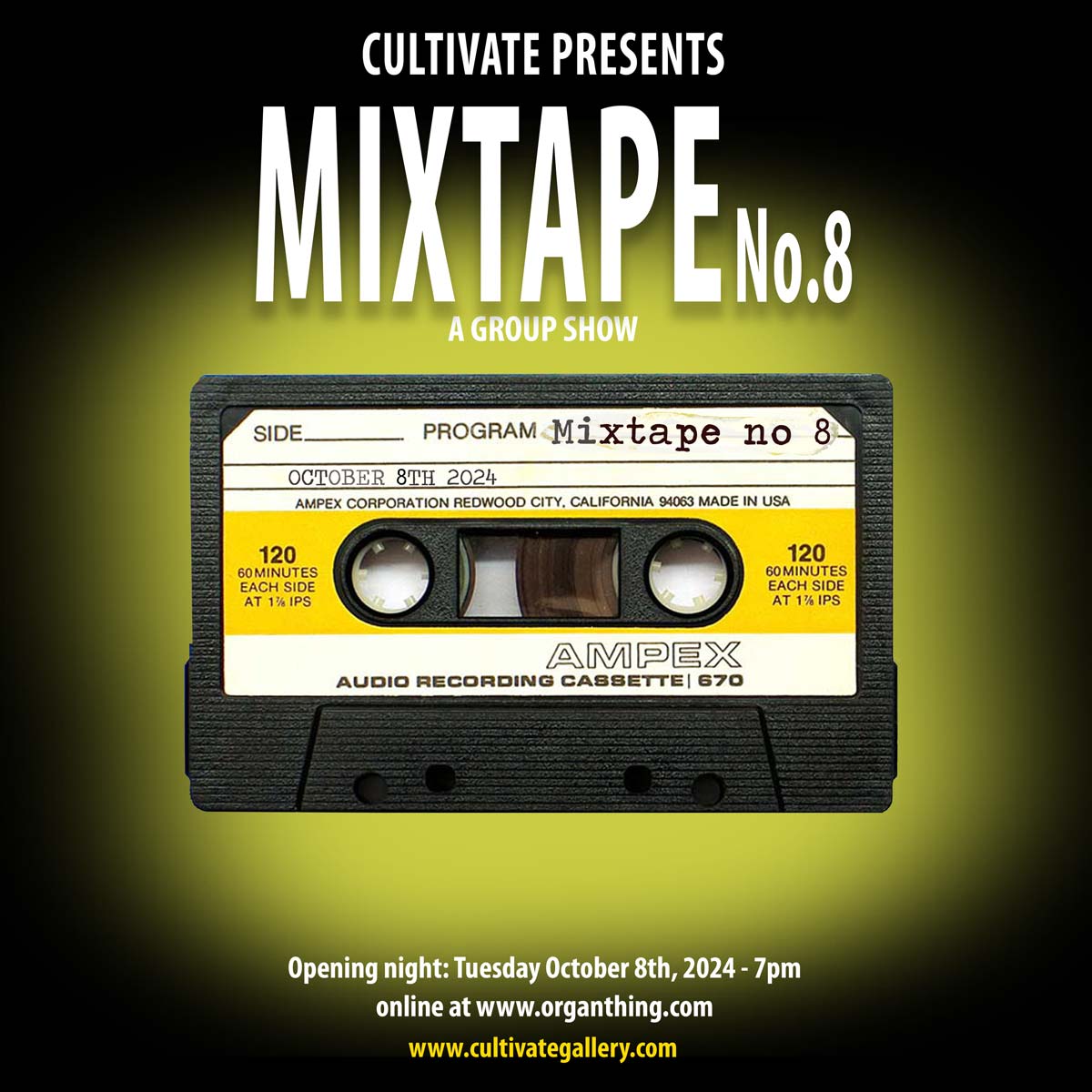
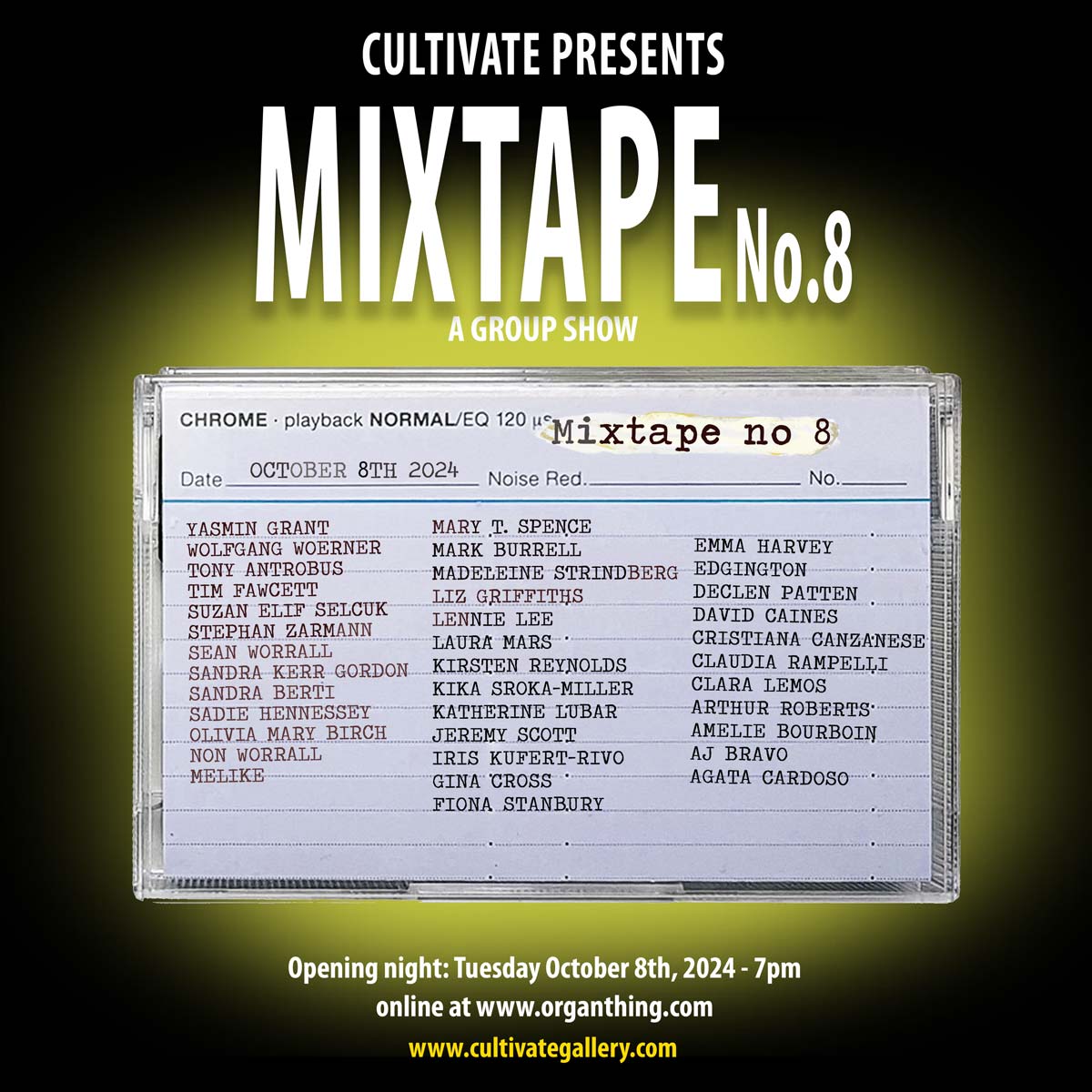
5: Mixtape No.8 via Cultivate – And yes, we will recomment our own show, an online group show that opened last week and can be viewed now from anywhere you wish to view it. A very carefully mictape of a group show feature 37 invited artists, here’s the link – Cultivate presents Mixtape No.8 – an online art exhibition…
 THE ORGAN