

A Cardiacs piece in three parts. Part One, in which Marina Organ explores the just released album…
Cardiacs – LSD (Alphabet) – When that message arrived from Tim Smith, late spring of 2008, it was a little green shoot or a break of watery sunlight after a relentless heavy endless dragging winter. It was headed
HARES JUMPING ABOUT
or something along that line – and being familiar with the way Tim loved to play with words and ambiguities that nailed exactly what you needed or felt but didn’t know you needed, our hearts soared. The email went on to say the album he’d been working on since Guns was almost ready to release, and it was the start of discussing putting out two more singles on The Organ’s record label, ORG. It’s long lost on a crashed hard drive somewhere, but I remember us both giggling with joy at it, at the pure Timness of that announcement. Hares jumping about… yes. Of course.
Plans were afoot: a double album, tours, strengthening and rebuilding the old networks built up over decades of legendary gigs and hard work, finally shining out to the world online, brushing aside the gatekeepers that made creative life so difficult for Cardiacs (and other bands) through the Nineties.
The timing felt so right. All over the planet, people who would instantly ‘get’ Cardiacs’ were hearing them, often via the burgeoning social networks of equally unique bands. What used be impossibly hard – describing the indescribable in the hope that you could just get someone to listen, or come to a gig, just the once – became easy. Here, listen to this sample on Cardiacs.com, watch that stupendous ‘rehearsal’ video Tim uploaded to YouTube. No more interpretive dance about architecture. And the thousands of lost fans who’d encountered a Cardiacs or Sea Nymphs gig or recording since they hit their stride in the early 80s, the people who’d lost touch or moved away from going to gigs, many of whom were surprised Cardiacs still even existed – they too were starting to return. Cardiacs were potentially the biggest truly independent band in the world, a DIY, cottage industry triumph, about to reappear to dazzle us and inspire us.
Tim said that the new single would be ready soon. It needed more work, it needed vocals. We knew how he poured his heart and soul into every millisecond of his work and it wasn’t easy, you had to let him do his thing, it would take bloody ages. But he always got there, never let you down. We got braced for summer, warned our usual mastering people it was coming, and waited.
And waited.
Summer came. Just before his birthday, in June 2008, Tim lost his voice and his ability to move and everything stopped. Struck down in a life or death battle that left him with a horrible condition that locked up his limbs and placed him in 24 hour constant care.
Forty years ago this September, I interviewed Tim Smith, at a long gone venue called the Croydon Underground.
I’d first caught a glimpse of them the previous December, far off on the stage of the Hammersmith Odeon, and went home with their songs on repeat in my head. Then spent all winter and spring sneakily skim-reading all the Inkies (as the UK press was called) from cover to cover in WH Smiths or the local newsagents until rumbled, searching for more information about a band that seemed to have appeared from nowhere, performed miracles, and disappeared.
The only mentions were in the gig listings, so I took the train up to London to some scary place called The Marquee, knowing that I had to leave for the last train by ten thirty, only intent on finding something, anything, I could take home to listen to. Expecting aloof, inscrutable indie cool, I found only friendliness and warmth from the band and the people there, and a sense of coming home. I had to leave after two numbers (showered with accidental beer during the unexpected moshpit of To Go Off And Things) but that was fine: I had the tape-album of The Seaside and the A5 photocopied Cardiacs Book, a little zine of lyrics to go with the album, bought from an actual wooden Shop from an entity called The Consultant, the semi-mythical manager who would appear at the end of every gig to celebrate the performance with balloons and rotten flowers whilst a glamorous assistant ushered Tim offstage as he howled and threw a tantrum.
The whole package had a completeness and beauty that hit all the deepest personal feels on a dozen levels. The Seaside contained every sort of music I ever hankered after – I’d longed for a band to play film soundtracks at battle level, with guitars and synths and drums and emotion, ideally with lyrics that connected to real life in a non obvious way. With a bit of otherworldlyness thrown in. It was all there.
On top of this, the scary, funny, mesmerising bloke at the front of this furious rollercoaster of a performance turned out to be nice. During the interview, Tim was kind, polite, considered, had a way of communicating his ideas that made the important things clear. He confirmed what we saw on stage: absolute genuineness, and, underneath the humour, the focus of a serious artist. Deadly serious, if you like – whistling in the dark humour, the laughter that shouts in the face of an all too thin spun life – and at the same time joyous and vulnerable.
A fragile thing, this. A few years later, Cardiacs got their first exposure to the world via a performance on the The Tube, a TV show watched by millions. At that time, they were manifesting as the six piece band who ‘like to put on a show’ as Tim put it, with smeared facepaint and rotten marching band uniforms and a backdrop of a child’s idea of a suburban front room. A single finger to the pompousness of ‘rock’ and ‘indie’ and Serious Pop Music, whilst playing serious pop music containing layers and layers of meaning. Whilst making you cry with laughter. Or not. On reflection, that Tube performance probably did irrepairable damage to Cardiacs’ standing in the eyes of the movers and shakers of the music Industry, but the Marquee gigs the next week were sold out with people fighting to get in.
So the story of Cardiacs goes on through the eighties and nineties with Tim dialling down the theatre but upping the composition mastery. That was right and proper, because it hid what we were really witnessing in the guise of a wild, loud guitar band: a truly remarkable composer at work. The self taught creative who had to create a shield of make up and onstage persona to protect himself and his vision. A songwriter who used sheet music to capture what he could hear in his head because that was the only way of doing it, until he built his home studios and cranky early DAWs became available. Someone who felt intimidated by ‘proper’ musicians, despite having a staggeringly original compositional ear.
Ten years after his stroke and brain damage closed the door on his playing and singing, Tim was honoured with a Doctor of Music degree by the Scottish Royal Conservertoire of Music, as a composer.
There was always hope, and plans, to get Tim back to the home studio he built hidden away in the countryside outside Salisbury, so that he could carry on making music. Unable to speak beyond the quietest of sounds delivered, rarely, with huge effort, but ‘all there’, all full of ideas and emotions as ever, and endless time to think of it, his friends, co-composers and family hoped to create a place for him with all the care and technology needed. It was getting there, starting to happen, in a world increasingly hostile to broken people and their carers. And then, the plague. Locked down in a care home, waiting for the world to restart, Tim left the world in summer 2020, a final heart attack taking him in his sleep.
Those who are truly hurt, are the silent ones, or something like that. Who wants to talk about lost albums when the real loss is almost too much to bear?
In 2023, a sort of miracle happened. There was always talk of some kind of celebration of Tim Smith’s life, when the time was right. Outside of the pain of those closest to him, there was the mass grieving of many, many thousands of people for whom Tim Smith’s music is a lifeline, a life soundtrack, a reason for living. There’s no guidebook for any of this. Not that, or the exponential increase in love for what was left behind, the magnificent body of work of thirteen unique life changing studio albums through the main band and associated works.
One of Tim’s great talents was an ability to draw others into his creative crucible and perform alchemy, making newness out of both. One of his many collaborators included Jo Spratley, creating a spin off band together to free himself up from the Cardiacness of Cardiacs, exploring a softer, stranger, poppier place. During the years of Tim’s illness, his friends and family organised a series of ‘Alphabet Business Conventions’ in Salisbury Arts Centre, enabling Tim to enjoy gigs and the love of friends and family and fans, and a gigging version of the Spratley’s band formed, perfoming the supposedly-unperformable songs of the album Pony for Tim’s delight. Out of that spirit of collaboration, three years after “Tim left the planet to become a rat” (Tim adored mice and rats) Jo set up a series of gigs, part memorial, mostly celebration, all catharsis. Called Sing To Tim, the events gathered together musicians onstage from pretty much the entirety of Tim’s career. They were immensely healing, gathering, astonishing moments in time. Afterwards, the idea that there could be a finishing of LSD became less of a painful thing to even consider, and more of a need.
Tim Smith was a very private person. He’d give of his deepest, most tender feelings in his lyrics and his music, but he’d wrap them up so you could glimpse them without really knowing the private details. He’d retreat away from everyone before a gig, so he could get his nerves and his act together, and he’d hide away in his studio to do what he had to do without the world coming in and messing it all up, or giving away his working process before he’d got it just right. That was part of the magic, the not knowing, and I think we all knew that.
He also always made the right decision, when it came to his work.
That’s not a throwaway statement. As a commercial artist myself, who has worked collaboratively with many hundreds of other artists as an animator and graphic designer, asked to contribute to a project, I learned (the hard way!) that some people, you don’t question. You take their ideas, and follow them to the letter, or the pixel, because they know something you don’t, and never will. In fact, when I encountered that I usually thought ‘yup, this is a Tim Smith situation’ because no matter how weird or awkward that particular line or colour or timing might seem, altering it would never be as… something… as that particular creative choice.
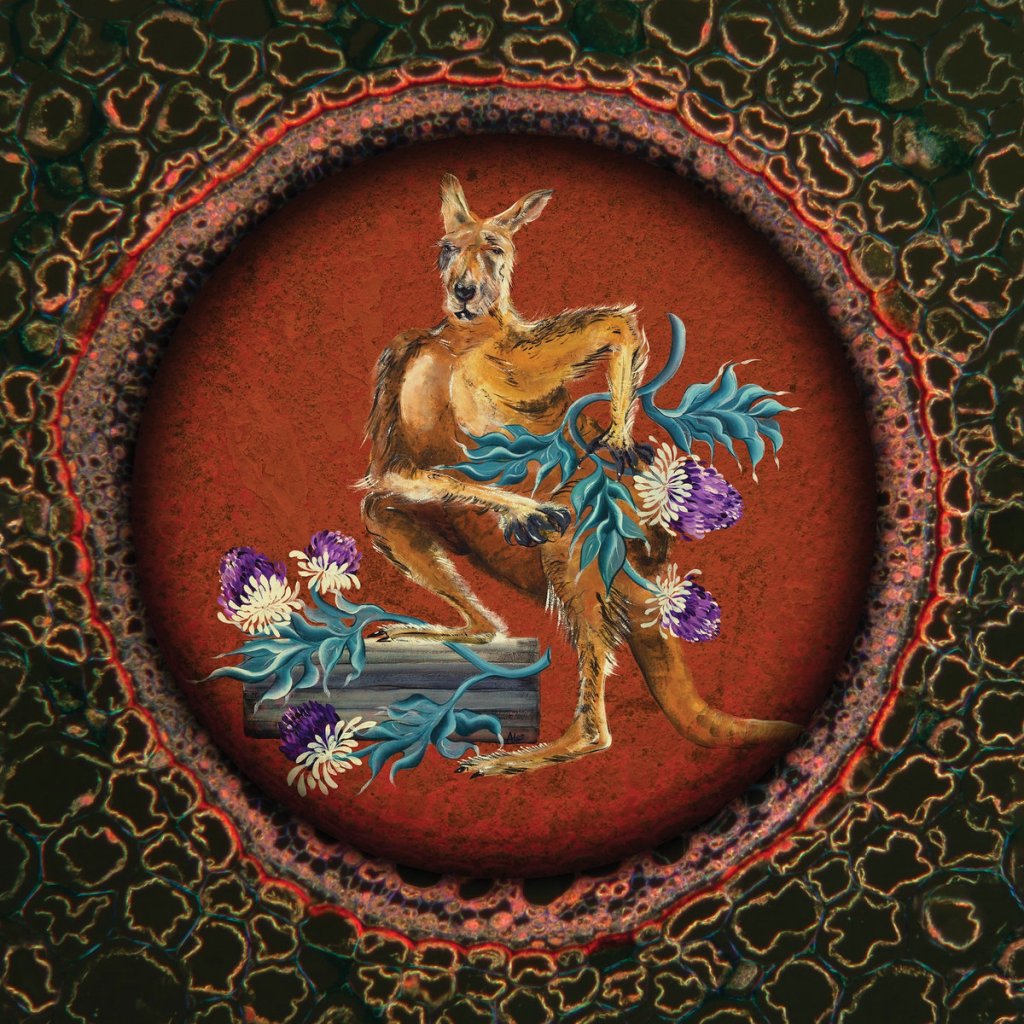
The moment I saw that cover… yes, that kangaroo… I saw Tim looking back at me. Or rather, I saw his beady, intense gaze fixed on it, seeing is somewhere for the first time, knowing he had to have it. That it was Correct, the Right Thing… That. Something wordless, funny, something something the absurdity and beauty of Life. I didn’t want to know anything else about it, I’d certainly not seen it in his home, he’d never mentioned it. I saw it leaked accidentally, in fact, in a tiny thumbnail. And thought, yep. Only Tim would. There’s Tim.
And that, everyone, is what we’re dealing with, when we talk about this album. That something. Really, we’re all fucked, all of us who have this legacy to… play with, in all our different ways. What do you do?
You do that thing with the gold fixing the broken cup, what’s it called again? The Japanese thing. Kintsugi, that’s it.
This broken cup sparkles. It shimmers with need, life, pain, well fuck I’m crying in a cafe now.
Of course, it’s Tim’s work. And of course, from the first moment, you’re slapped with regret. Is THIS what he had, ready to go? Where he’d gotten to after setbacks and one terrible year after another? Ready to declare itself without compromise or hesitation or holding back of his intent in any way? What a cruel pisser of a world. I do not know if his intent was to start with Men In Bed but I hope that it was, it’s an opening track for the ages. Not the potential pop hit but the huge and mysterious and frightening choral work.
If it’s the choice of those left holding the cup, then it’s a very good choice.
But then, there’s the difficulty in listening to this album. If you’re new to Cardiacs, it’s easy. Either you’ll be one of those people who just can’t handle any of it, or you’ll be blown away. You won’t go ‘what if Tim was singing there’ or ‘there’s something extra that he used to do, I think it’s missing’. You’ll dive in, and you’ll be astonished. Maybe baffled, and overwhelmed, and needing to digest it one slice at a time, over weeks or months.
Because it is a truly astonishing album. Cardiacs was always about stretching pop music into new dimensions whilst still being pop music, with detours through the entire history of rock, studded with whatever shiny jewel of sound Tim could harvest from a passing TV show or old film soundtrack or a scratchy old Vaughn Williams LP found in a charity shop. There’s the thing: no matter where Tim goes when he’s exploring composition, it’s in search of a gut reaction, an emotional reaction, and there’s no limits to where it comes from. If the pop music suddenly appeals to a metal head, or someone whose record collection revolves around Henry Cow, or someone doing a masters in Bartok, or a five year old who wants to hear ‘the Curly Song’ over and over again (the one called RES that appears on their 1984 album The Seaside) then – it’s all the same thing. It’s all Cardiacs.
For those of us immersed in the studio albums of Cardiacs and Spratley’s and the Sea Nymphs and Tim Smith’s Oceanland World, it’s going to be a harder ride for some than others. There is no road map for this. Perhaps this would be far easier if that unheard album had peaked with the trio of tracks on the Ditzy Scene single, and even the first single we heard from LSD, Woodeneye. These are four rich and rewarding tracks in themselves, but they’re the lighter side of Cardiacs, in as much as they’re about energy and melody and sound and colour, suitable for bouncing about and punching the air to. We could all enjoy, and sigh a bit, and return to On Land and In The Sea or Sing To God, etc etc.
Well, those tracks are just the appertizers.
Tim appears to have left us all with a most magnificent solid ghost of an album, a heavyweight, multifaceted, multi layered beast. No filler. It’s unlike anything any of us have ever heard, whilst reminding us of dozens of things. It’s hugely enjoyable. And he’s all over it in the form of his writing, sometimes his vocals too, saved from completed and half completed pre-illness recordings.
That really should be all we have to say about it. But… it is a broken cup. The truth is, it wasn’t finished. Other people had to finish it with him and for him. Astonishingly (that word again) Tim was involved in that finishing/mending process to a certain degree: making choices, directing by the slow and painful method of forcing his own misbehaving hand to point out words one letter at a time.
How far he got, what choices he made, one grinding step at a time – do we really want to know? Because not one single bit of that question comes without hurt in a spring loaded trap, ready to crush the listener, the menders, the circle of creatives drawn into his orbit.
All we should know is what our ears tell us.
My ears love the shining colours in Downup just as it is. It’s utterly perfect pop, and the world would be a much better place, and possibly the apocalypse averted, if the machine that pushes pop music for the masses decided to force it on the public at large. I can hear a lot of collaboration in that one, a lot of heavy lifting done by humans who are not actually Mr Smith, both Mike Vennart’s clean choirboy voice and a melody lines that here and there must surely be Craig Fortnam’s. But then, Craig has spent decades of his life immersed Tim Smith’s melodies, and you can hear that in his own work, and I’m sure he wouldn’t mind me saying Tim’s influence is impossible to remove… even if he wanted to. Which he doesn’t. And it’s quite possible I’m hearing a line that Tim wrote after listening to and absorbing the North Sea Radio Orchestra. So… the music goes round and round.
As a song, Downup is one of Tim’s best, and Tim’s best songs were and are elegant. They said a great deal, and did a great deal, in a way that fitted together or flowed or simply worked, even when deliberately introducing a jarring change or telling a long story. Going back to The Seaside (1984) again, A Wooden Fish on Wheels is absurdly complex under the hood, but you’d never know, you’d just think it was an easily danceable ska number. Similarly the interlocking polyrhythms in Core from Heaven Born and Ever Bright (1992). It’s the same subtle songwriting tricks that made the Pixies so addictive at their best, revved up to a running-around-a-maze anxiousness, and then released into a sweet melody. Elegant, perfect really; not quite what Tim would have done with it, not quite the production he’d go for, maybe this or maybe that… and yet so, so much could only have been created by him.
And that’s where we are, and you get two whole albums of it. All in one go. It’s overwhelming. No matter how you come to it, new fan, lifetime listener, never mind friend and family or anyone involved in the making of it.
LSD feels like exactly what it is: a carefully curated collection of uncut gems, polished to sparkle, arranged to fit together with great care. Once you get over the hugeness of Men In Bed the tracks hang together in an easy arc, a journey that goes from the straightforward energy (that was hinted at in the Ditzy Scene single back in 2007 and kind of what I expected this album was going to be) of The May, Gen, Woodeneye to the increasingly ‘out there’ via soulful strangeness of Spelled All Wrong. Lyrics remind me of something Tim said in a phone call in oh, I guess 2004, when we were talking about how the ‘new stuff’ was going – ‘I’m going to make it more dark‘.
By the time we get to Skating we’re already dazzled, but this is something else. When you’re done with talking about how brilliant Cardiacs’ pop songs are, how infectious the hooks and immaculate the choruses, it’s time to bend an ear to the wild stuff. This is pure unfettered Cardiacs / Sea Nymphs at their most adventurous, taking off the runway as psyche-pop, hitting an updraft of heavenly ecstatic Steve Howe style riffage, then up we go into bewildering clouds of mouse choirs and David Lynch organic weird. It’s mesmerising, delightful, oddly fresh, and, most importantly, joyous and emotional. It also has to be said that there’s chunks of Jitterbug from Guns and a passage that’s uncannily like a moment on an early Thinking Plague album. Then along comes a passage that sounds exactly like a fly or a bee trapped in your kitchen banging against the glass while you try to usher it with a bit of paper towards the open window, but it keeps going the wrong way, and this process goes on forever and you’re both the bee and the bee saver getting increasingly wound up, until suddenly, ahh, freedom.
By the end of Skating you’re done. It’s everything Cardiacs ever promised, however we got here.
Following that with the solemn, gentle relief of Breed is perfect, and then we’re lifted by the glorious pastoral pop of Volub, the track most strongly featuring Rose Kemp’s voice. Finally, we get to find out what Tim meant by ‘Hares boxing about’ – this must have been what he intended to be the first single from the album. It’s stupendously beautiful, reeking of winter and spring and bright wistful hope, and her voice is perfect.
The second album opens, once again, with another Big One: the instrumental Busty Beez which feels like a distilled, concentrated essence of the monumental endings of The Breakfast Line and Closely Guarded Line and the legendary Jitterbug Coda. It’s terrifying.
The breezy vigour of Lovely Eyes following that is a bit of a shock, but feels oddly right and one of those huge contrasts that was part of Tim’s emotional armoury. A splendid song, immaculately produced, with Mike Vennart up front though sharing vocals with Kavus, Rose and Jim and subtle sprinklings of strings. Roll From a Dirty Place takes that further, then winds itself up into unexpected places (via that nod to The Who at the start); when it flows nicely into Made All Up, Tim Smith’s voice arrives all quavering and fragile and shockingly familiar and makes our tummies feel funny. At this point, instead of the intended final track, Vermin Mangle (gifted to us all freely on the day of Tim’s funeral) the ending is a song, Pet Fezant, an ensemble piece made from a work by Tim, with lyrics by his partner Emily and the voices of many of those who worked on this album. Thirteen voices, and strings and brass by Craig Fortnam, and, most movingly, Jim Smith’s rolling, speaking bass, a declaration of truth: that this collection of jewels and precious fragments are bound together by this group of humans, in this time and space, that this is indeed what it is. It is indescribably emotional, and there’s no way of talking about it.
So there is is, out in the world. Don’t pick at it. Don’t go down that rabbit hole. Just look at the stupid battered face of that kangaroo that nobody with any bloody sense would ever have on an album cover, wonder at the absurdity of it all, here and now. Packaged up nicely, that message (“look at this! Look at the beauty, even this is beauty”) straight from the guy himself made into a shiny gold motif like the spine of an old book. Did I mention that this is the most contemporary collection of songs we could possibly have for our time? We live in a world where everything is breaking and falling apart even as we struggle to imperfectly mend it, over and over again. We can try to hang onto the patina of the old bits, but it rubs off.
There’s a principle in restoration where you mend using the nearest materials you can, but when it comes to the bits that are missing, be careful, blend it in as best you can; but if you can’t blend it perfectly, be obvious, glue it with gold. Don’t create a pastiche. Tell the truth.
The truth is beautiful.
(Marina)
Also
ORGAN: A Cardiacs piece in three parts. Part Two, exploring the album…
 THE ORGAN
5 responses to “ORGAN: A Cardiacs piece in three parts. Part One, exploring the album…”
[…] ORGAN: A Cardiacs piece in three parts. Part One, exploring the album… […]
[…] ORGAN: A Cardiacs piece in three parts. Part One, exploring the album… […]
[…] ORGAN: A Cardiacs piece in three parts. Part One, exploring the album… […]
[…] ORGAN: A Cardiacs piece in three parts. Part One, exploring the album… […]
[…] so many ways the album of the year… When it did eventually come out we both reviewed it; A Cardiacs piece in three parts. Part One, exploring the album… and A Cardiacs piece in three parts. Part Two, exploring the album… and there was a third […]