

Another week, another Five Art Things thing, We are in the body of something of other now, well, we’re not really surely the time has come to stop asking if it is all going to pick up a little? Shall we go on and never mind the bliss or the selfies in front of the art or whatever we said last time. Normal service miles away from being resumed, am I falling out of love with art? Did I say that last time? And the time before? Are we done here?
Five art things, five more art things happening somewhere around right now (or any moment now). Five art shows to check out in the coming days as we repeat ourselves. We do aim to make this an (almost) weekly round up of recommended art events, five shows, exhibitions or things we rather think might be worth checking out. Mostly London things for that is where we currently operate and explore, and like we said last time, these five recommendations come with no claims that they are “the best five” or the “Top Five”, we’re not one of those annoying art websites that ignore most things whilst claiming to be covering everything and proclaiming this or that to be the “top seven things” or the “best things this weekend”. This Five Things thing is simply a regular list of five or so recommended art things happening now or coming up very soon that we think you might find as interesting as we think we will…
And we should add, that entry to these recommended exhibitions and events, unless otherwise stated, is free…

1: Nathaniel Rackowe, Asphaltos Phos at Varvara Roza Galleries – 10th until 29th November 2025 – “For his debut solo exhibition with Varvara Roza Galleries, entitled Asphaltos Phos, internationally acclaimed artist Nathaniel Rackowe presents a compelling body of work”. I don’t know, something just speaks out here….
“Across older works and new commissions, Asphaltos Phos orchestrates a structural symphony where surfaces, structures, and luminescence converge, inviting the viewer to interact with the sculptures and reconsider the overlooked textures of the urban fabric and the infrastructures that shape our daily experience. Based on extensive research and spatial observation, Rackowe’s practice continues to evolve at the intersection of art and architecture, responding to the built environment while uncovering hidden narratives beneath its fabric.

Nathaniel Rackowe is a London based artist from the UK. His often large-scale urban referenced structures, and light sculptures are designed to recreate the experience of navigating the city around us. His works are abstracted impressions of today’s metropolitan experience evoked through the vicissitudes of light as it fluctuates throughout the city. Influenced by Modernism, film and video games, Rackowe uses the mass manufactured derivative products of the modernist era – glass, corrugated plastics, concrete, scaffolding, breeze blocks and strip lights – to recreate the collective experience and visual sensations of urban contemporary life, while incorporating a deeply personal emotional response to flowing through built space”.
Varvara Roza Galleries is found at 8 Duke Street, St. James’s, London, SW1Y 6BN. The space is open 10am until 6pm, Tuesday until Sunday
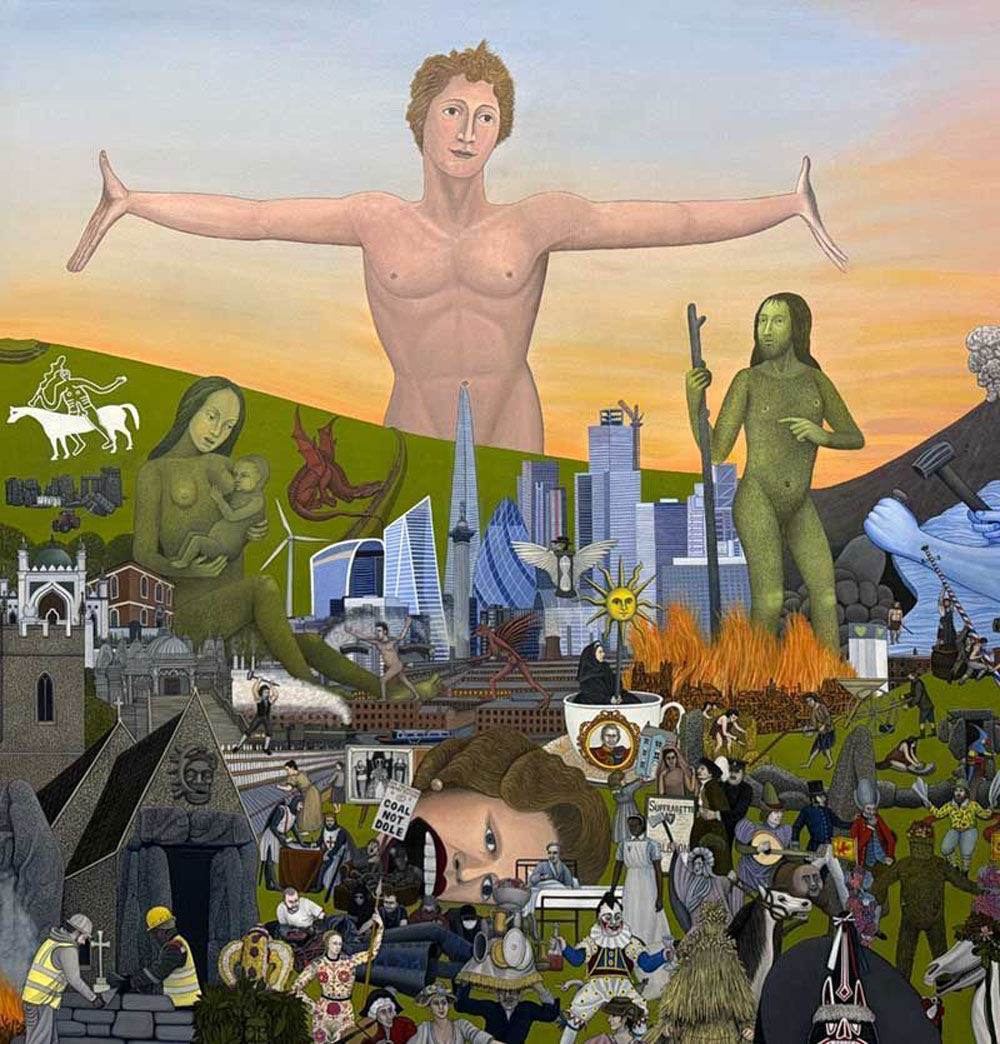
2: Ben Edge, Children of Albion at The Fitzrovia Chapel – 6th November until 26th November 2025 – “This November, the Fitzrovia Chapel presents Children of Albion, a powerful new exhibition by London-based British artist Ben Edge (b.1985). In this showcase of painting, sculpture, and film, Edge continues his deep dive into British folklore and mythology – mining the ancient stories and rituals rooted in the land to uncover their enduring resonance in a modern world marked by disconnection”.
“Edge captures what he calls a “Folk Renaissance,” reflecting a rising desire to reclaim ancestral roots and reconnect with nature. But Children of Albion is no exercise in nostalgia. Instead, it’s a forward-looking vision, an invitation to re-enchant our relationship with the land and reimagine a shared cultural identity that bridges past, present, and future. Edge’s works conjure ancient sites and the mythologies that surround them, where demons, superstitions, and timeless tales take shape within today’s fragmented world. Through these works, Edge blends tradition with the tensions of modern life – grappling with environmental collapse, identity crises, and a collective yearning for meaning.
“As contemporary Britons, I believe we’re all part of this evolving story,” Edge says. “It transcends time and heritage, forming a diverse, interconnected whole. Since the pandemic, I’ve seen a renewed fascination, especially among younger generations, with folk traditions and the spiritual power of the land.”
At the heart of the exhibition is Edge’s most ambitious painting to date: Children of Albion, 2025. Serving as a dramatic altarpiece in the Chapel, it offers a sweeping visual history of Britain, from prehistory to the present. Inspired by the fantastical complexity of Hieronymus Bosch, it explores the unravelling of our bond with nature while confronting Britain’s colonial legacy. Through themes of migration and transformation, Edge reclaims Britain as a “mongrel nation” – a place shaped by waves of cultural exchange and constant evolution.
From Summer Solstice celebrations in Milton Keynes to ritual scenes inspired by the folk song John Barleycorn, Edge’s works teem with hybrid figures – part man, part animal, part plant – and spectral presences that exist beyond time. In an increasingly urban world, these works serve to remind us that we are not separate from nature, but part of it – deeply and inextricably woven into its fabric”.
The Fitzrovia Chapel is at 2 Pearson Square, London W1T 3BF. The gallery is open Tuesdays through to Sundays, 11am until 6pm, (midday until 5pm on Sundays)

3: Conor Harrington, Pallium at Ben Brown Fine Arts – 7th November until 6th February 2026 – “Ben Brown Fine Arts is delighted to announce Pallium, an exhibition of new paintings by Conor Harrington, marking the first presentation of work by the acclaimed London-based Irish artist with the gallery”.
“Harrington’s paintings interrogate the legacies of colonialism, empire, and the masculinist ideals that underpin them – archaic systems of power that continue to shadow contemporary life. Drawing upon the conventions of history painting and the visual rhetoric of the eighteenth century, he reworks their languages of costume and symbol to expose the mechanisms through which authority was staged and sanctified. In his hands, these emblems of power are rendered as hollow vestiges, garments that outlive the bodies and beliefs they once adorned, emptied of conviction yet still haunting the present.
Reimagining classical history painting through a critical engagement with Britishness from an Irish perspective, Harrington’s work is deeply informed by his own identity and his experience of life and politics in Britain. The artist was inspired by historical re-enactments he observed in Bristol where participants don period costume to restage scenes from the past. He saw in these performances a potent metaphor for the way outdated systems of power are maintained today.
Two recurring motifs – bunting and ermine – cloak the shadowy protagonists of this series. Bunting, once a naval signal and now a token of festivity, functions as a hollow signifier of unity. Where national flags proclaim allegiance, bunting gestures only towards generic celebration. Its physical lightness and ephemerality become, in Harrington’s hands, emblems of the fragility and vacuity of such symbols. By contrast, ermine cloaks – ceremonial garments historically reserved for European monarchs and long associated with purity and prestige – carry the heavy residue of inherited authority. Their opulent weight bears down upon the figures, offering a visual counterpoint to the insubstantiality of the bunting. The tension between these two materials crystallises Harrington’s critique of power as theatre – a spectacle in which the rituals of grandeur persist, even as their ideological substance has long since disintegrated
Pallium – from the Latin for “cloak” – refers both to the garments that drape Harrington’s figures and to the region of the brain associated with memory. The title encapsulates the artist’s wider enquiry into pageantry, power, and the ways history is constructed and sustained. Rather than depicting history, Harrington dissects the rituals through which it is performed, remembered, and mythologised – revealing authority itself as a costume repeatedly donned to preserve the illusion of continuity.
With Pallium, Harrington turns history painting inside out – exposing its seams, unpicking its myths, and holding the remnants to the light in a reckoning with the narratives that continue to shape us. His paintings refuse to glorify the past, instead questioning the stories we persist in telling about it. They offer not resolution but a space in which the performance of power can be seen for what it is. Yet beneath the pageantry, Harrington searches for the moment when the mask slips, the performance falters, and we are left to decide what might take its place”.
Ben Brown Fine Arts is found at 12 Brook’s Mews, London, W1K 4DG. The gallery is open Monday to Friday, 11am until 6pm

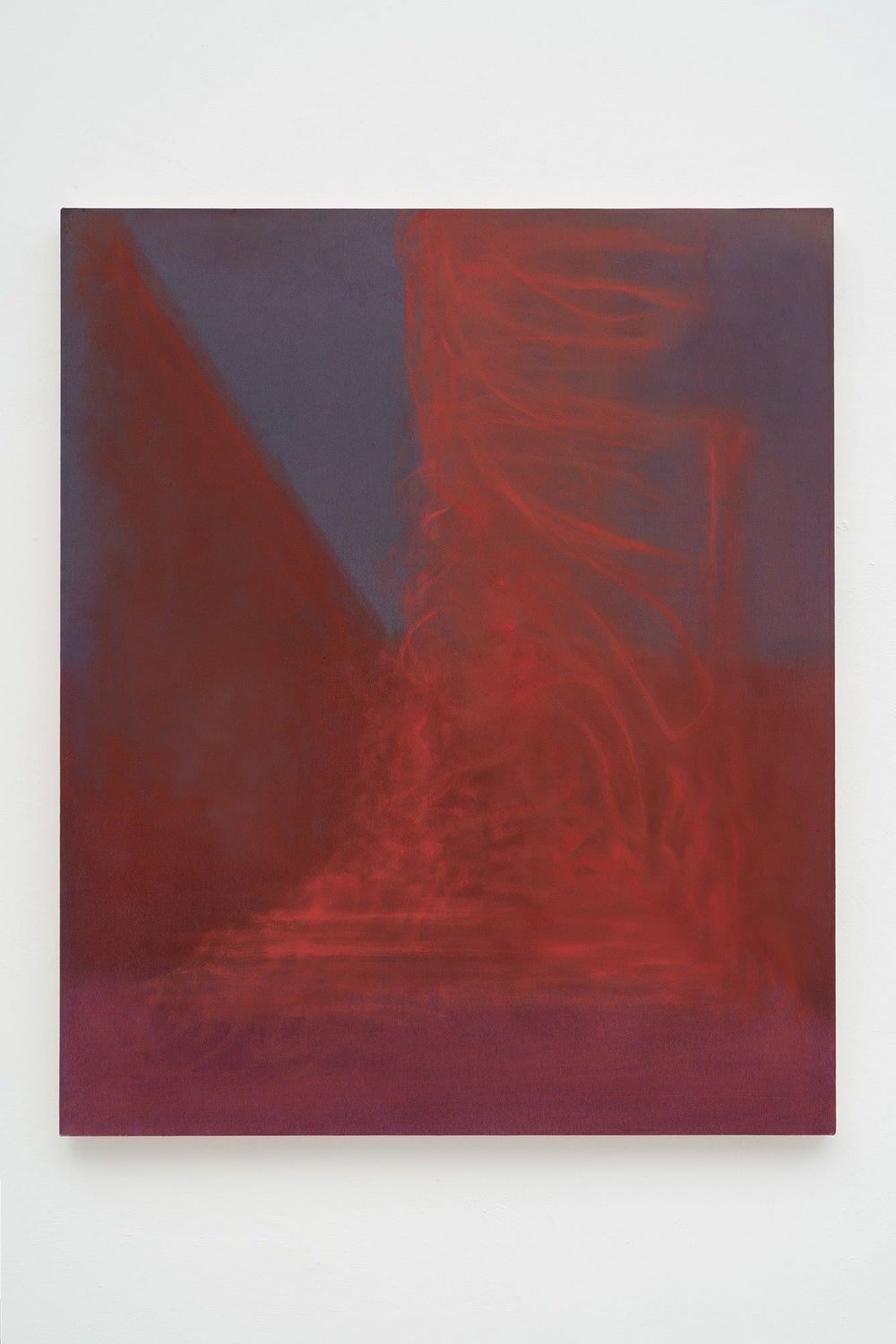
4: Rachel Rose, Slips at Pilar Corrias (Savile Row) – 7th November until 17th January 2026 – “Pilar Corrias is pleased to present Slips, an exhibition of new paintings by Rachel Rose”. The smaller of the two Pilar Corrias space, adjacent to Cork Street, is alwaysa good space to see a painting properly.
“Rose’s work traces the ways landscapes shape human experience and how the stories and belief systems we weave are born from them. Across film, painting, drawing and sculpture, she draws on the cinematic to explore terrains both minute and immense—from a child’s toys scattered across a bedroom floor to the vastness of outer space—each scale opening onto the same core enquiry: how landscapes inscribe themselves into human life and the narratives we build around them.
In recent years, she has turned to early modern British landscape painting as both resource and reference, creating new works that evoke the uncanny, surreal forces unleashed as land was burned, cut and reshaped in the early industrial era. These paintings reflect on how that historical rupture continues to reverberate in our perception of nature today. With Slips, Rose extends this line of questioning into a new body of paintings that fuses landscape with psychoanalytic theory, a conjunction that opens new ways of considering how images both conceal and reveal underlying reality. Reflecting on the ideas that shape the exhibition, Rose writes:
A screen memory is a term from early Freudian psychoanalytic theory. It describes a memory we return to again and again in our lives—like recalling the exact way one flower looked in a garden you once visited, or how the desk felt beneath your hand on your first day of school. Freud believed such innocuous images might serve to repress deeper, more significant memories.
When I first began working with early 19th-century British landscape paintings over five years ago, I was struck by how they functioned in their own time. They offered romantic portraits of idyllic scenery at the very moment industrialisation was violently erasing those views. The paintings concealed what was in fact a far more destabilising reality.
A slip is another psychoanalytic term, but it works almost in reverse. Rather than hide what’s there, a slip exposes it. They betray our illusion of control. When I began noticing my own slips—saying the wrong name, forgetting my keys—I started to see they might reveal an alternate desire. Maybe though I thought I was tired and wanted to leave the party, when I left my phone behind and had to run back, it revealed that no, I truly wanted to stay. To notice a slip is to notice improvisation, to recognise that our speech—and our selves—are never fully coherent or known to us.
In these paintings, I let myself slip: the sky into the ground, grass into a tree, a cloud into blue air. I released my grip on the screen, allowing the landscape to be guided through me by the intuitive force of gravity and colour. When we loosen our hold, something paradoxical happens—it steadies us. What is obscured usually finds its way back into view, and insists on being seen”.
Pilar Corrias (Savile Row) is found 2 Savile Row, London, W1S 3PA. The space is open Tuesday to Friday, 11am until 6pm.
5: Julia Dubsky, The Angels Are Dials at Amanda Wilkinson Gallery – 6th Nov until 13th Dec 2025 – “This exhibition presents a new body of work arising from Julia Dubsky’s suggestive meditations on the parallels between paintings and actors. A painting not only represents a subject, but also itself as a medium, much as our appreciation of an acted role is coloured by prior associations with the actor. Dubsky observes a “direct comparison between actors and paintings in that they perform a similar kind of alchemy, since an actor becomes a character in addition to themselves, not in place of themselves”.
Many of the paintings in the exhibition are diptychs in the vein of ‘small colour fields’ paired with ‘light cartoons’ which play on the notion of relationality, in terms of colour perception, material and picture. Others take a familiar motif such as Rosso Fiorentino’s cherub playing the lute, a painting thought to allude to Rosso’s favoured ‘instrument’, the medium of painting. As Dubsky redirects the gaze of the cherub toward the viewer, the painting shifts (like a dial) in attitude.
The exhibition is accompanied by a publication with a new essay by Dubsky in which she expands on these themes by weaving art historical observations through a rumination on her recent experiences in acting classes. She invokes, amongst other things, an imagined dialogue between Caravaggio and Tiepolo from Roberto Calasso’s Tiepolo Pink (2009): ‘Caravaggio berates Tiepolo for failing to share his “craving for truth.” He insists Tiepolo should have painted gondoliers brawling instead of rosy-skinned ladies and mocks Venice for its widespread use of masks. Tiepolo’s reply punctures Caravaggio’s rhetoric of truth, showing it to be parochial, unable to accept disguise: even beggars wear masks in Venice. The mask, in other words, is not an evasion of reality but part of it.’
Julia Dubsky (b. 1990, Ireland) is a painter based in Berlin. She completed her BA at the National College of Art and Design, Dublin,in 2016.
Amanda Wilkinson Gallery is found at 1st Floor, 47 Farringdon Road, London EC1M 3JB. The gallery is open, Tuesday through to Sunday, 10am until 6pm
And while we’re here…
© David Hockney
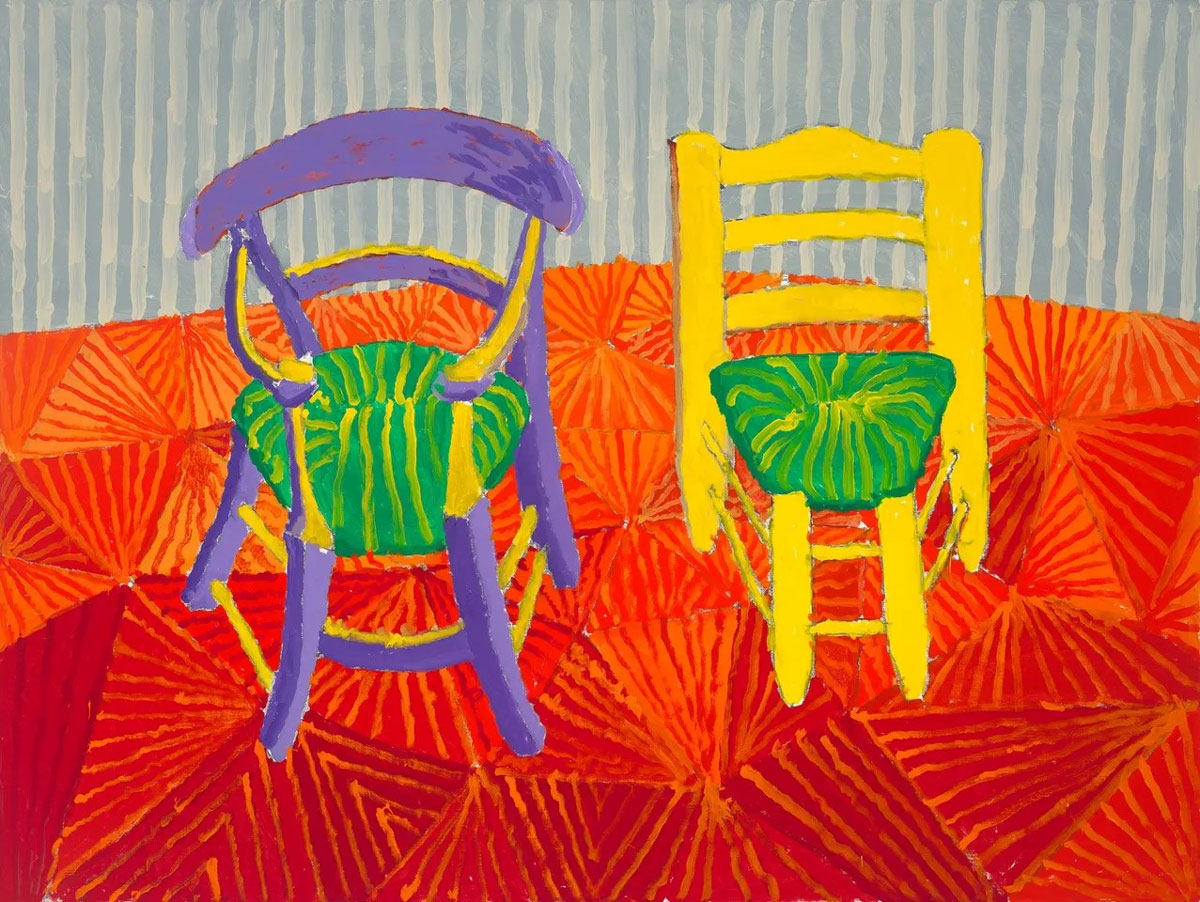
David Hockney, Some Very, Very, Very New Paintings Not Yet Shown in Paris at Annely Juda Fine Art – 7 Nov 2025 – 28 Feb 2026 And it hardly needs to be one of our five, he is a household name, I hope he’s not a national treasure, I love a lot of what he paints, yes even those I-Pad painting, I love to hear him talk about art, I love to hear him talk (when he’s not talking about his obnoxious smoking habit in such a selfish way and well, this show obviously does not need to be one of our five but hey. Good to see the new Annely Juda space as well.
“Annely Juda Fine Art announces its inaugural exhibition at the gallery’s new space on Hanover Square with works by David Hockney. Opening in early November 2025, the exhibition will debut a series of new paintings alongside the first full presentation in the UK of Hockney’s “The Moon Room”.
Hockney’s fourteenth exhibition at the gallery, and following his celebrated exhibition at Fondation Louis Vuitton, Paris this summer, this show will debut never-seen-before paintings completed in his London studio over the last six months, underpinning Hockney’s unwavering commitment to and vigour for the act of painting and cementing him as perhaps the most iconic artist of today.
These very, very, very new paintings mark the most developed stage yet in Hockney’s dedication to ‘reverse perspective’ in paint. For decades, Hockney has observed that traditional linear perspective in art and photography doesn’t reflect how humans actually see: we have peripheral vision, we move and we constantly generate multiple viewpoints. Viewing is therefore not static, but dynamic and experiential. It’s not an inversion of perspective that interests Hockney, but an expansion of the possibilities of representation. In these recent canvases, which depict colourful interior scenes, he disrupts planar perspective and engineers multiple vanishing points in a single picture, bringing us closer to the lived experience of perception.
The show will also include “The Moon Room”, comprising 15 iPad paintings of the night sky. The moon works were created in 2020 outside Hockney’s Normandy studio in France throughout the seasons and, just as previous iPad works have, these works capture a joy in nature, this time brightly illuminated by moonlight. Influences of Van Gogh are present, yet Hockney’s signature use of line and colour is unmistakable. With the ability to paint easily en plein air, Hockney enjoys the speed with which he can capture light with the iPad, evident in the luminosity of these works.
Hockney said: “Once, when we were just sitting outside the house, we put all the lights off in the house to see the moonlight more clearly. The moon could then be seen to cast shadows of the trees on the grass, so with my backlit iPad I could draw it. This would have been virtually impossible without it.”
One of the longest-standing represented artists of the gallery, David Hockney became known as a central figure of British art in the 1960s and continues to be widely celebrated as one of the most influential artists of our time. Born in Bradford in 1937, he graduated from the Bradford School of Art in 1957 and studied at the Royal College of Art from 1959–62. Alongside his prodigious painting and drawing practice, he has constantly explored new technological possibilities in making art. In the 1980s he embraced Polaroid film, photocopying and faxing and, more recently, digital media including photoshop and his iPad as new means of conceiving and creating mesmerising multiple-view and composite images. Now in his eighties, Hockney continues to create new works in all media with his unwavering desire to continually challenge conventions of perspective in art and how we truly ‘see’. In March 2026, Hockney will present, A Year in Normandy, a ninety-metre-long frieze inspired by the Bayeux Tapestry at the Serpentine, London.
Annely Juda (1914 – 2006) established Annely Juda Fine Art with her son, David Juda in 1968 in a warehouse space on London’s Tottenham Mews. The first exhibition was ‘Now Open: Important Paintings of the 20th Century and Young Artists’ and the presentation of the twentieth-century avant-garde works alongside contemporary art has carried on throughout the gallery’s history. The gallery presents exhibitions of its represented artists along with curated group exhibitions. In 1990, the gallery moved to 23 Dering Street off New Bond Street in London’s Mayfair and in November 2025 the gallery will open new premises at 16 Hanover Square, London, a Grade II listed Georgian building with two large floors of exhibition space with an exceptional glass-domed ceiling. The new space will be led by co-Directors David Juda – who founded the gallery with his mother Annely in 1968 – and Nina Fellmann, who has been with the gallery since 2003.
Annely Juda Fine Art is found at 4th Floor, 23 Dering Street, Hanover Square, London, W1S 1AW. The space is open Monday to Friday, 10am until 5pm.
previously…
 THE ORGAN
One response to “ORGAN: Five Recommended Art Shows – Nathaniel Rackowe at Varvara Roza Galleries, Rachel Rose at Pilar Corrias, Ben Edge at The Fitzrovia Chapel, Conor Harrington at Ben Brown Fine Arts, Julia Dubsky at Amanda Wilkinson Gallery and…”
[…] ORGAN: Five Recommended Art Shows – Nathaniel Rackowe at Varvara Roza Galleries, Rachel Rose at Pi… […]