
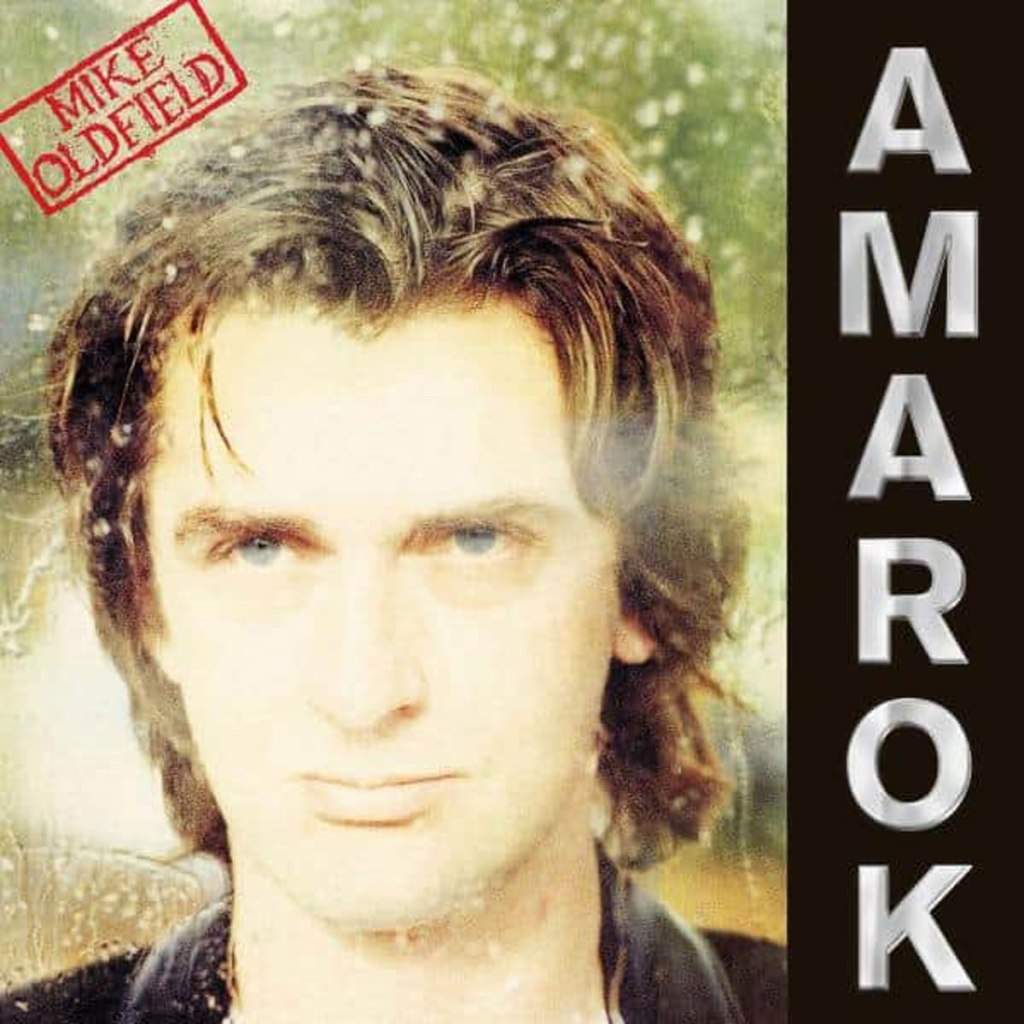

What we have here is the 35th anniversary re-issue of Mike Oldfield’s rather overlooked 13th album, an album that Oldfield himself has stated is one of his personal favourites, is it time to a take a fresh look at it in these more experimental post rock flavoured times? The album, Amarok, is celebrating that 35th birthday with a rather plush double-LP vinyl reissue. Seems this new release has been half-speed remastered and chopped into four parts to allow for the remaster and is now presented to us over four sides of vinyl.
“Originally released in 1990 and presented as a sixty-minute suite of music, ideal for the CD age, Amarok was originally split into two halves on single vinyl. Here, with the full approval of Oldfield, the album is now divided into four 15 minute edits, in order to optimise audio fidelity, with expanded artwork” which kind of means you are going to want us to tune our ears in and tell you how this remastered version differs? Well it certainly sounds brighter, the clarity is definitely allowing the detail to breath just a touch more, a sense of space, depth. There’s more of everything, well certainly more clarity, allowing you to hear everything. Happy?
That “Happy?” question there will of course make sense to those who know the album already. Seems that, having increasingly embraced the latest technology as the 80s progressed, here he returned to a more “granular” approach. Mike Oldfield has said that Amarok was an experiment to see whether he could once again create an album without the aid of computers, which he had used increasingly in his work leading up to this 1990 album. Apparently he wanted to focus more on the musicianship, back to playing all of the instruments himself, handmade as it were. Although he has at other times discussed the role that his Amiga computers had in the album’s creation (Mike Oldfield has often contradicted himself over the years).
So yes, a return to his earlier days and playing almost everything on real instruments on this fine album rather than just pushing buttons and feeding and clicking mice, Proper you might say, everything for real including those gorgeous baselines of his as well as the playing of those long thin metallic hanging tubes that are listed on the sleeve. It isn’t difficult to argue that this was 90s update of his glorious debut and possibly a dry-run for the soon to follow Tubular Bells II in 1992, although he did himself refer to it more than once as being more of an Ommadawn follow up than anything.
“Let it all come out without any interference… I felt I was getting ideas from somewhere inside me, and six months later I had a whole album.”
Amarok does have a feel of his mid to late 70s work. Crisper, clearer, unmistakably Mike Oldfield, that uplifting way of his, those fingerprints and rather unique lines, those strange bits that could come from no one else. It always did have a very open sound, a touch more excentric even by his often excentric standards, reassuringly so you might say. It does feel like a step back towards the classic era of Tubular Bells or the excellent Ommadawn without ever being a complete return or heaven-forbid, a rehash – this is very much a froward looking album however much it might have looked back. Both playful and serious, never going through the motions (which he maybe might have been entitled to do so by that point?) If you already know the album and you are a follower then yes this remaster is well worth your time, if you’re maybe just a casual listener, a fan of Tubular Bells who maybe has another couple of of his albums that you never played as much then this is probably for you as well, a place for re-engagement. Of course if you know nothing then Ommadawn or Tubular Bells really is where you need to start but this is almost as good (and maybe, if it hadn’t been for bloody Thatcher, ever better? More on that Mrs bloody Thatcher bit in a moment). And yes. this version, this half speed remastered version, as already said, is beautifully detailed, crisp, alive, refreshed, refreshing…
As an album, as a piece of work, Amarok has a lightness to it, almost like he’s gone off on a musical walk, gone exploring, trying out things and then returning to familiar paths to go on with the walk and the exploring again. And yes, there is a sailor’s hornpipe and yes now again he almost touches on heavy metal guitar until he hits the breaks and takes a ninety-degree left-field turn. Of course it can be a little crazy at times, slightly unhinged, he always does his thing with such beautiful emotion though, those euphoric bits he does so so (so) well, That playing with mood, with texture, Mike Oldfield always did manage to lift things. Almost English folky at times, but he’s stretched that folk feel to other places here once again. Some of it sounds African influenced (well obviously so even before you check the titles). Two of the album’s sections, Mandolin Reprise and Africa I: Far dip, feature that almost trademark processed “caveman” voice first used on Tubular Bells, that thing where he’s shouting partly unintelligible words into the microphone while running, another deliberate reference to earlier work maybe? It is all rather refreshing, hopeful, or is that something associated with the youthful hopeful days of Tubular Bells (yes, I am one of those people who wore out several copies of Tubular Bells back in my school days, Tubular Bells was my go to school homework music).
Thing is, as much as I like this in terms of the remastering and the clarity, I do kind of want to listen to it as the one piece of music it was intended to be, rather than these four sides. Tubular Bells always felt like a two sided affair, listening to that on CD never felt quite right, here, I do rather want this version on CD. Although I guess the voices of what is now side four do make for a natural break and maybe allows you to avoid that bit (more on that coming up, why did he do it?!)
A quick bit of research tells us the original concept, as already kind of mentioned, was to make Amarok a sequel to his third album, Ommadawn (1975). it is said that his then label Virgin suggested Amarok be renamed Tubular Bells II based on its style and the strength of the music (a suggestion made by a label probably desperately in need of a marketing idea, Oldfield was at odds with the label and their lack of promotion at the time, it is said that by this time he had had enough of listening to the label’s ideas and with paying the game and going along with their need for a single as he had done with previous albums, singles that were then in his eyes and probably everyone else’s, never marketed properly). Oldfield refused the name change and later said; “if anything, it’s Ommadawn II“. Incidentally many of the people who were involved in the creation of Ommadawn – Jabula, Clodagh Simonds, Bridget St John and Paddy Moloney – also appear on this album. Was he already thinking about Tubular Bells II though? Was it really a calculated dry run or the thing that planted the seed?
The bottom line here is Amarok is classic Mike Oldfield although the rather uncomfortably annoying bit with then popular comedian/impersonator Janet Brown as Margaret bloody Thatcher is just a step too far (even if it does kind of reference previous appearances of Vivian Stanshall as Sir Henry at Rawlingstone End). Bloody Thatcher (as she will always be know around here) does make side four rather unlistenable at times. I guess he was tolling in a way, being a git with Thatcher, surely he knew it would alienate many of us? it still sticks in the throat now. Was he happy? Incidentally, there are unofficial versions of Amarok, bootleg fan-altered versions where the words are instead spoken by a Vivian Stanshall impersonator. Thatcher apart, Amarok is classic Mike Oldfield, if it isn’t his best then it is surely at the top of the debating list, it falls in comfortably with Tubular Bells, the emotion of Hergest Ridge and Ommadawn without ever just being a rehash, it both looked back and at the same time looked forward, and yes, this remaster, half-speed or whatever it is, is excellent (if only they had got rid of bloody Thatcher!). This version is brighter, clearer, there’s space to hear it all, as a remaster it really works (not every remaster does). It might just be time to take a fresh look at what might just be Mike Oldfield’s best album of all and yes, especially this rather excellent version. (sw)
There isn’t a version of this new remaster on the official Mike Oldfield YouTube page so here’s a version from 2000 (although the whole idea of listened to remaster on a computer or heaven forbid, a phone!)
And while we’re here….

 THE ORGAN