
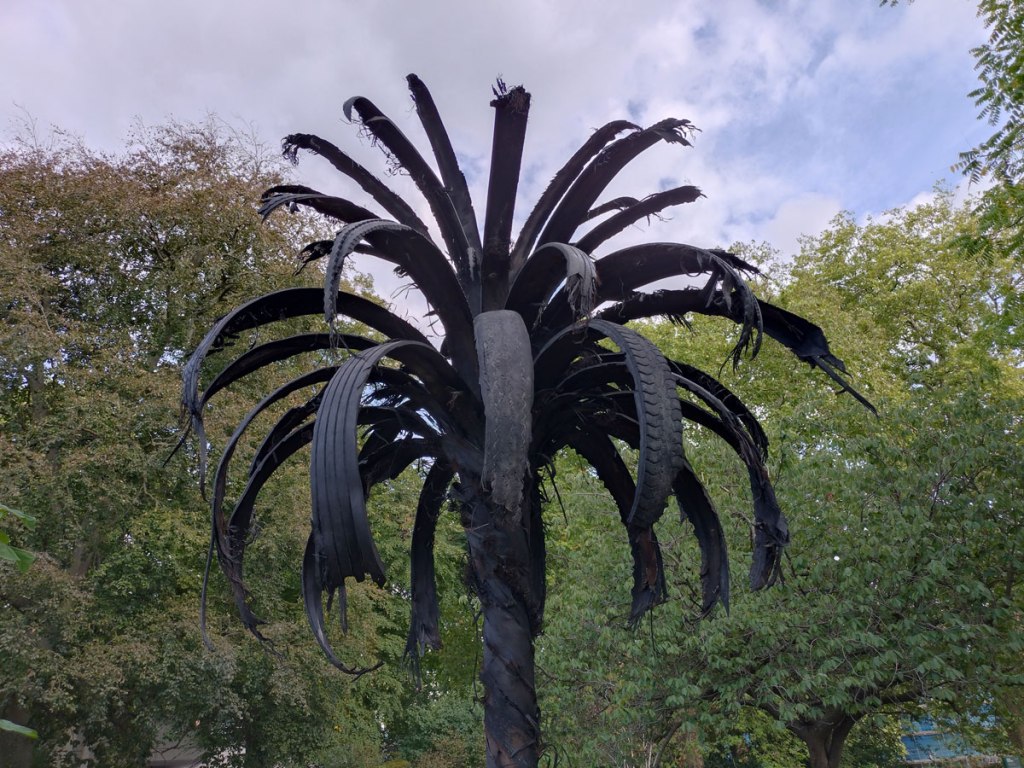
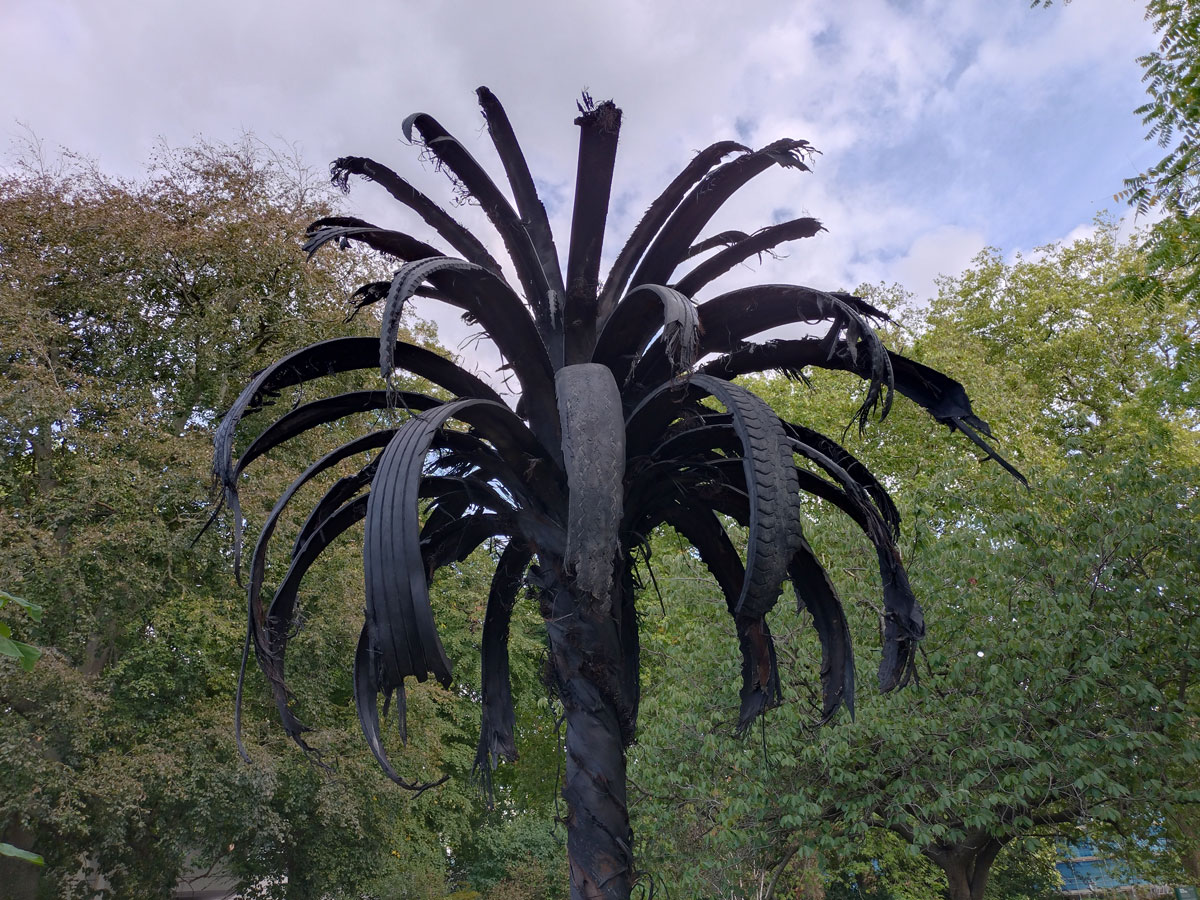
Has anyone seen a bird sitting in it yet? Would it be as lonely as a kite up any of the trees in the park? Has anyone seen a bird sitting up in the very black looking palm tree is what I mean, black until you get up close to it and engage with the delicious looking trunk and start to think about all the possibilities. Frieze Sculpture time again. Do like to get to see it as soon as possible, get to it before it becomes dangerously like nothing more than an add on to the side of the fair. This is day one proper, the press day and all that goes with it has been avoided, far better to see it as a member of the public on the first day proper, let the pieces do the talking rather then the galleries and of course we are out on the open of the park, in the daylight (or the cold light of day) it is, if you can, better to get there in mid September rather then the last days of October (the event opened on September 16th, it runs until November 1st 2026)
Before anything else, the simple facts: Frieze Sculpture is open for seven weeks, it is a free public art exhibition, right there in The Regent’s Park down at the end where you find the tube station of the same name, it is free to enter or walk through or pass by or spend hours exploring, you don’t need to pay to see it, you don’t need to feel intimidated by it or think it isn’t for you, you can just go enjoy it. All you really need to understand is, well nothing, just go explore enjoy or react, you don’t need any of the baggage and thankfully, all the pieces are well labelled and come with a short and simple user friendly bit of information so no need for a bloody QR code – don’t you just hate it when a QR code is the only option in terms of even the basic information like an artist’s name! I met an older man in the park yesterday, I hope he wouldn’t mind me saying he didn’t really stand out, he wasn’t obviously arty or anything, quietly dressed, I guess he was probably in his seventies, he said without any promoting as we were both quietly looking at a piece; “I don’t really understand this like you probably do but I do rather like it…”, we got into a conversation about how that was enough, that you don’t really need to overthink art unless you enjoy overthinking it. He admitted that he hardly ever went into art galleries, that he never feels comfortable or welcome. I mean there are QR codes on the signs with each of the pieces, there’s an app if you want it, curator’s commentary and guided tour if you don’t think the art can do all the talking for itself. Me? I’d rather have the very basic information the signs afford us and work out the rest for myself or at least try and let the art make the conversation and maybe go and do a bit of research back home afterwards, I don’t want to have to spend more time looking at my damn phone that the art, I detests everything a QR code stands for…
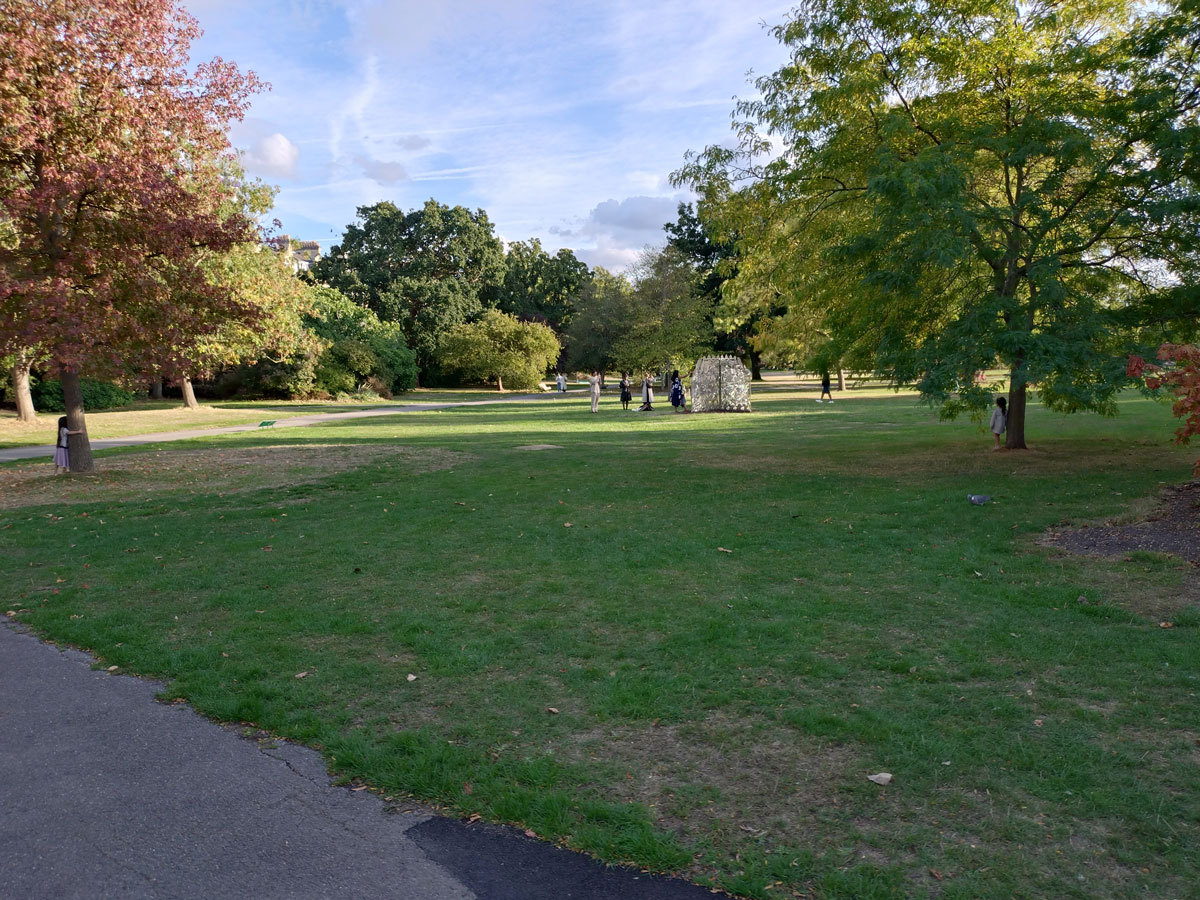
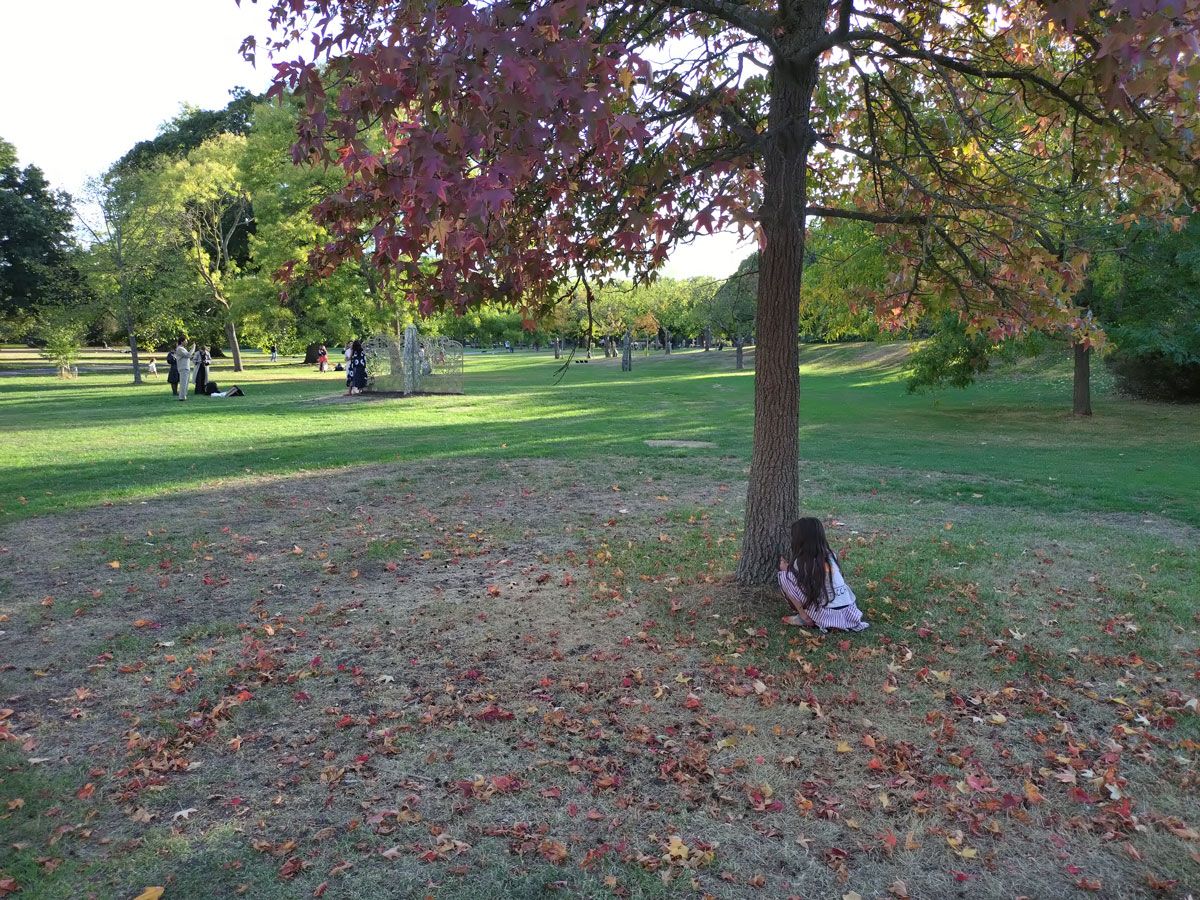
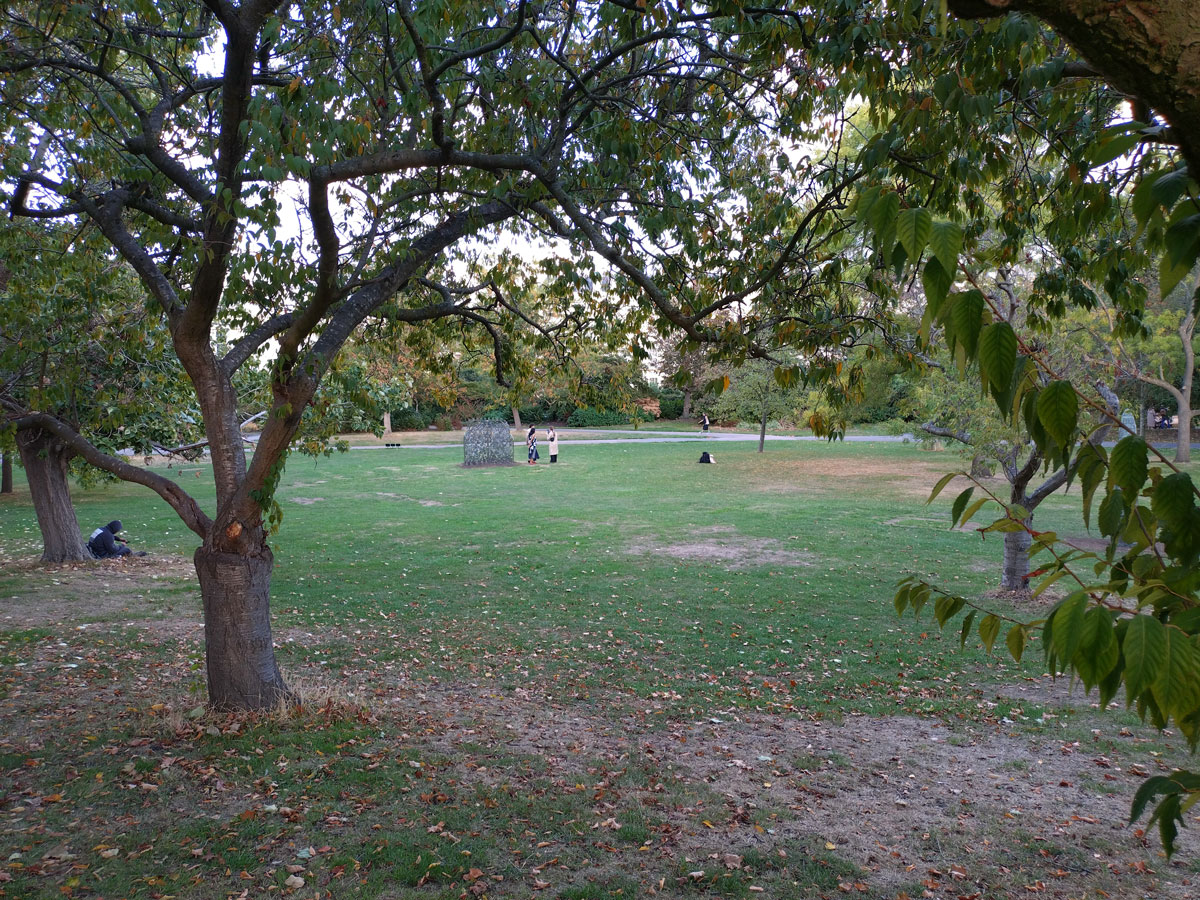
Not so much a group show as a collection of individual pieces that don’t really relate to each other as much as they quietly share the same space without infringing on each other. It is about seeing them in the Park with the trees, seeing the art under the big sky, being there with the people who haven’t noticed them although how they don’t is beyond me? It is about the conversations struck up with other people that don’t really happen in the same way in a gallery, a moment or two of human nature away from the ruthlessness of contemporary life…
Not everything fits comfortably and it would appear that nothing has actually been made with the Park in mind (yes there are a couple of the artists quietly hanging about and wanting to chat), more a case of a temporary home found by a gallery or artist’s representative for something that already existed and needed somewhere for that week or month. It would be interesting to see all these very same pieces in a more brutal(ist) environment (and it is interesting seeing this year’s pieces in almost exactly the same space and place as you saw last year’s work or indeed the year before that or the year before that or…)
So how was it this year? Well you initially walk away after a couple of hours kind of thinking well there wasn’t so much there was there? I just went back and looked at last year’s Organ piece, they are down three artists this year, in 2025 there was fourteen, the year before last it was twenty-two and lots more of a fanfare, I wonder what that tells us about the forthcoming main event? So yes, you walk away thinking it wasn’t as big, the individual pieces weren’t as big, the ambition of both the pieces and the whole thing maybe down sized? Not that bigger is always better, but you do kind of want giant dogs or massive horns out in the greenery of the Park, you want it to be audacious, or loud, well no, maybe not loud, maybe something that can deal with the Post Office Tower in the background? It wasn’t that (some of) what was there didn’t hold anything, I did already tell you the eleven artists more than held me for a healthy couple of hours, I did enjoy it, it was rewarding,it did engage, but you maybe do walk away after a couple of hours kind of thinking well there wasn’t that much there was there? And then you think about it a little more, you look at the photos you took, You think you’ll maybe go back for another look now you have some information (I did make a point of avoiding all publicity in the hope of walking around the park with no idea who or what was going to be encountered), there was that one, and there was, and well, maybe there was something now I think about it, maybe is was better than I initially thought it was when I was sitting on that rush hour tube train back to East London…
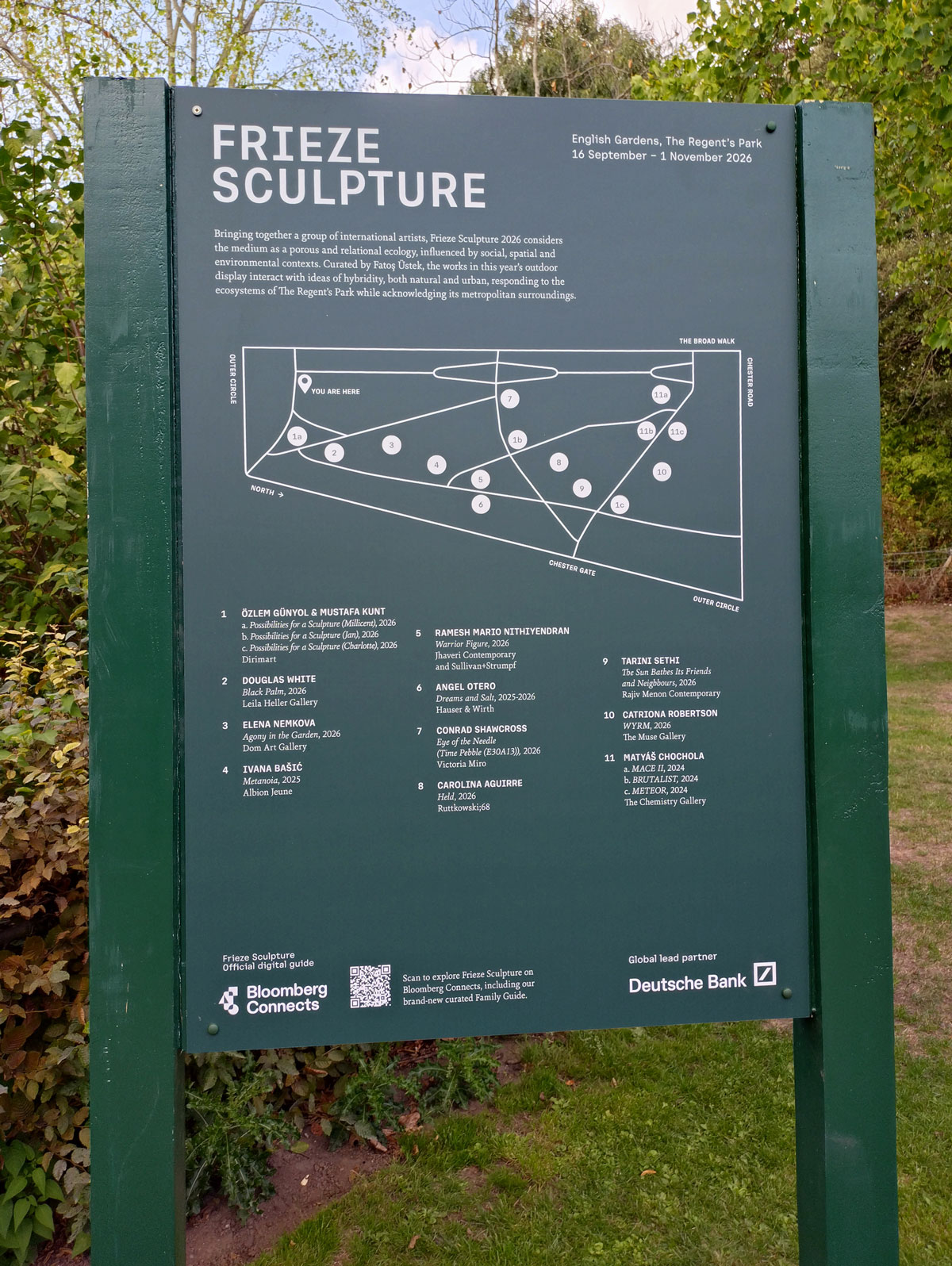
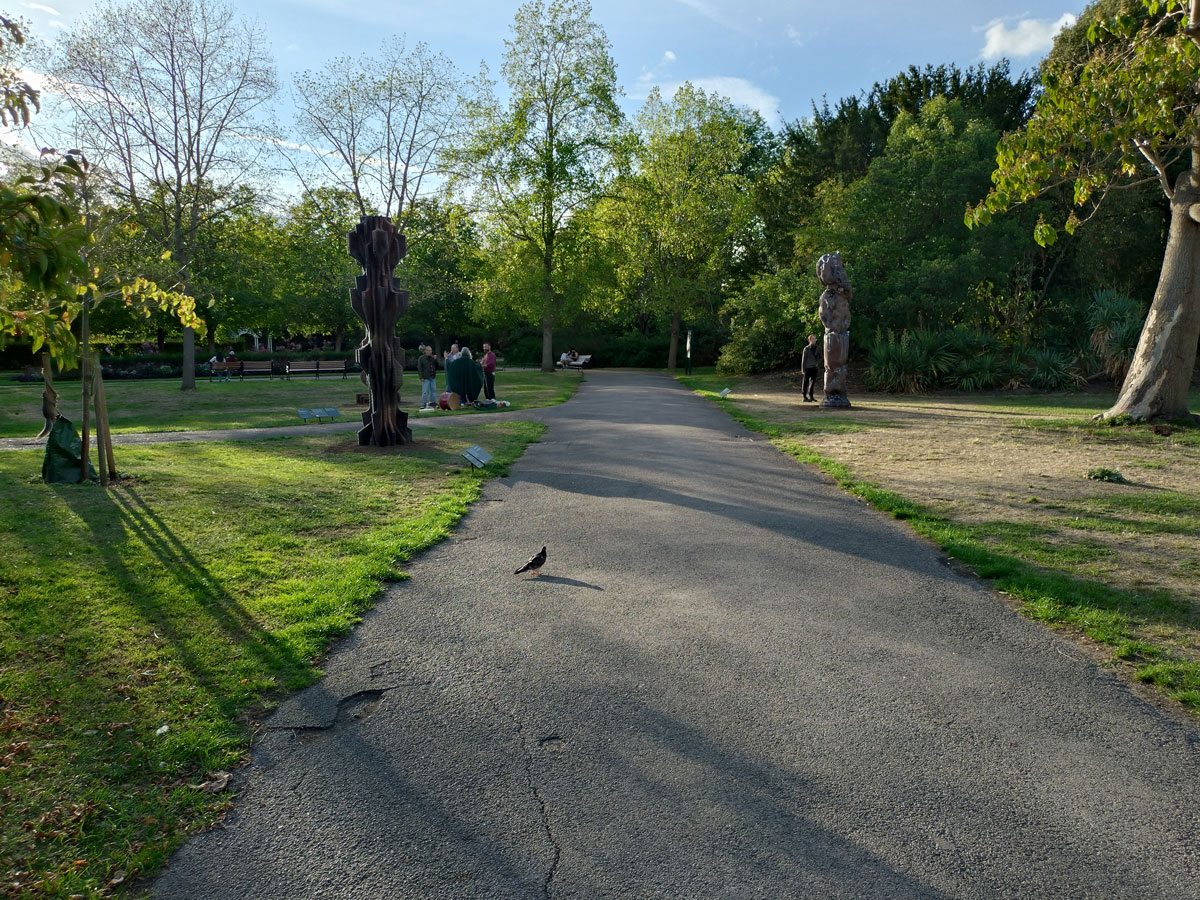
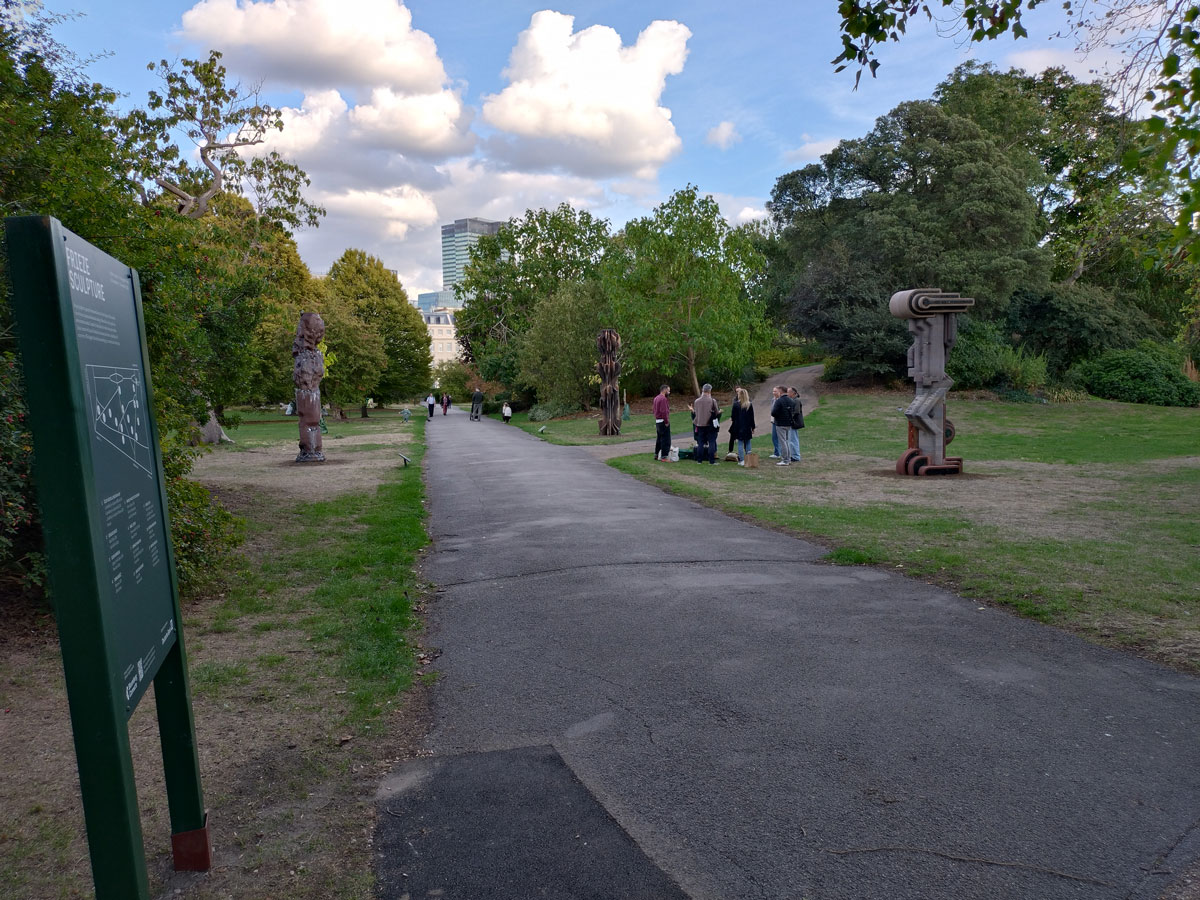
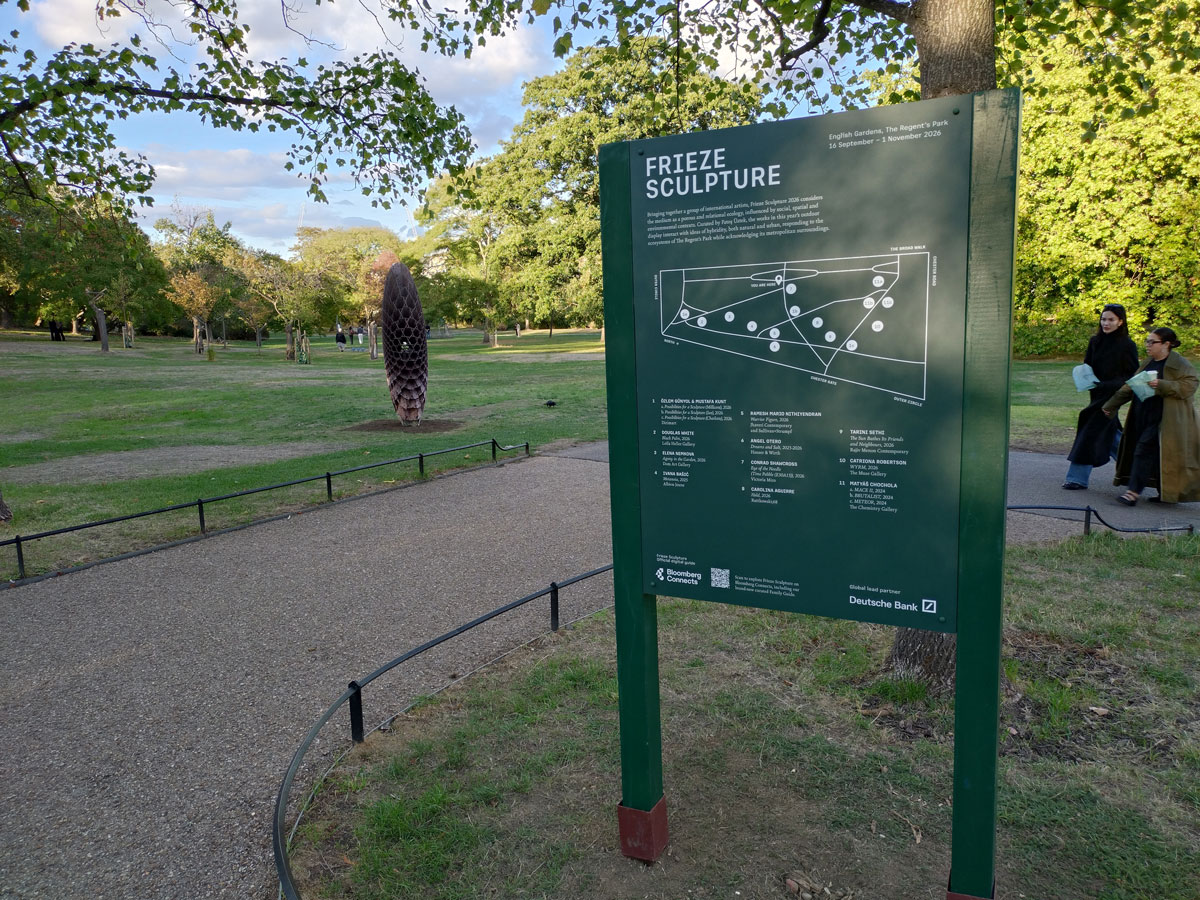
Eleven pieces then, well eleven artists, a perfectly restrained well placed set of green signs introducing each piece, thankfully no need to bring a QR code into the equation, no need to take your phone out of your pocket unless you fancy taking a couple of photos. Interesting to see that those who are here mostly aren’t taking photos, most are just standing and looking, considering, quietly discussing the art and their shared reactions (I do, as an artist, find myself quietly watching people’s reactions to art, the way they choose to engage..)
“Curated for a fourth year by Fatoş Üstek, Frieze Sculpture’s 14th edition includes eleven leading international artists whose work will be sited throughout the park’s historic English Gardens”.
– well not really in the actual gardens and not throughout the rather big Park, the sculpture is in fact comfortably housed in more than enough space over in one corner and thankfully not a case of walking miles. Find it over in the corner of The Regent’s Park that will house both the rather substantial Frieze London and Frieze Masters when both events take place concurrently between 14th and 18th October. Frieze Sculpture is also part of the rather secretive London Sculpture Week, something that apparently happens again this year between 19th and 27th September, a city-wide celebration of public art that unites five major initiatives: Frieze Sculpture, the Fourth Plinth, East Bank, Sculpture in the City and The Line, an annual major initiative that never really seem to want to engage with London’s artists or art appreciators that much.
‘We invite visitors to step outside the rhythms of everyday life and into the park, where artistic propositions open up new ways of thinking and feeling.’ so says Fatoş Üstek, the aforementioned curator of this year’s Frieze Sculpture event
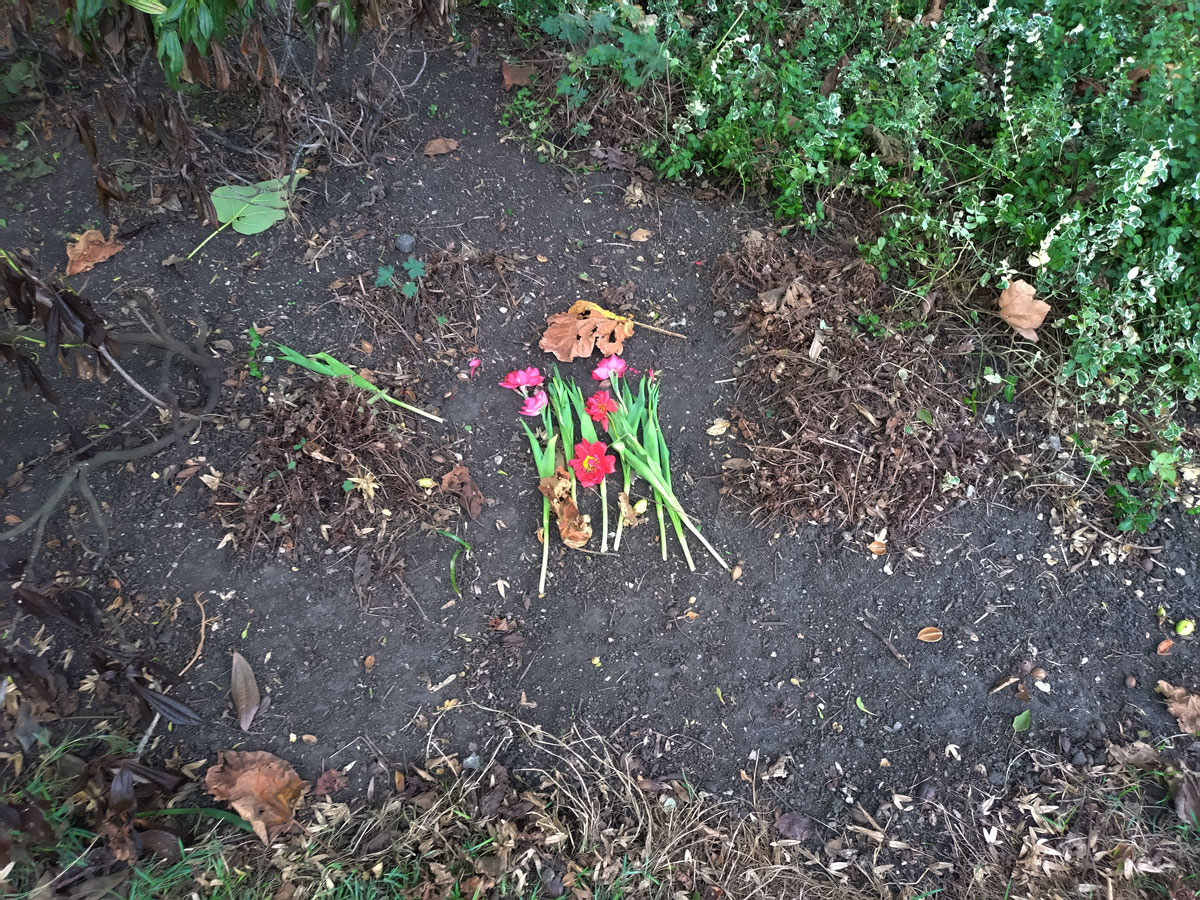
Not sure about the examining sculpture as a hybrid ecology bit, mere art talk? And who knows why the cut flowers were doing lying there, clearly nothing to do Frieze, but then again who say what can’t be part of all this out in a public park? Seems Galleries had to apply, I try not to think about the amounts of money involved in (taking part in) Frieze, it hard not to think about the money, especially when it comes to the main event (they invited us, as Cultivate, to take part a few years back, back there in our beautifully chaotic Vyner Street days, some kind of special deal for exciting new young galleries they said. The money they were asking being more than a whole year’s rent we politely said no. That’s the main event in the aircraft hanger of a tent next month, this is the Sculpture thing, seems like a good deal if you’re a member of the public just walking through the park, seems like all this free art is a positive, tickets to get into Frieze are an arm and a good chunk of leg for most of us)
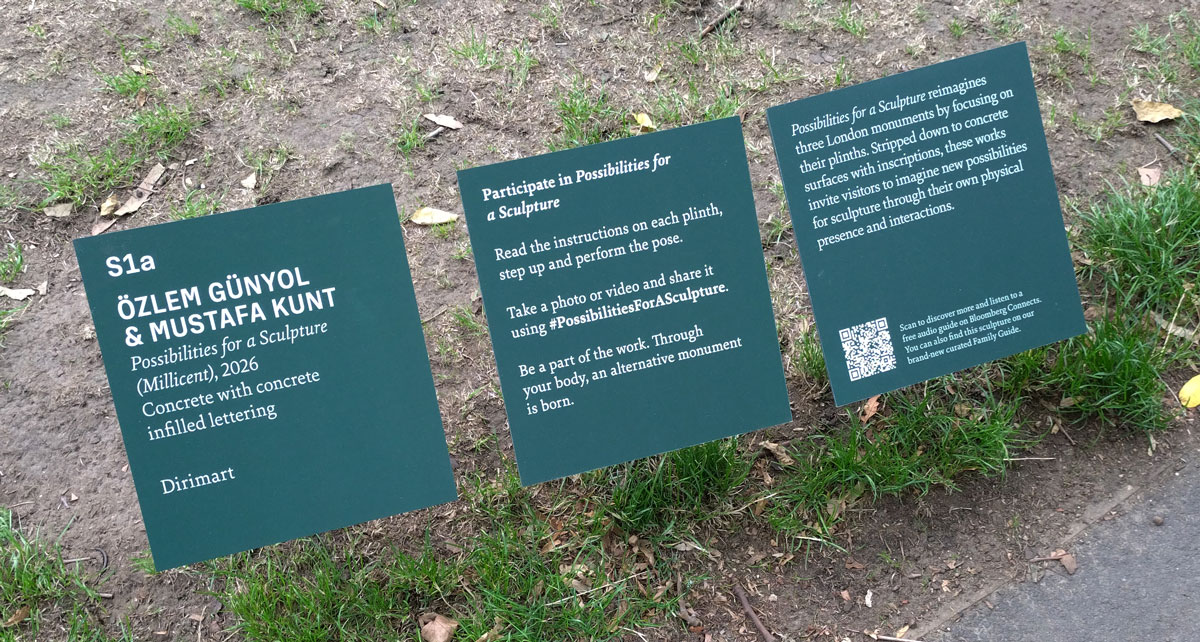
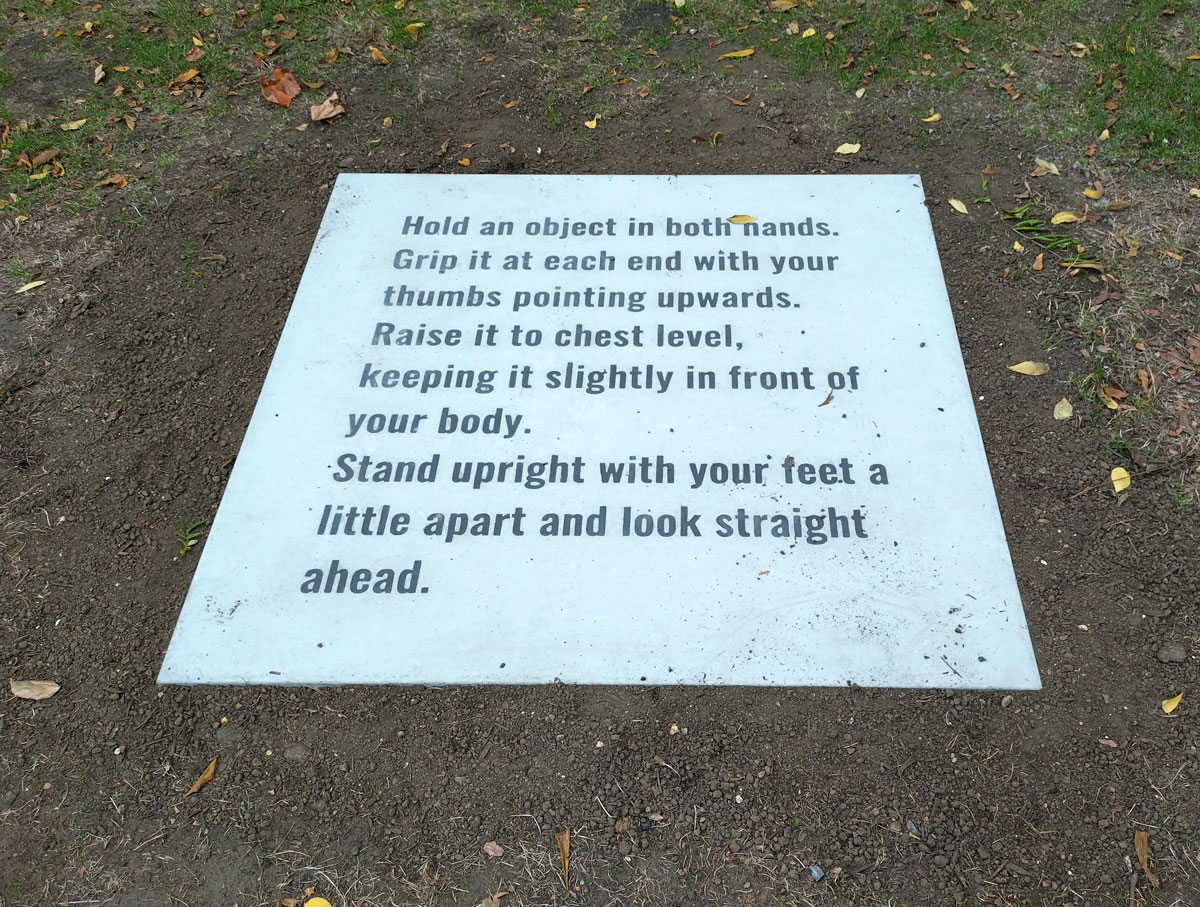
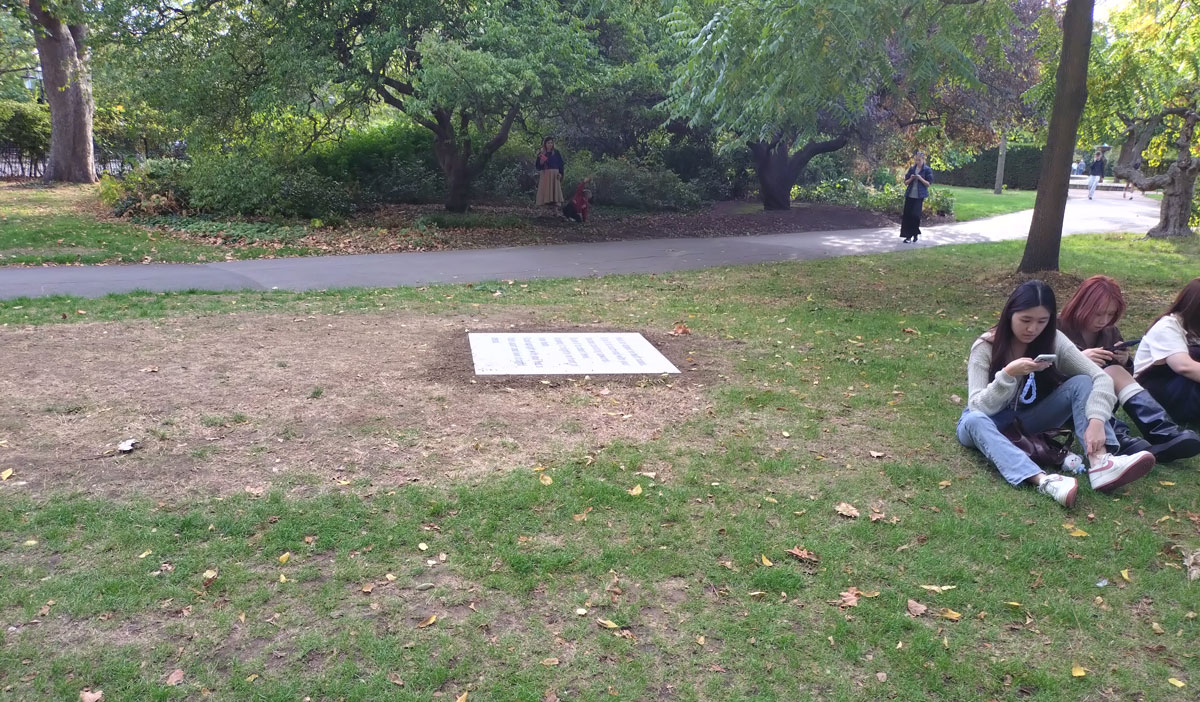
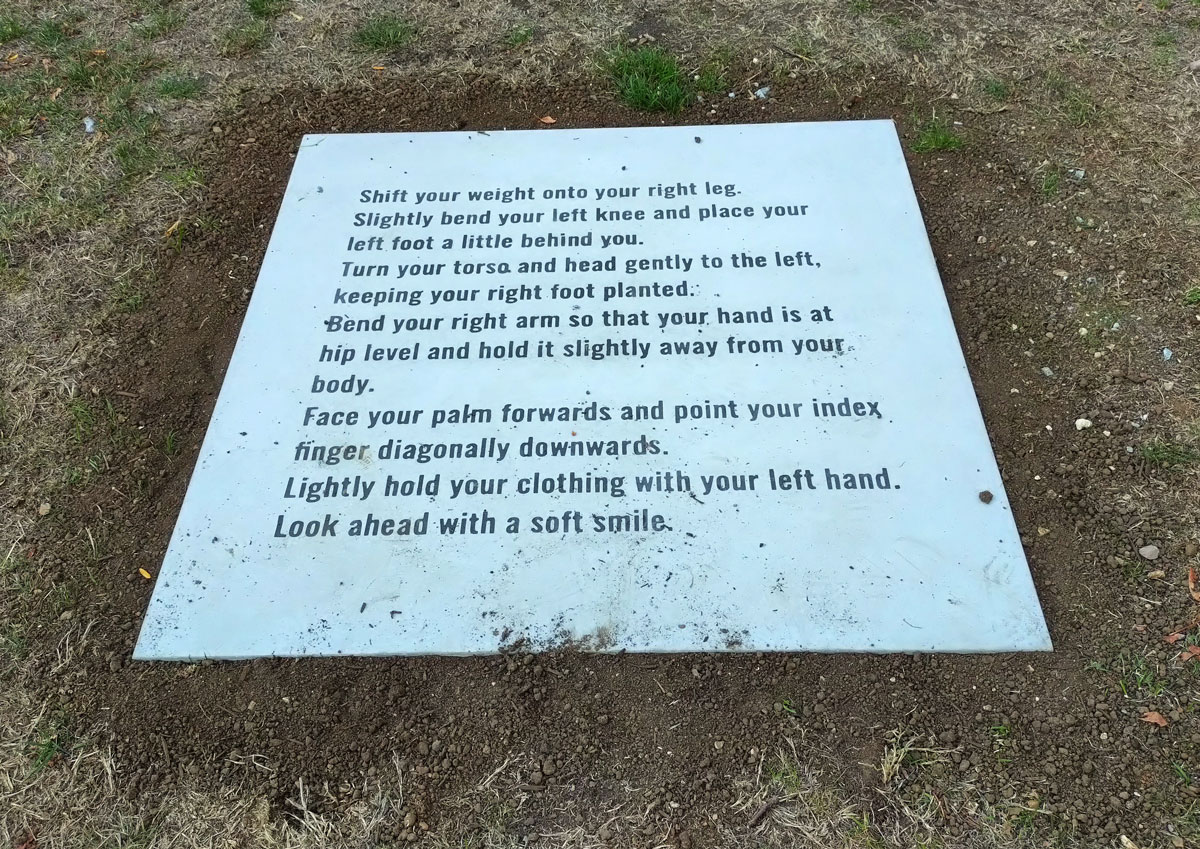
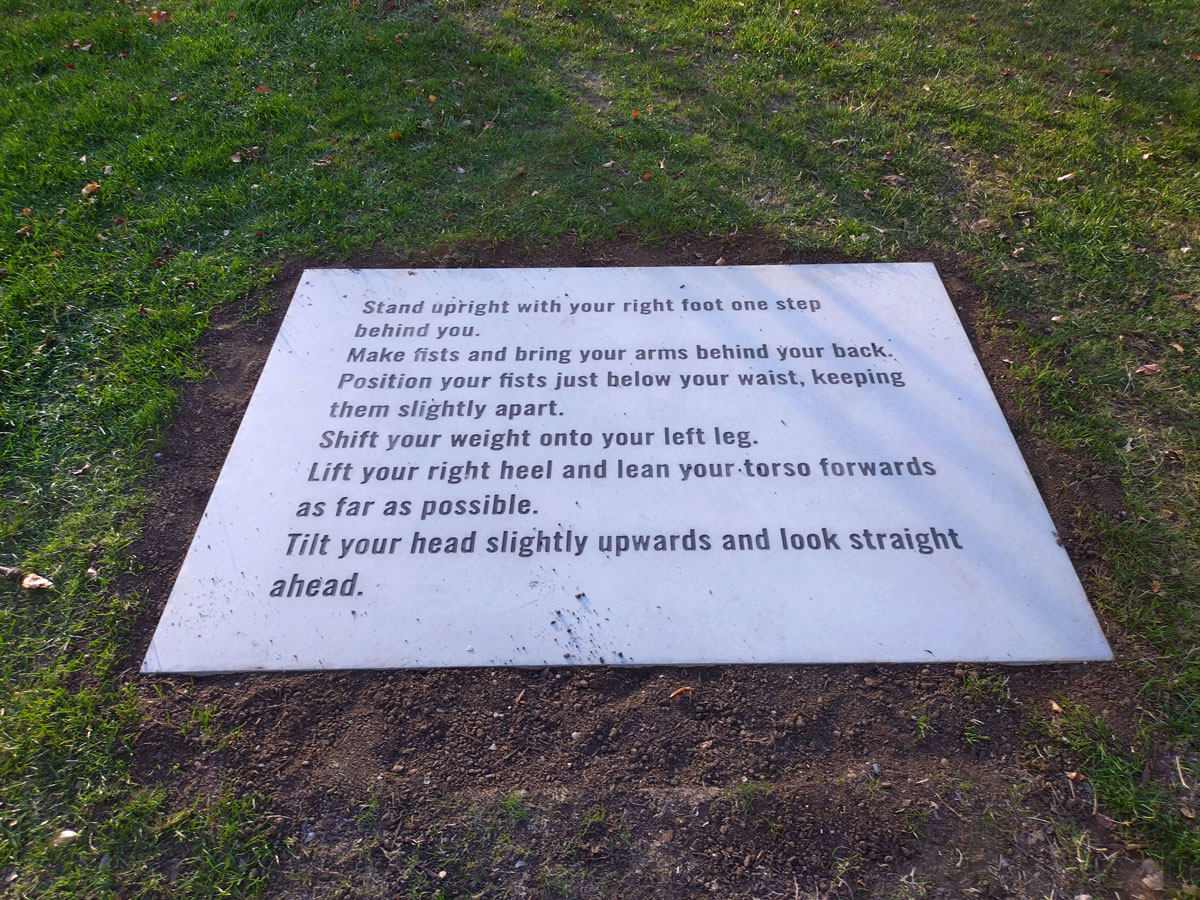
Cut the crap, cut to the chase, tell us about the sculpture I hear you cry. Start at the beginning, follow the route, the green map, well no, let’s not go through it in order writing about the the whole thing; Özlem Günyol and Mustafa Kunt‘s Possibilities for a Sculpture, consists of three flat slabs that are not not far off the nature of gravestones (presented by Dirimart, “a leading contemporary art gallery representing established and emerging artists from Turkey and beyond. With locations in Istanbul and London…”_ three pieces placed at three points around the event, three pieces that invite the viewer to do all the work – they don’t really make me want to do much more than politely read them and then move on….
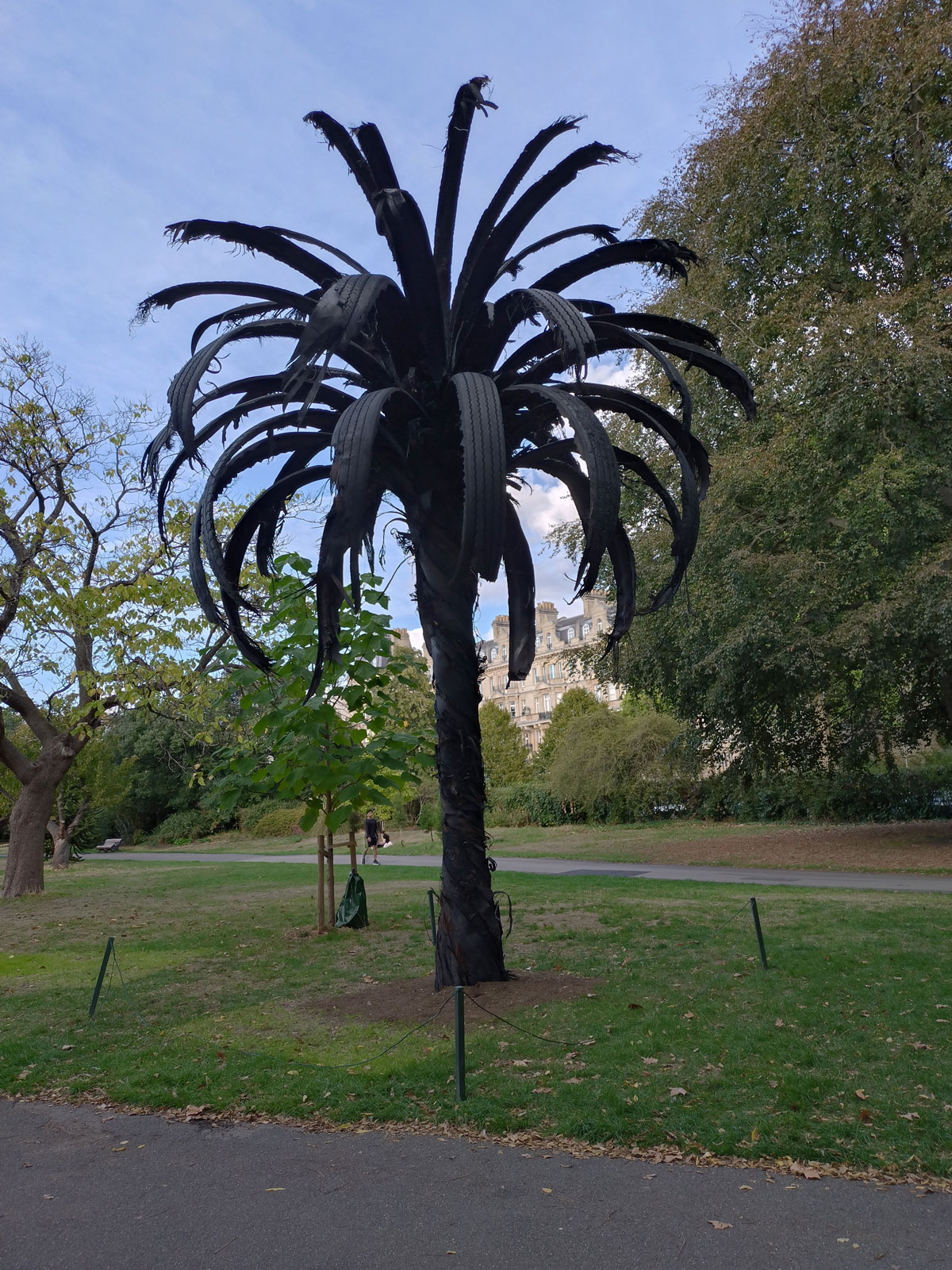
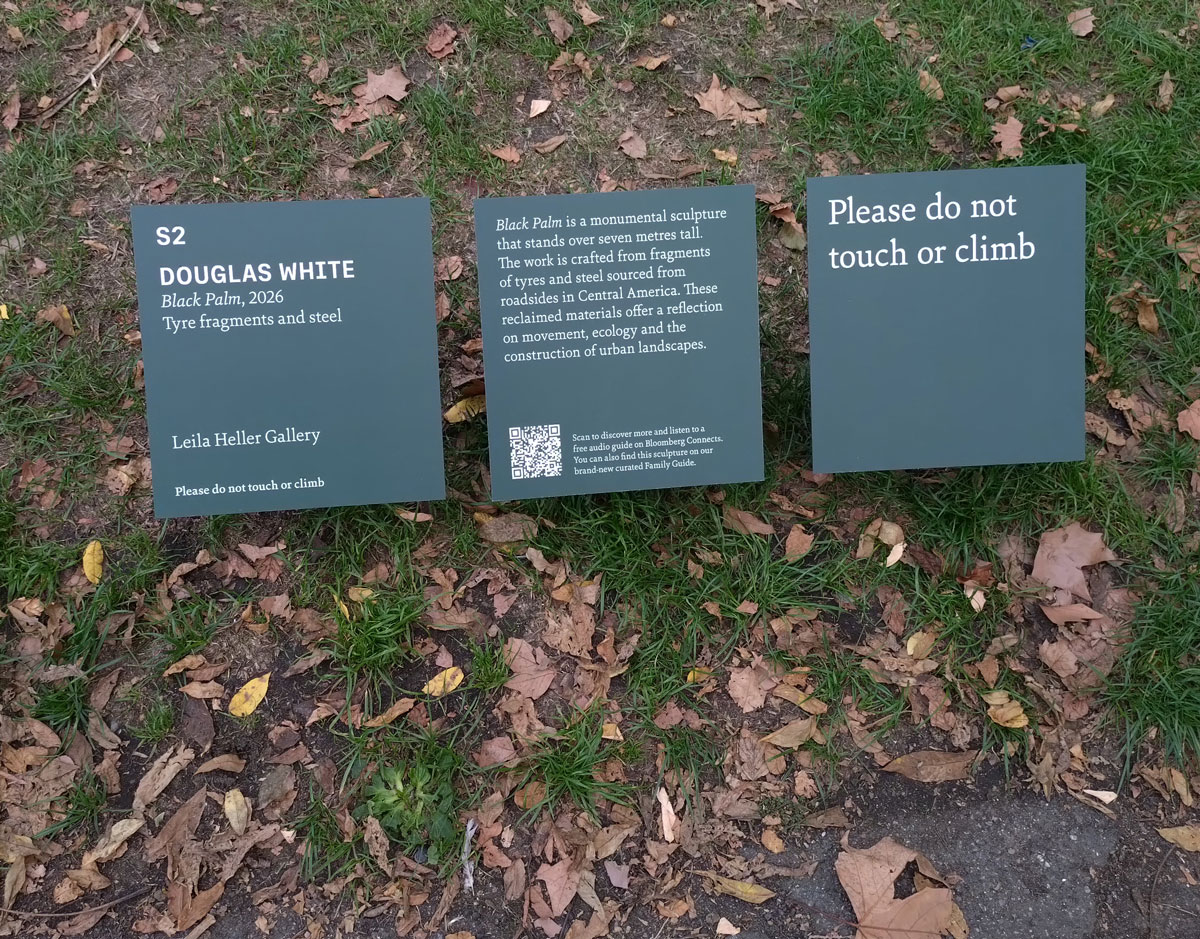
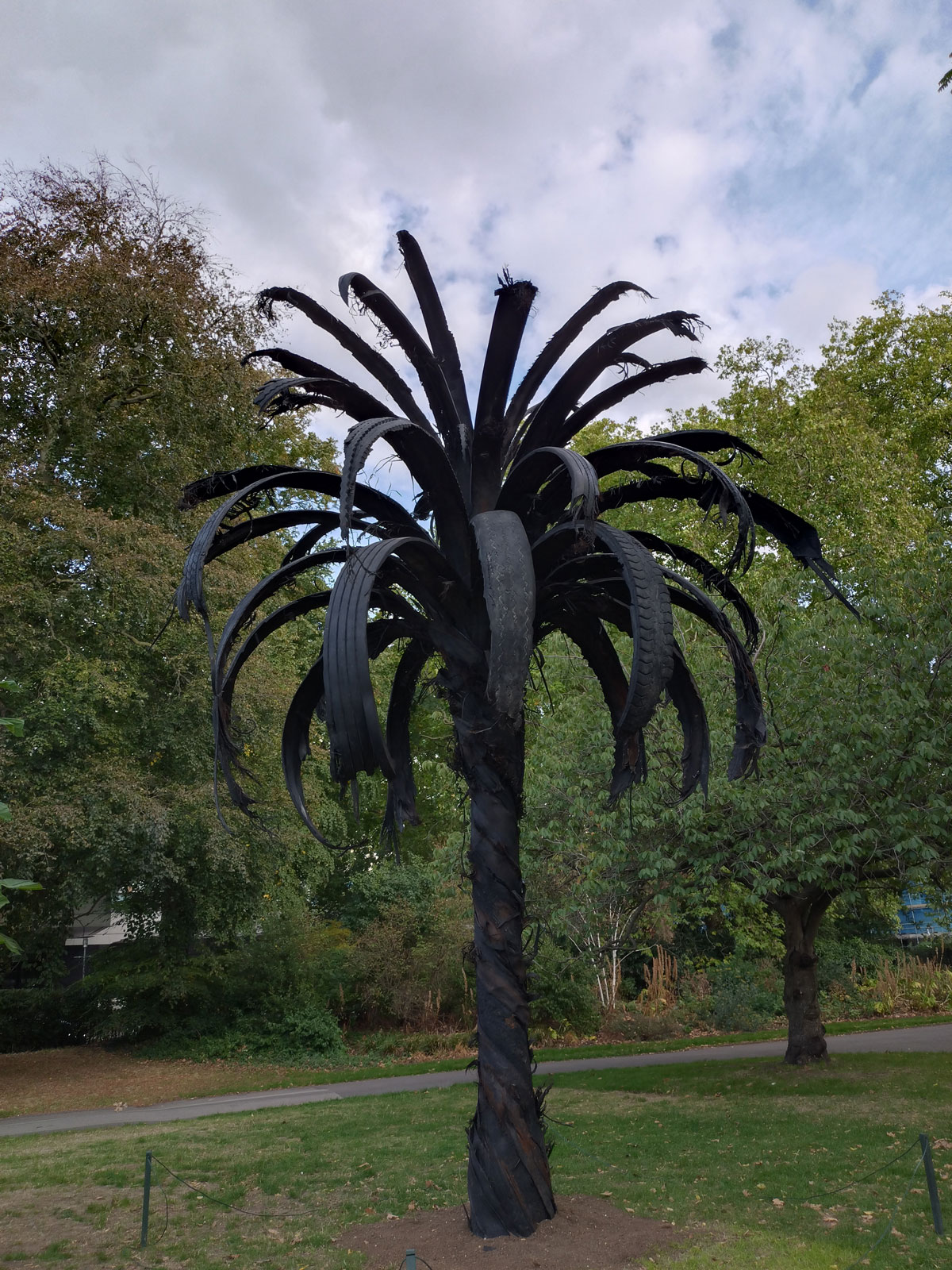
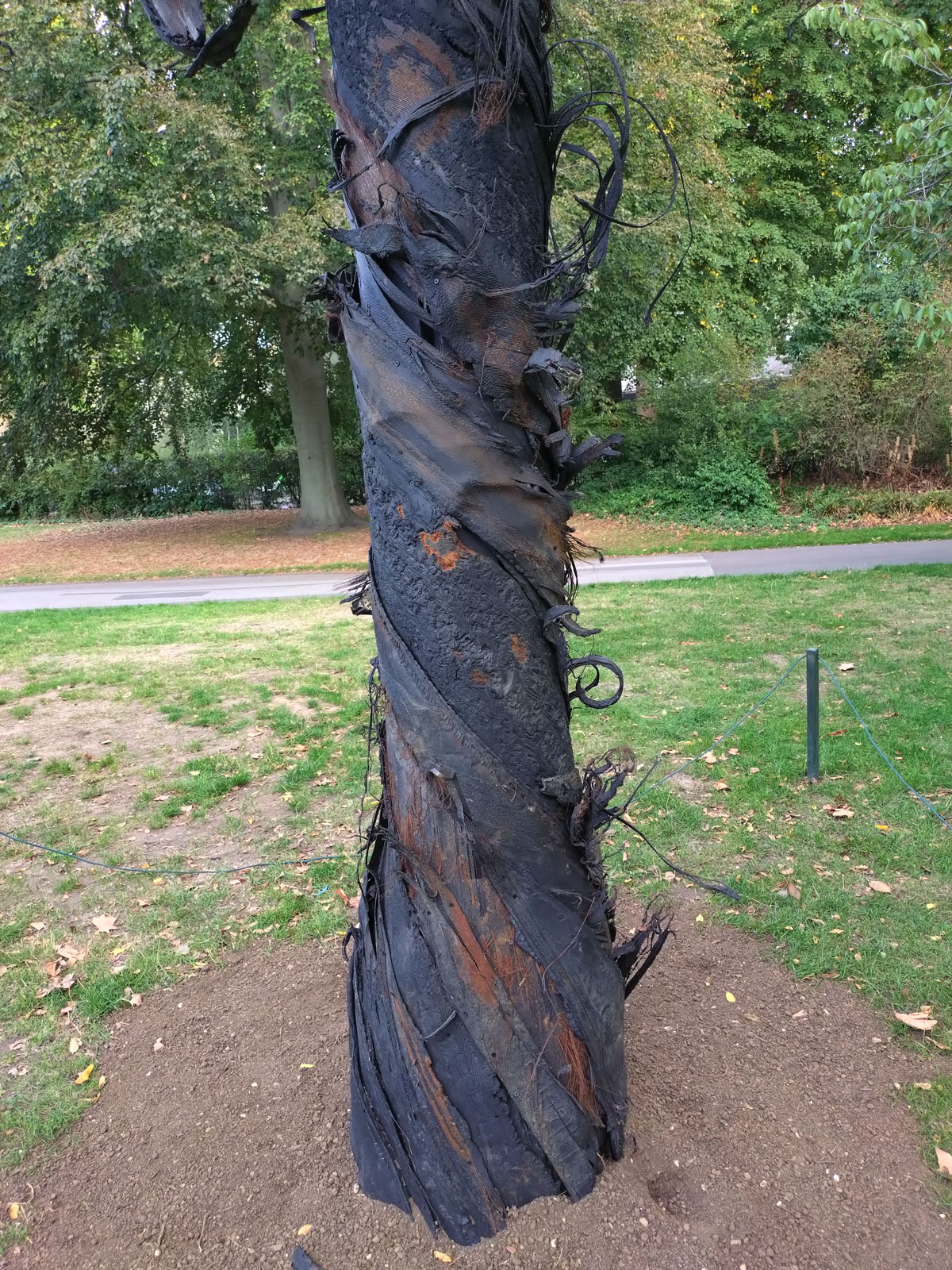
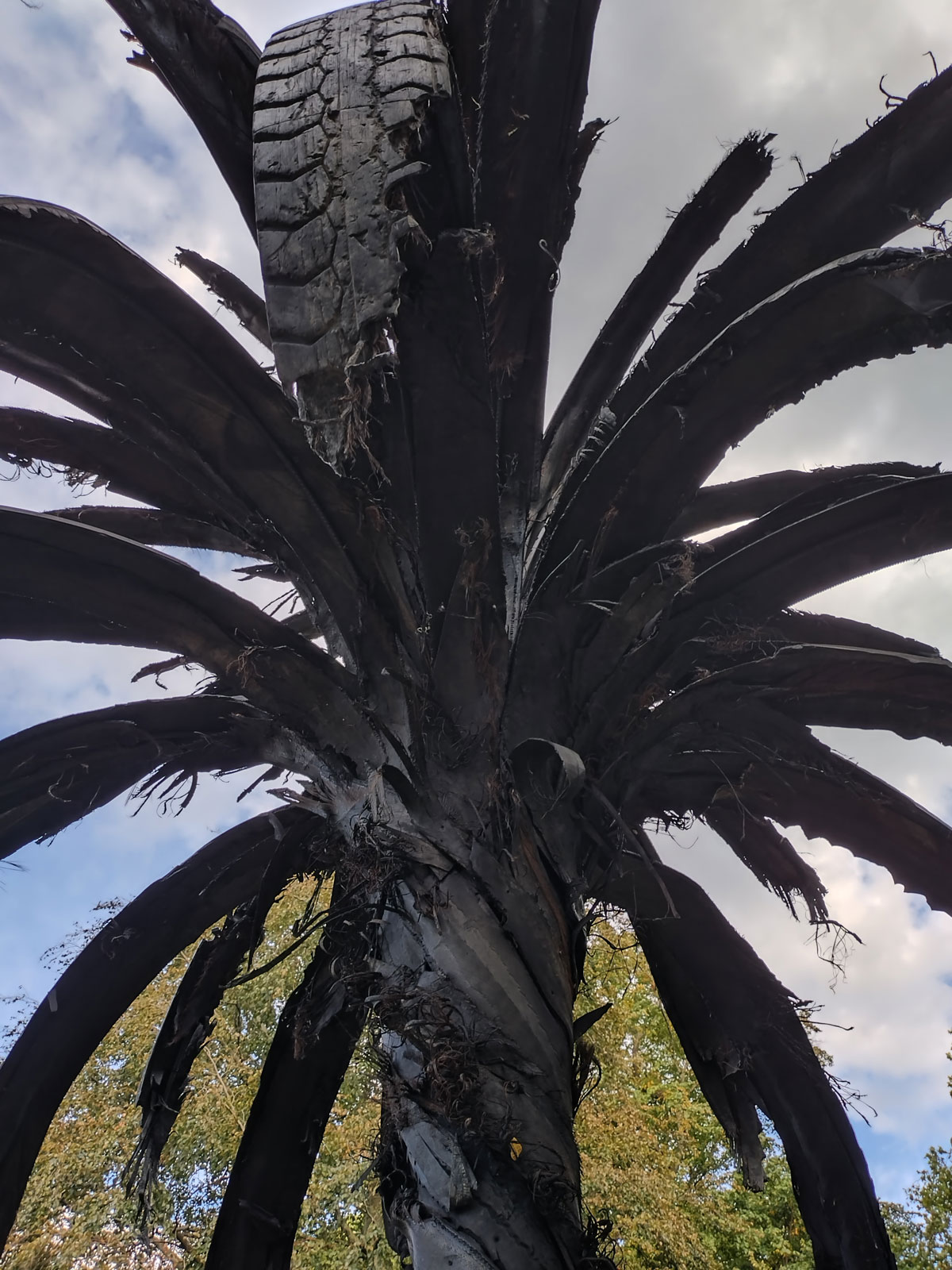
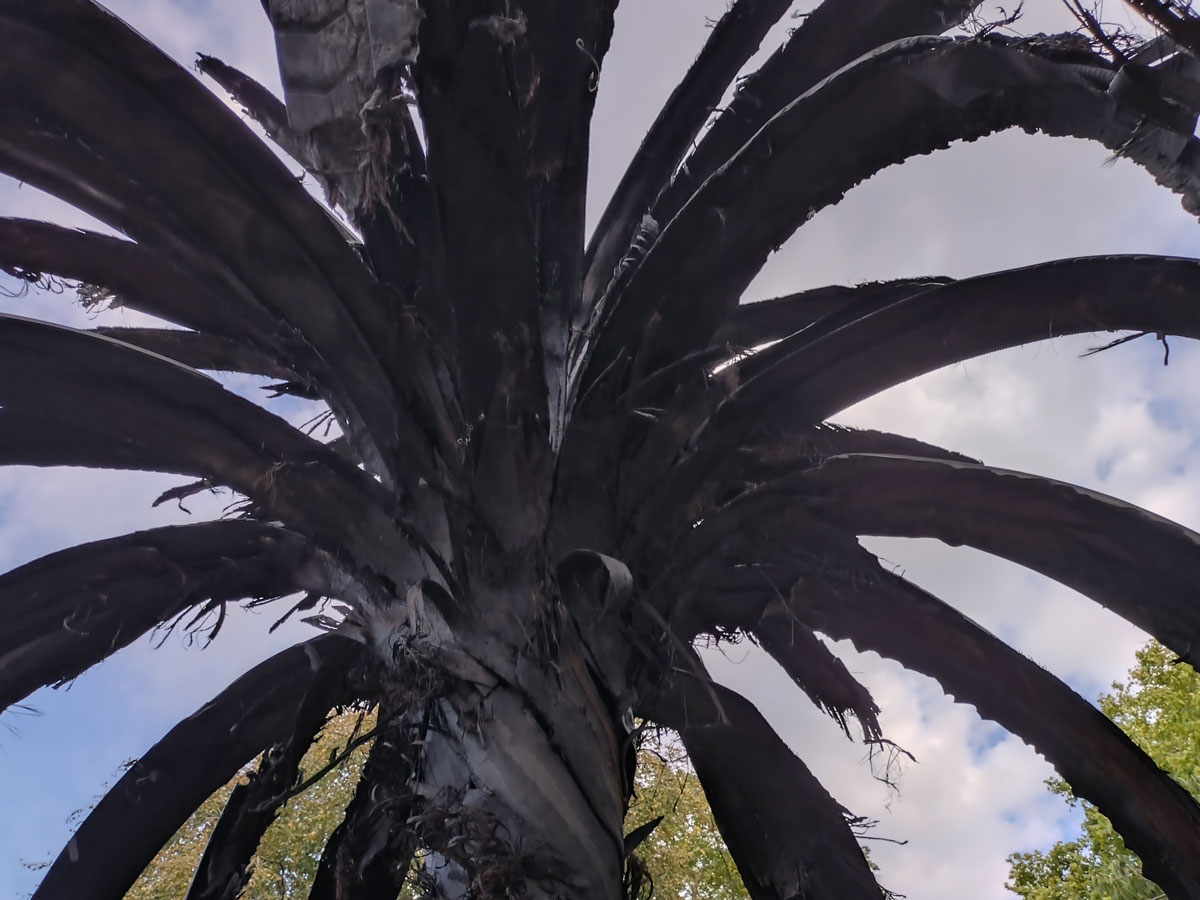
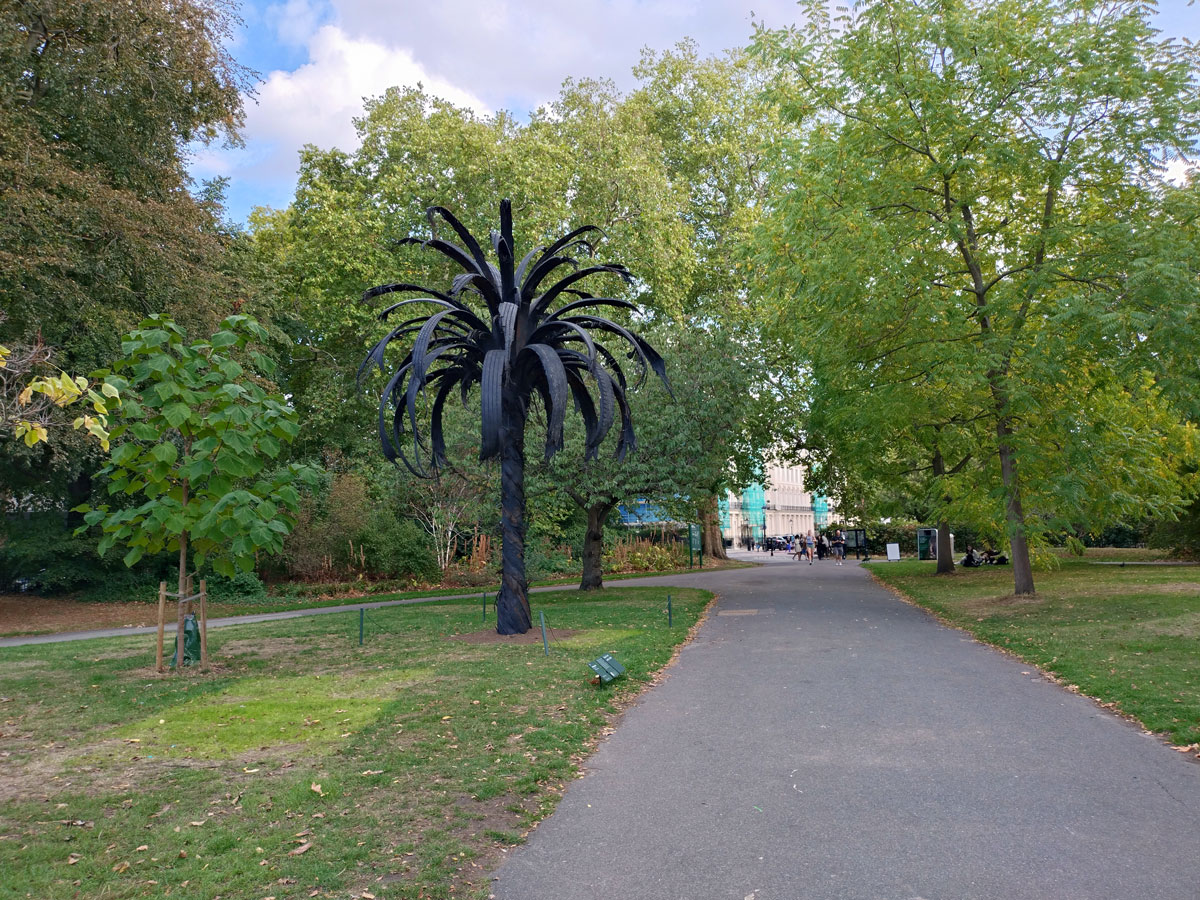
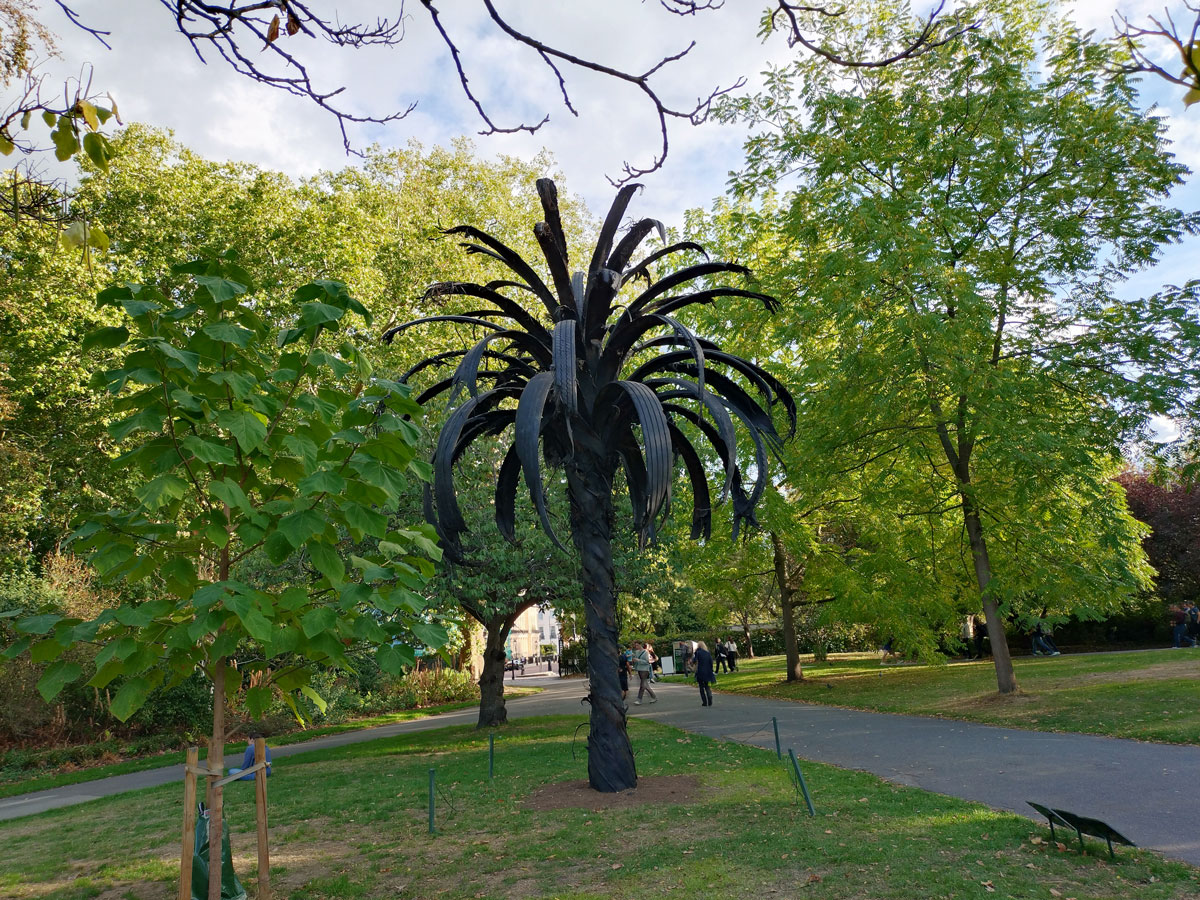
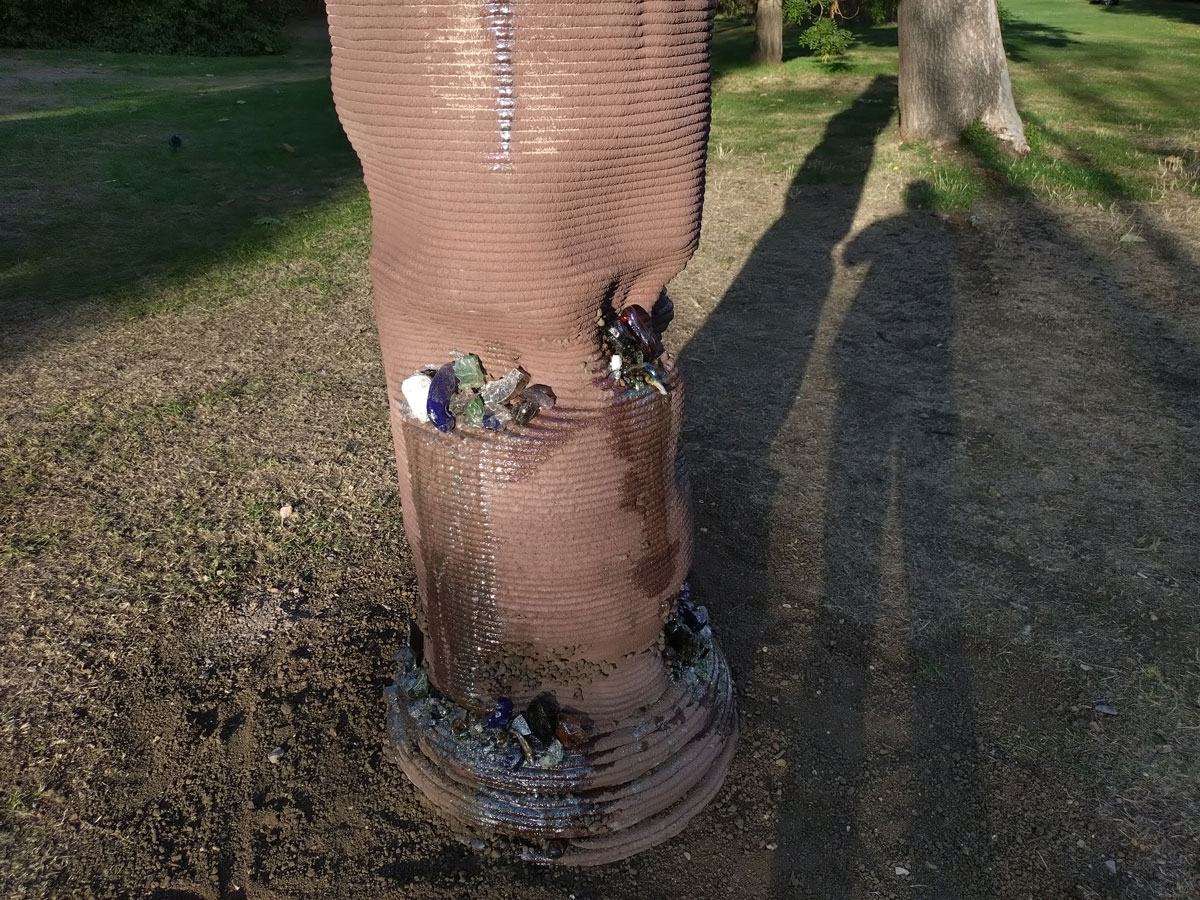
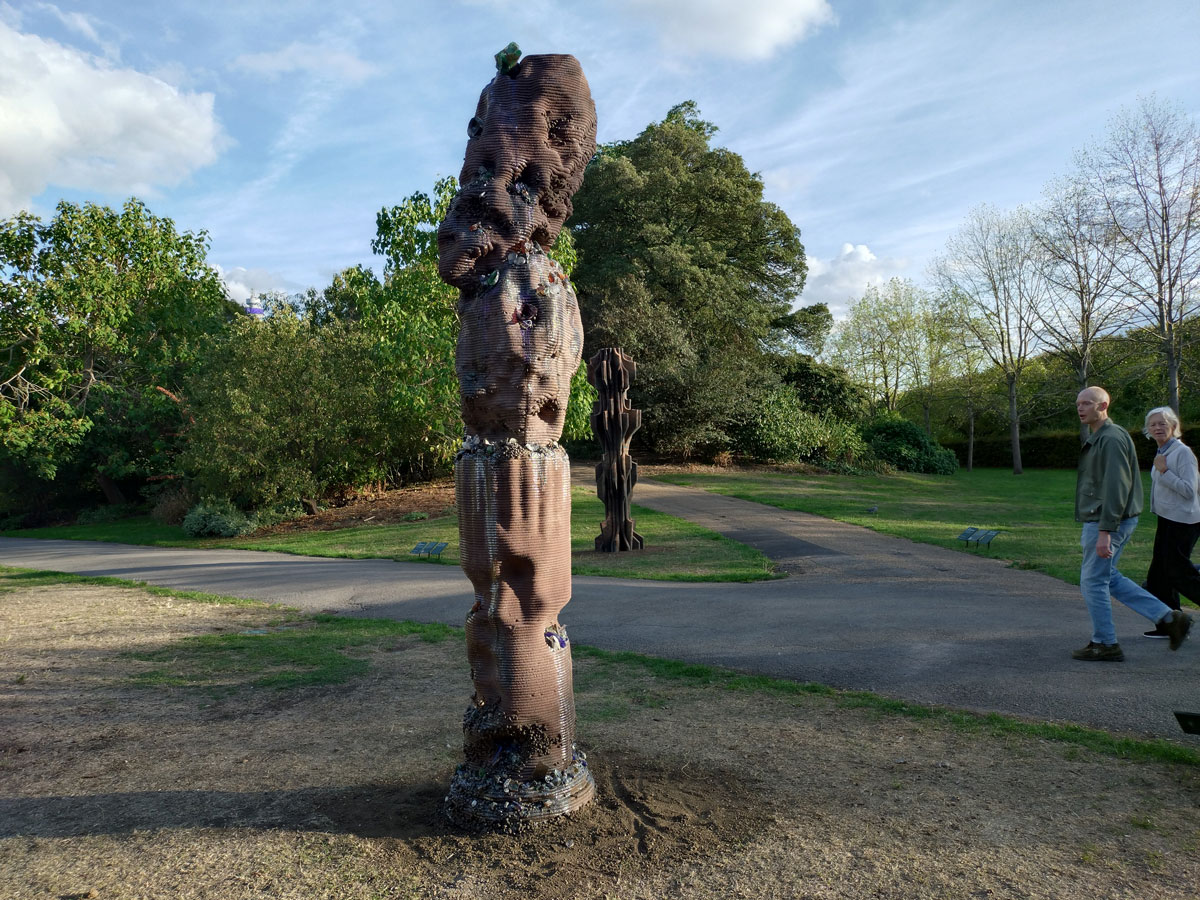
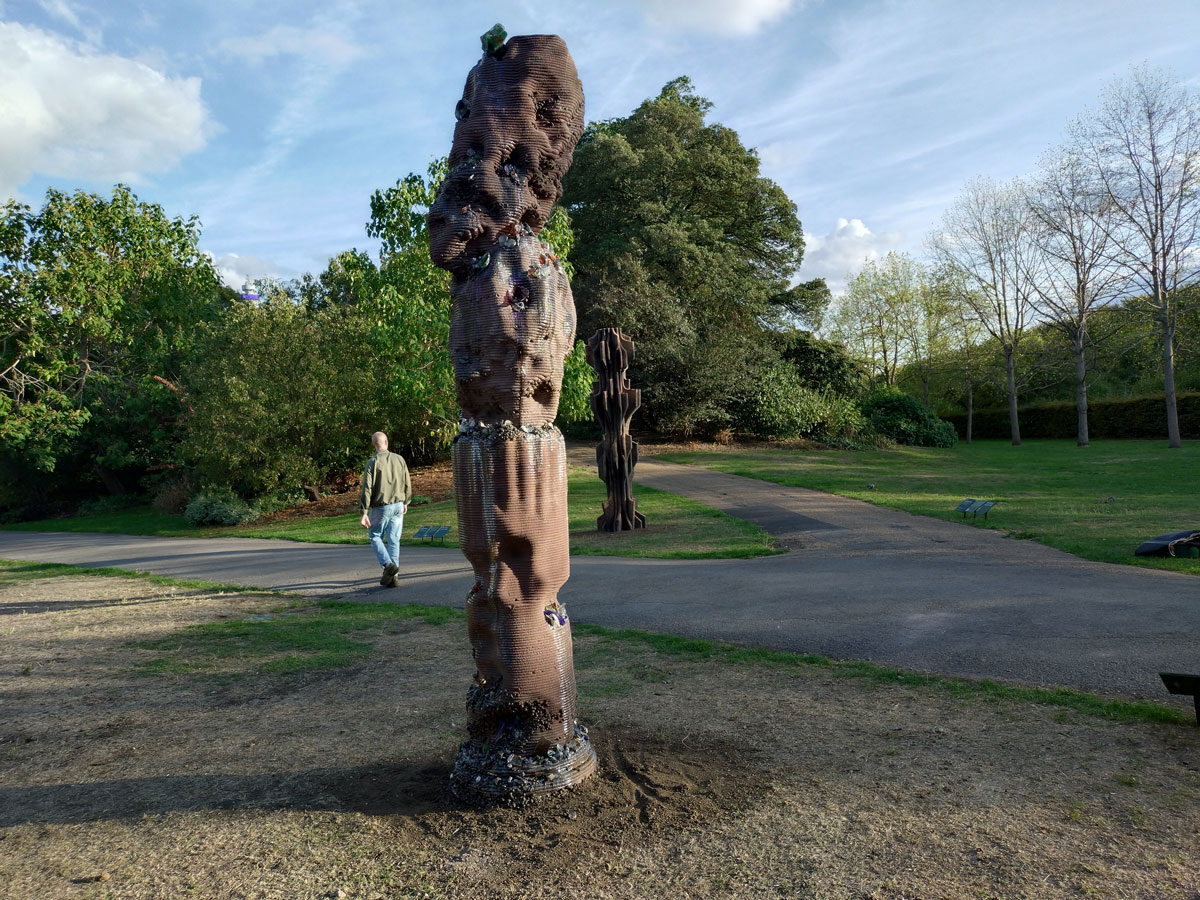
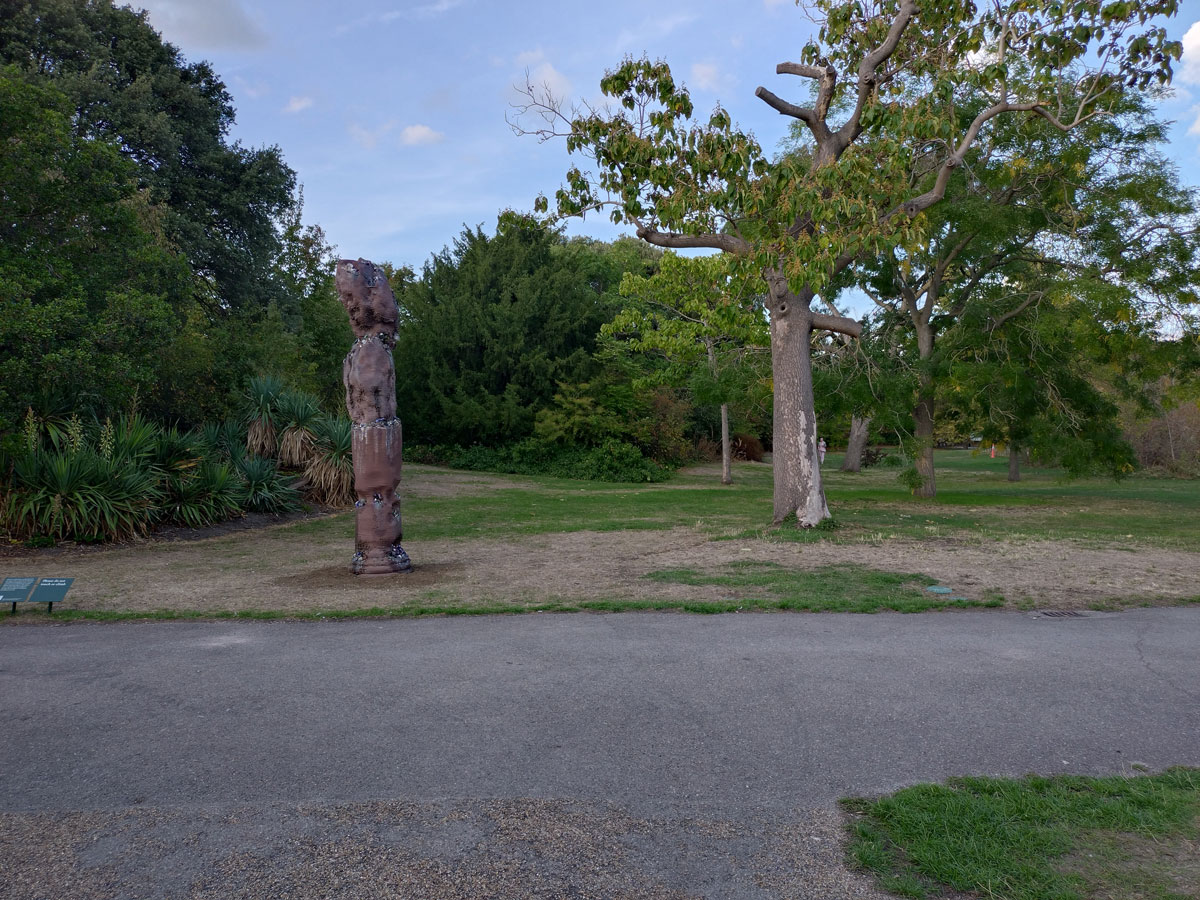
Douglas White‘s Black Palm looks as demanding as it looks exciting, Black Palm is immediate. Let’s cut to the paste; “White (b. 1977, UK) is a sculptor renowned for his powerful use of found objects and materials, repurposing society’s remnants to create compelling and often monumental sculptures” – there are, as some us know well, always possibilities in the the objects left unwanted on out streets. The black(s) of the Palm Tree and especially the trunk are (accidentally?) beautiful, the whole thing powerful, strong, it works on a number of levels, it is a piece that immediately demands you question it, that you question the why it should be standing there (it surely is right that is should be standing here, here of all places)
“Black Palm is an outdoor sculpture rising over seven metres high, made from reclaimed tyre rubber and steel. The materials were sourced from burst truck tyres White collected along the highways of Belize during a residency in a Central American rainforest. During his stay, he observed blackened palm trees burned due to disease and the scattered remains of exploded tyres, which became a catalyst for the work” – The piece is presented by New York’s Leila Heller gallery, Douglas White’s transforming of found materials into “evocative, hybrid forms that challenge distinctions between the organic and industrial” feels strong and right now, here rather than in a white cube, his piece seems just right, it feels like it is right here, right now, a timely presence in the middle of the park only now starting to recover from Summer drought damage and the obvious scars of climate change. I really (really) like that Palm Tree for more than a few (obvious) reasons, I really don’t like what the palm Tree is about for a number of reasons, it is a powerful piece of statement, a powerful set of questions, points well made, especially standing there as part of Frieze and all that that means as well…
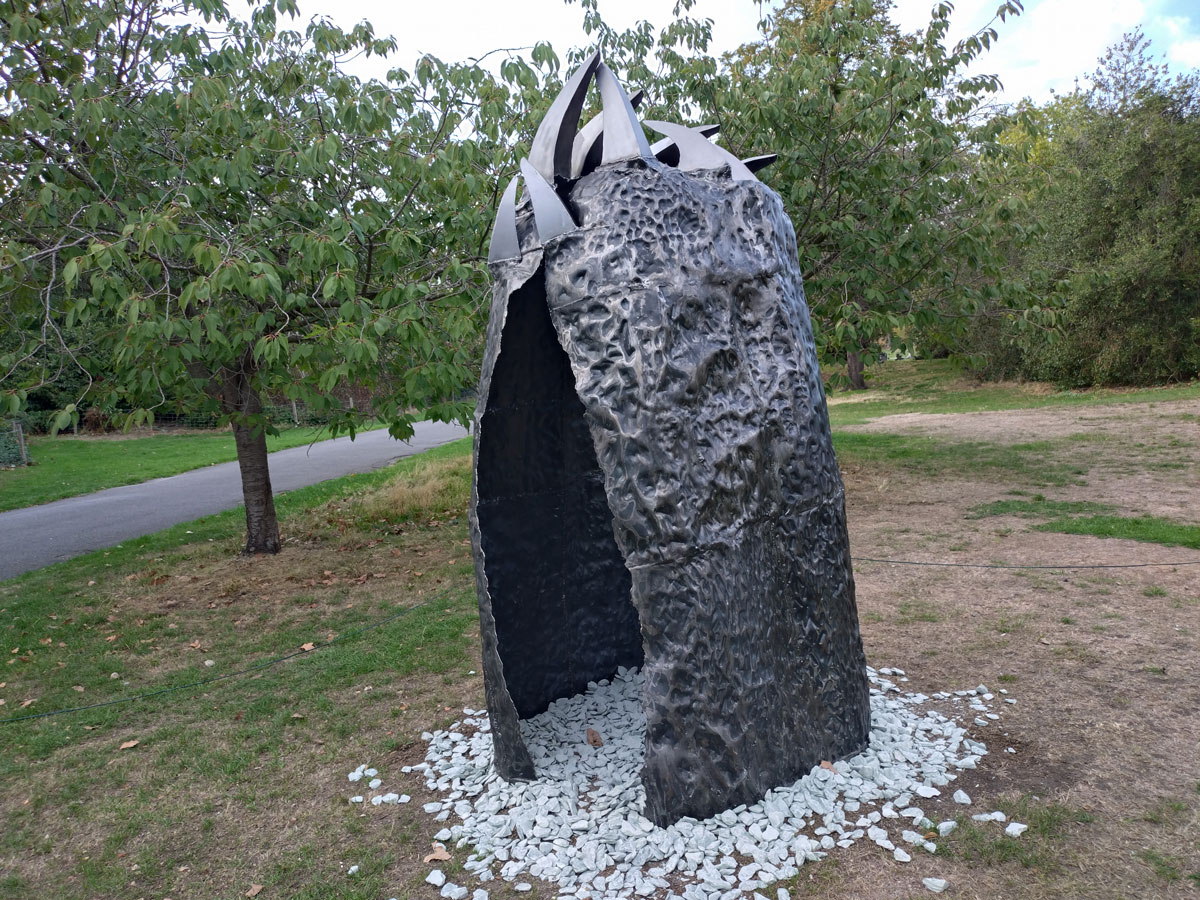
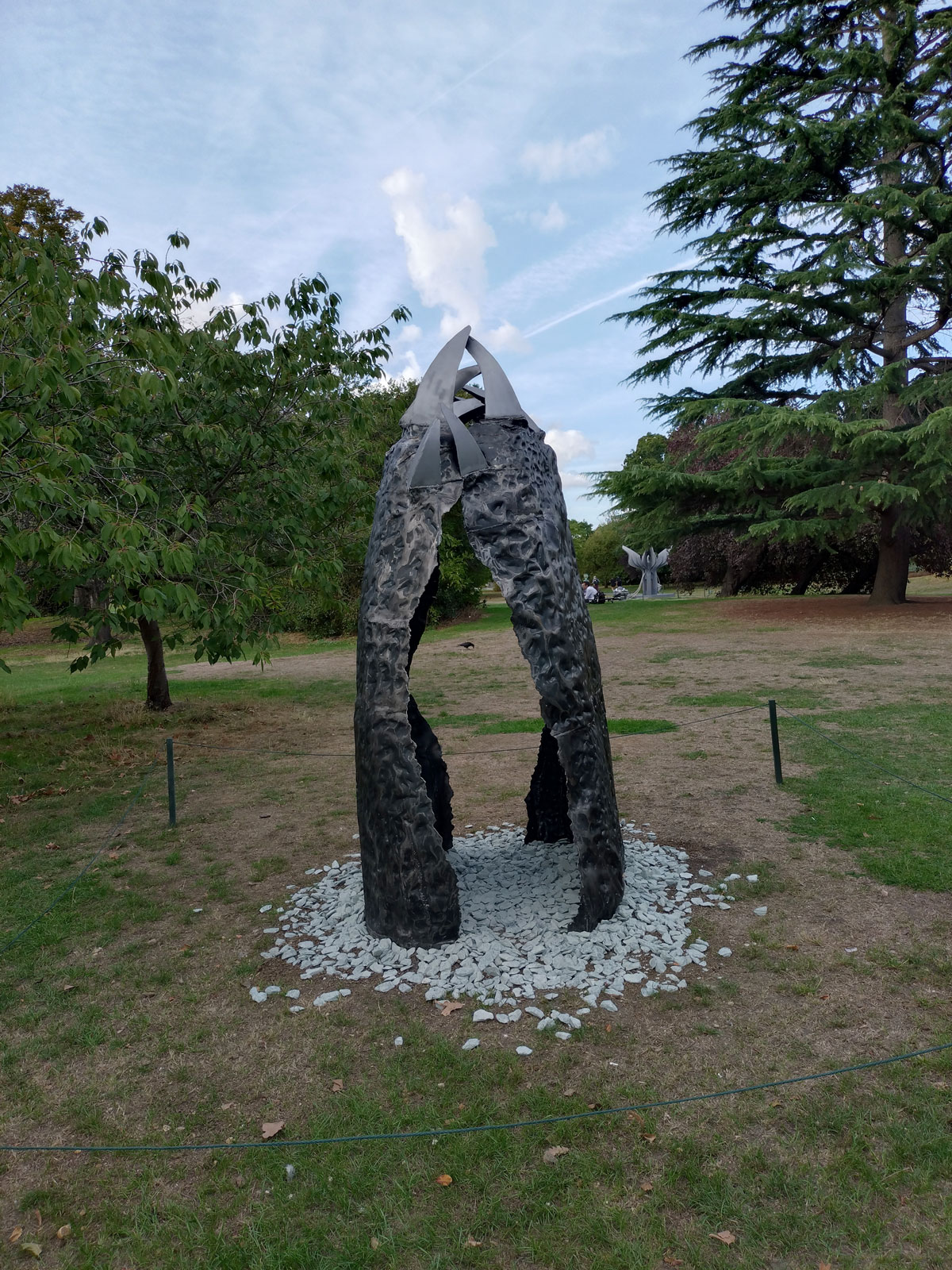
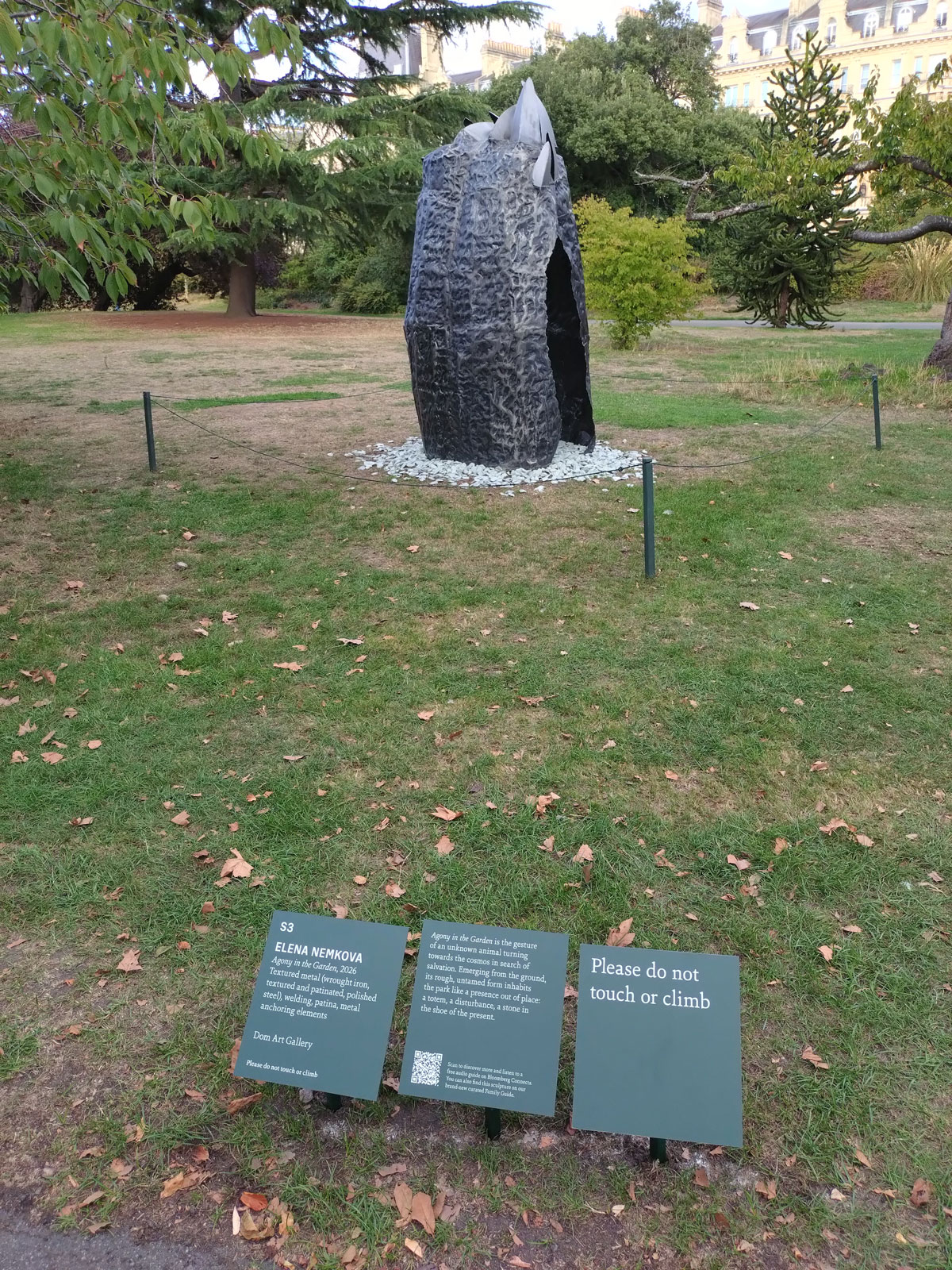
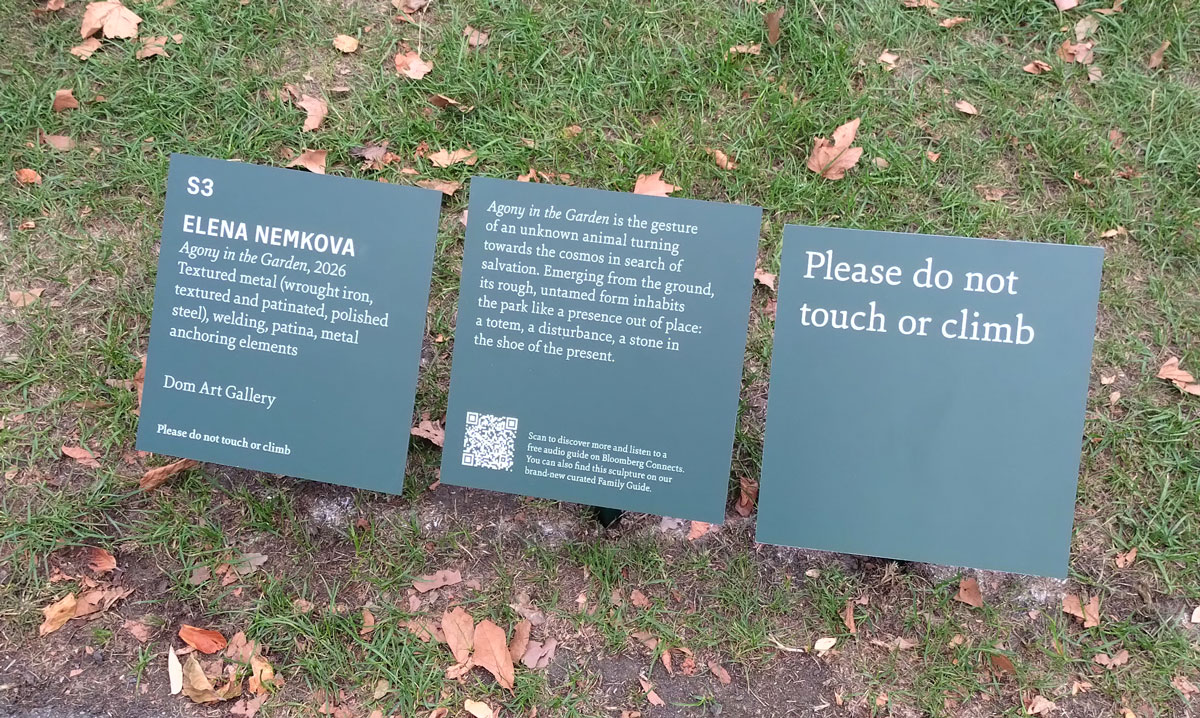
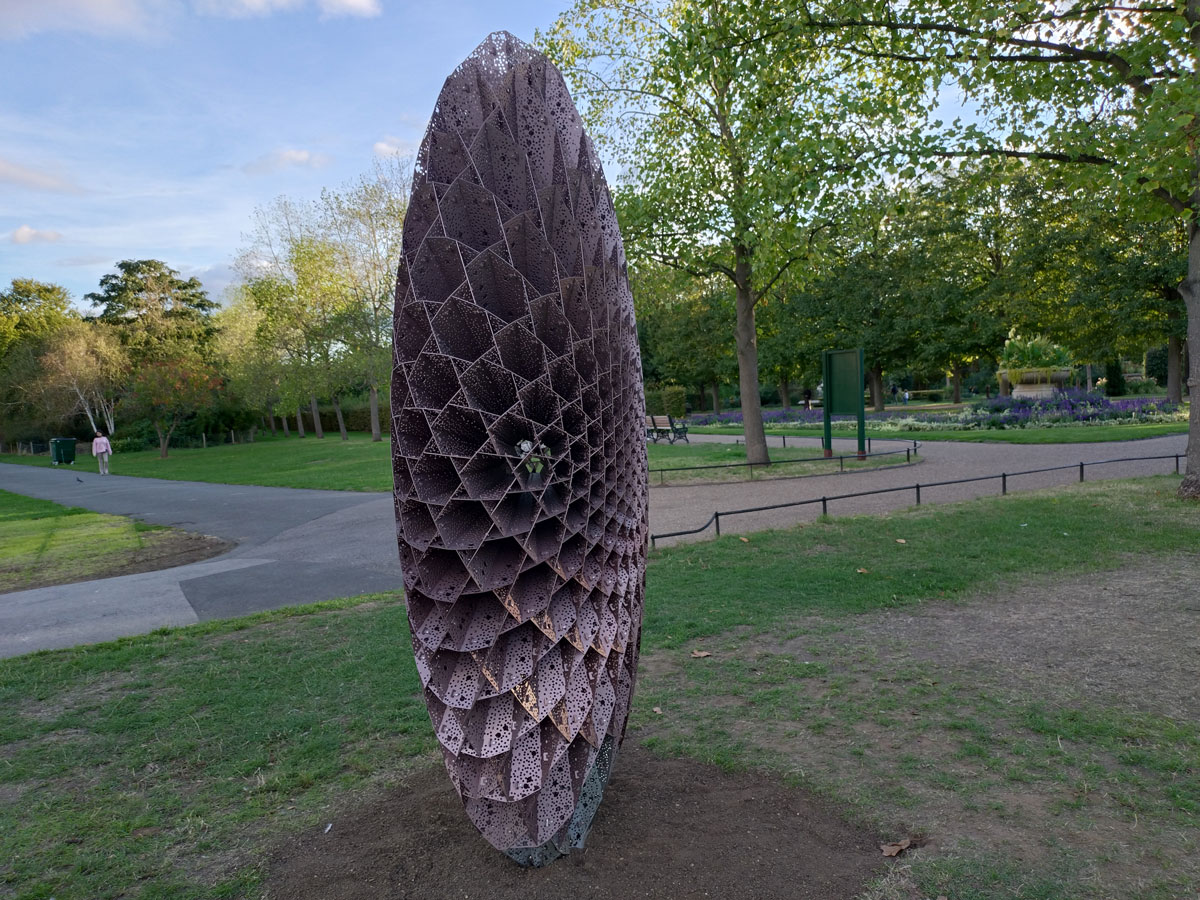
Onward to Elena Nemkova‘s piece, a pod-like forged metal piece (marked by scars and irregularities) presented by Dom Art Gallery (from Riga, Latvia), a piece called Agony in the Garden, a piece that kind of might, well, might be uncertain? Those crossed closed claws do rather suggest some kind of performance, some kind of grip, a tension…
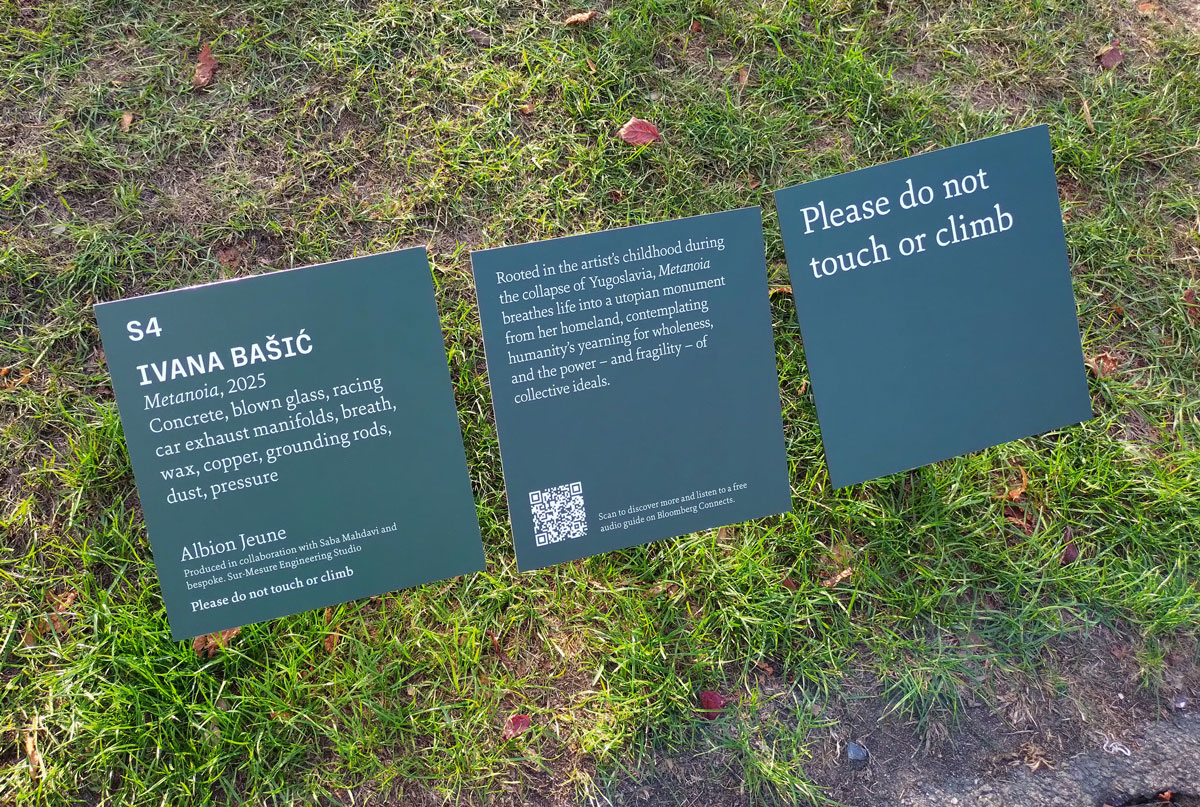
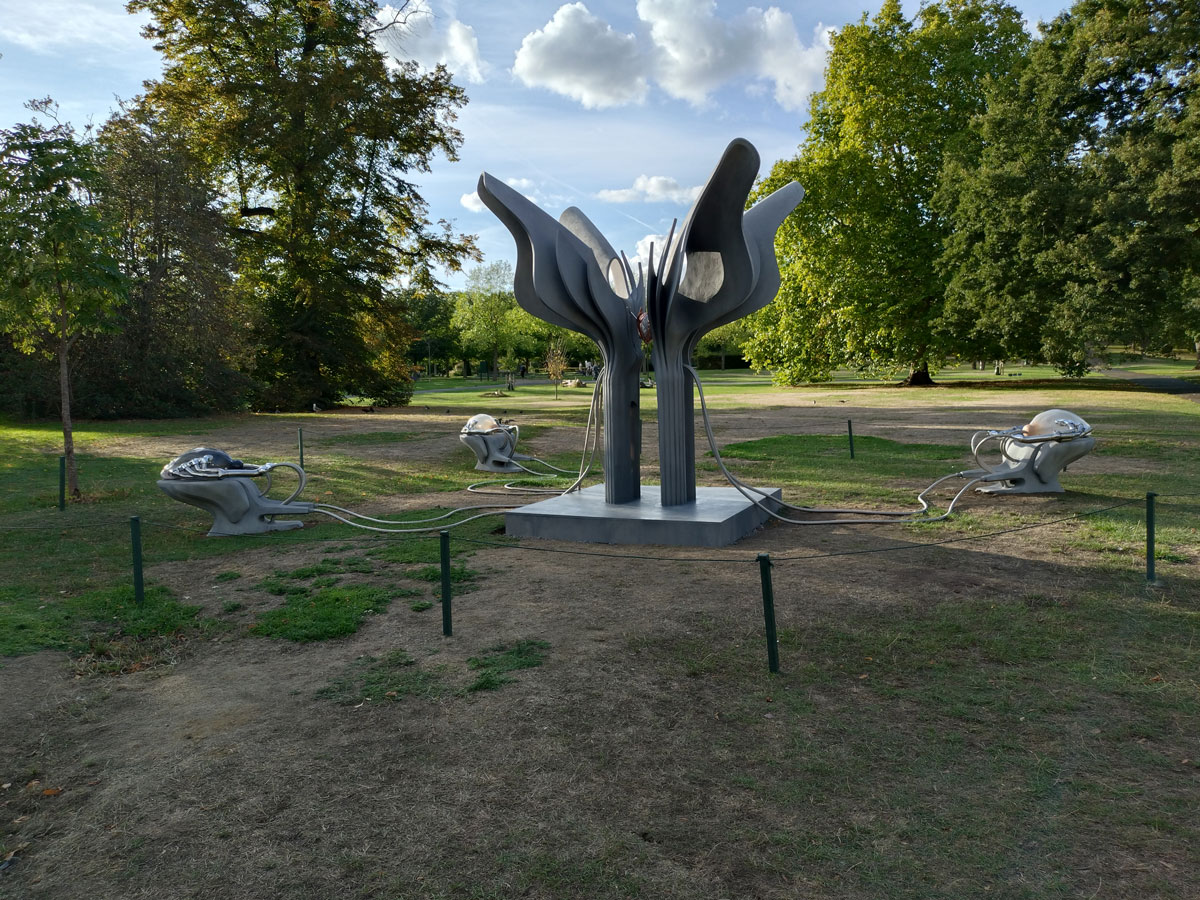
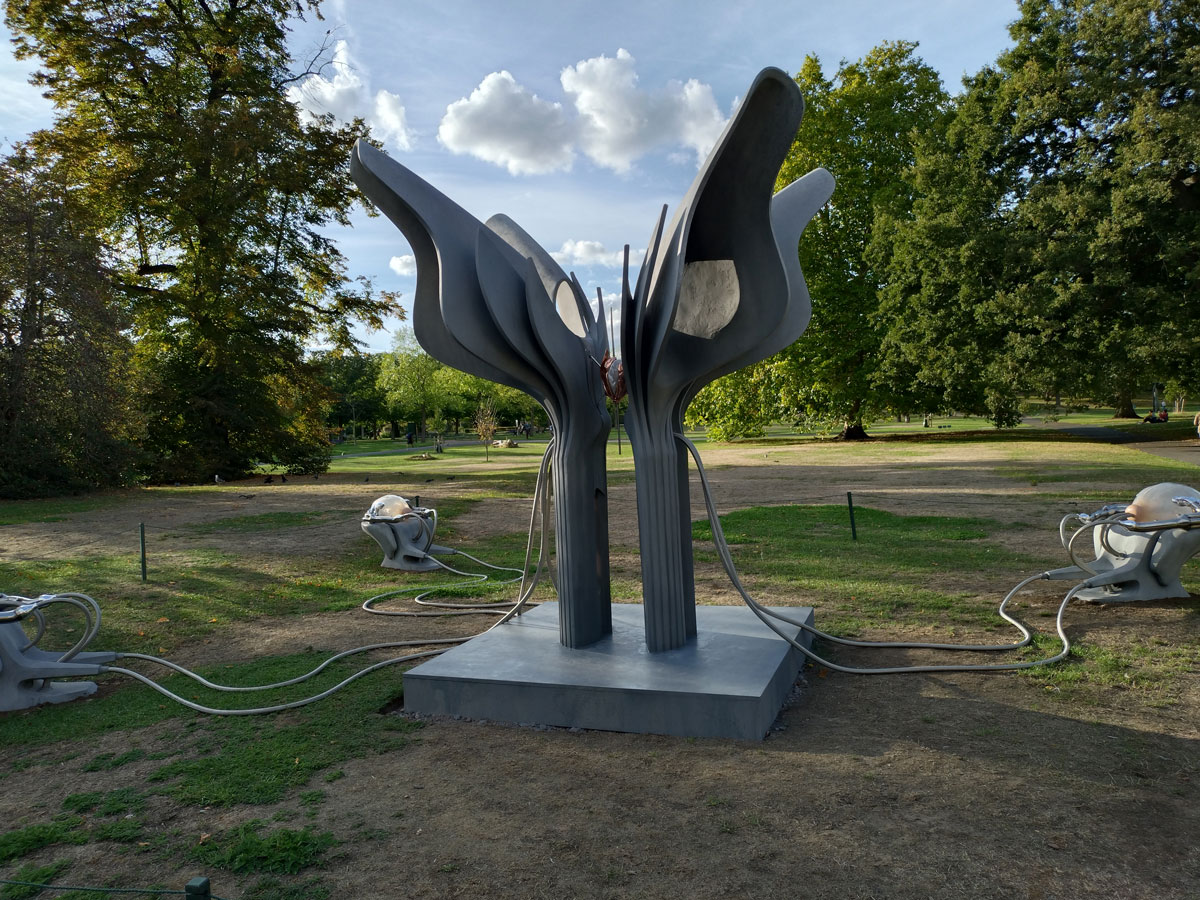
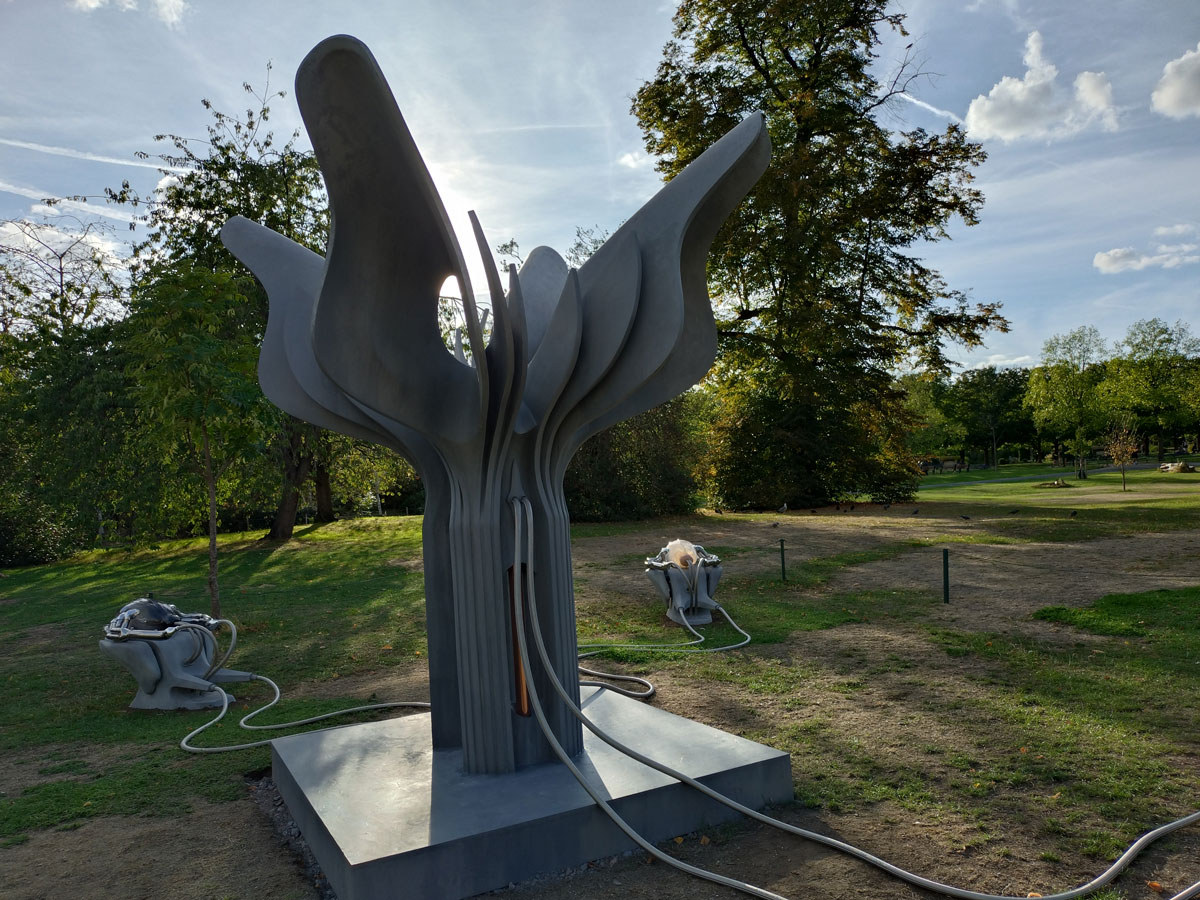
I don’t really feel that inclined to want to know what’s going on with Ivana Bašić‘s Metanoia, a piece that dates from 2025 (a piece presented by London’s Albion Jeune Gallery), it looks like retro science fiction, something to do with Eastern European “otherworldly concrete war memorials” – yes, it probably deserves my further investigation only the piece itself is really not connecting with me is any kind of way that makes me want to. It isn’t you, it really is me and saying that kind of leaves me feeling a little (disrespectfully) guilty – “Charged by the artist’s childhood experiences of violence and brutality during the collapse of her native Yugoslavia, Metanoia embodies the yearning for unity that lies deep within the human condition and contemplates what endures when political ideals fracture and personal identities fragment….”
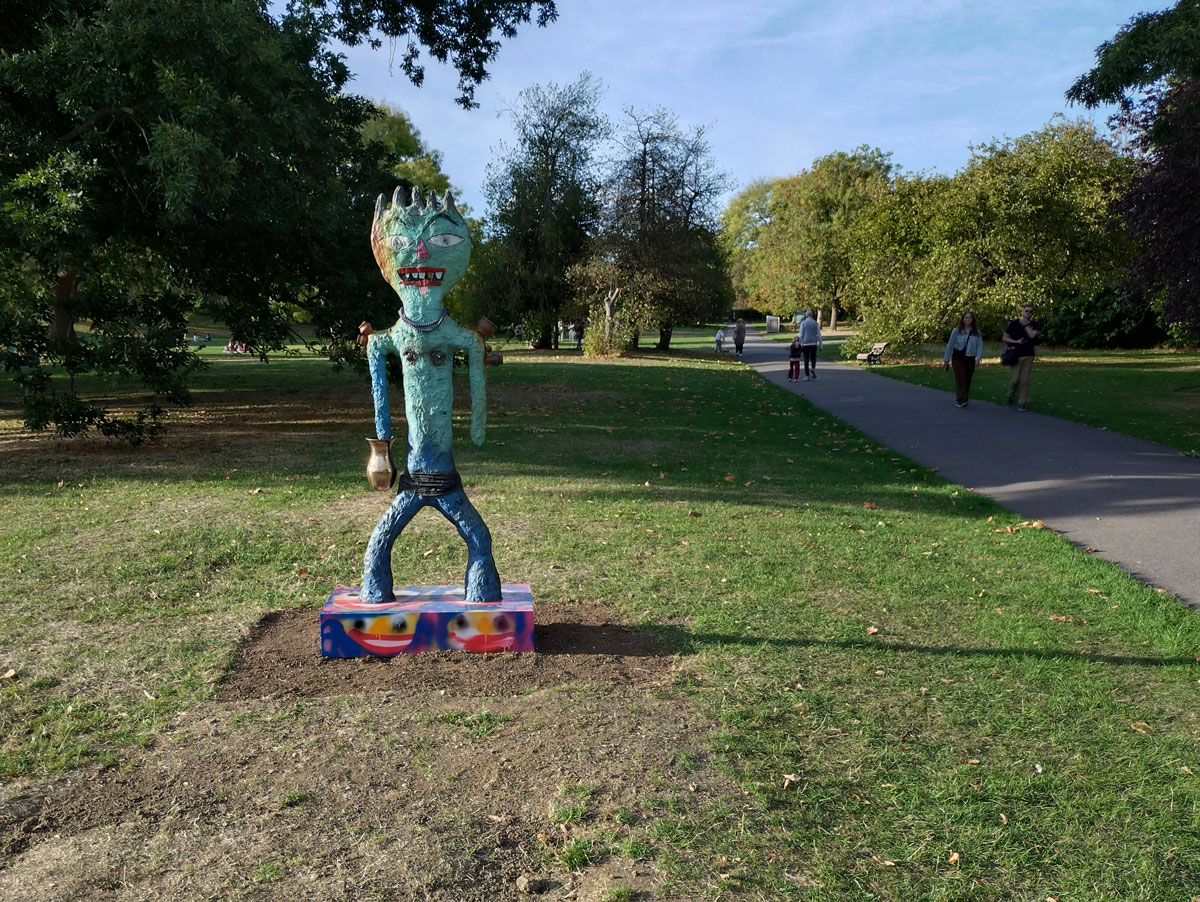
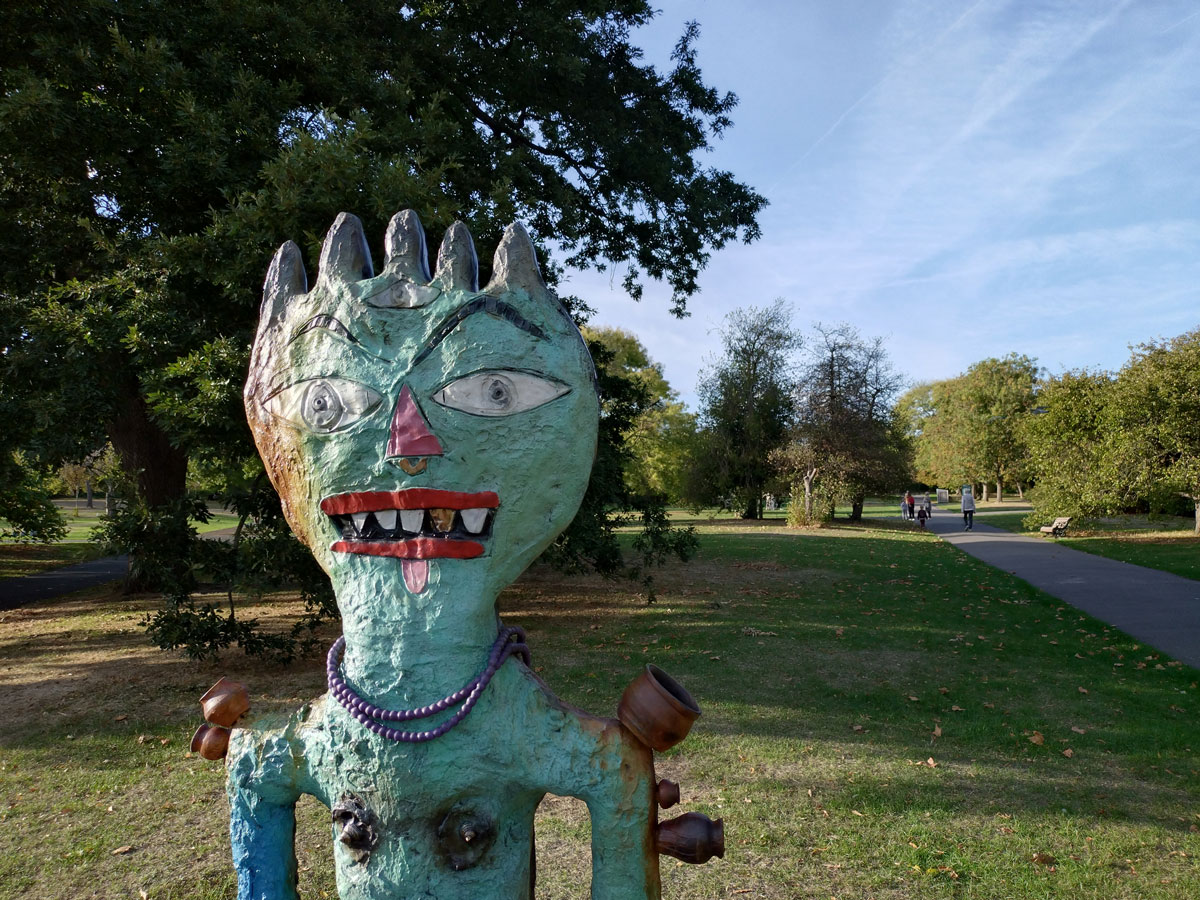
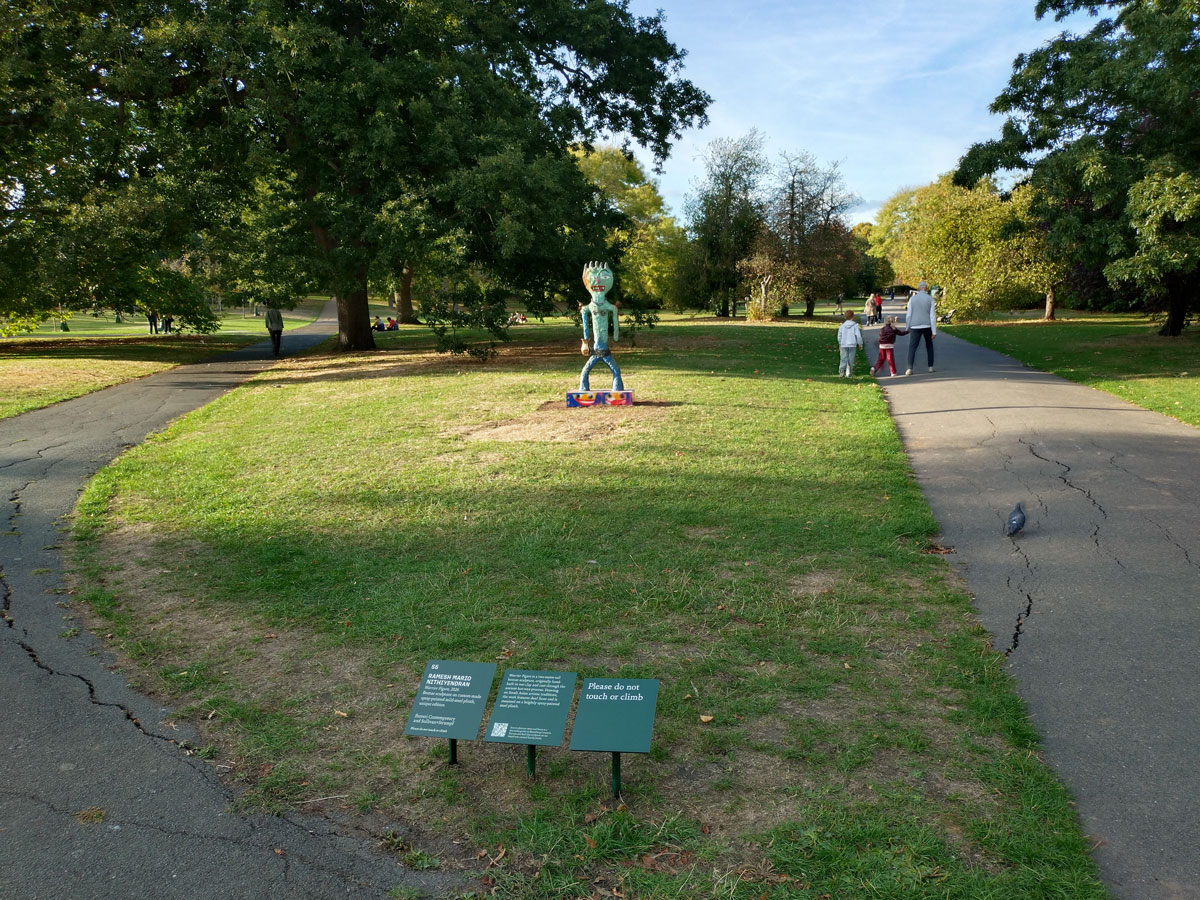
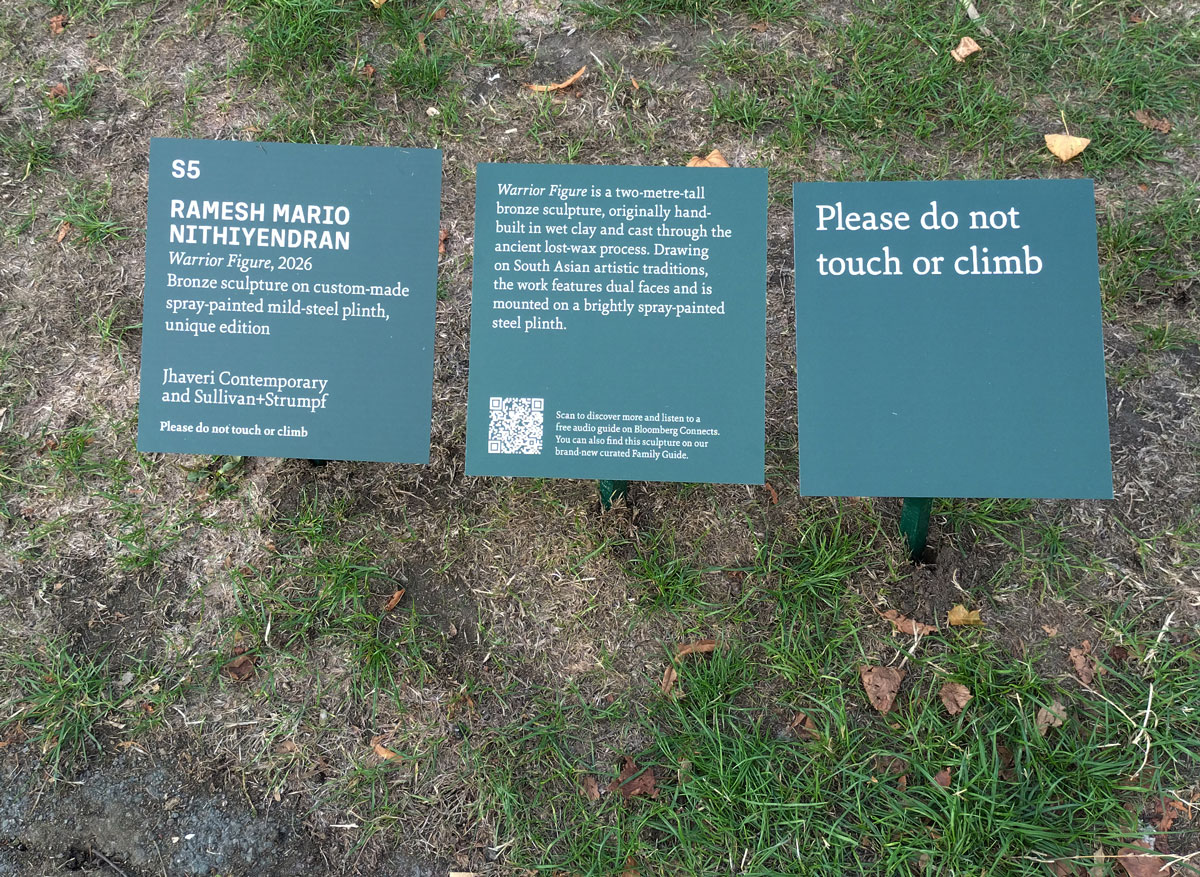
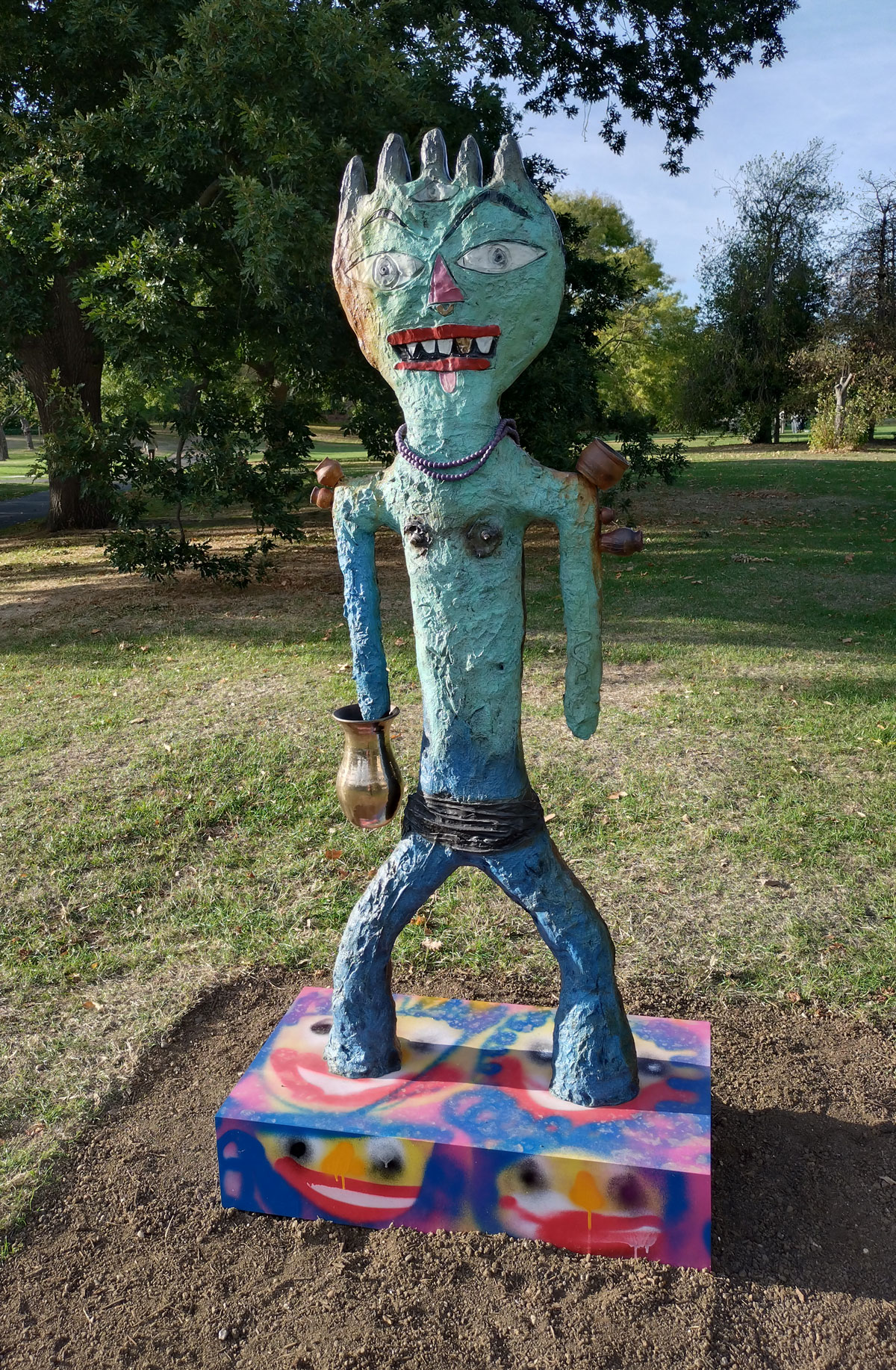
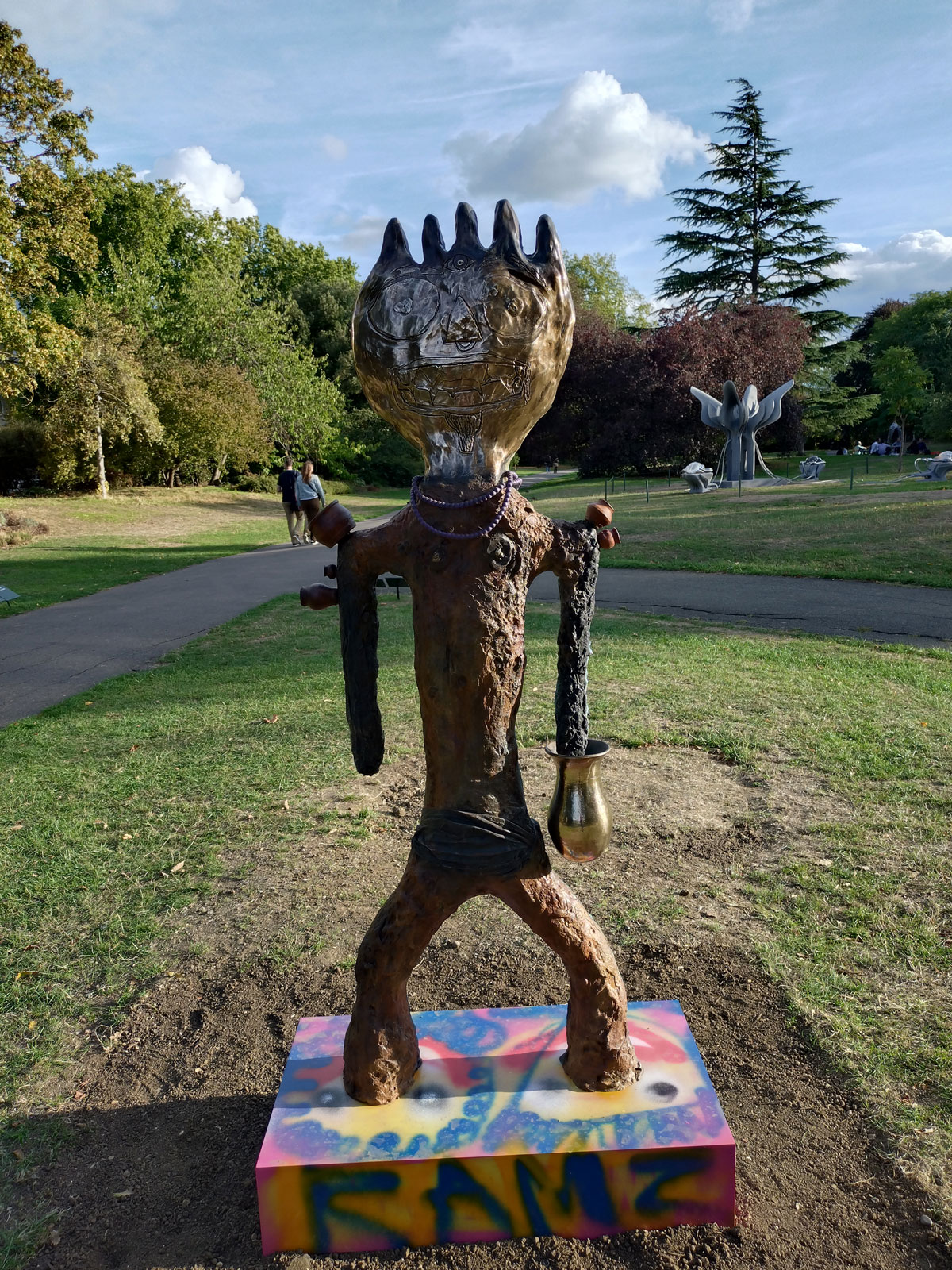
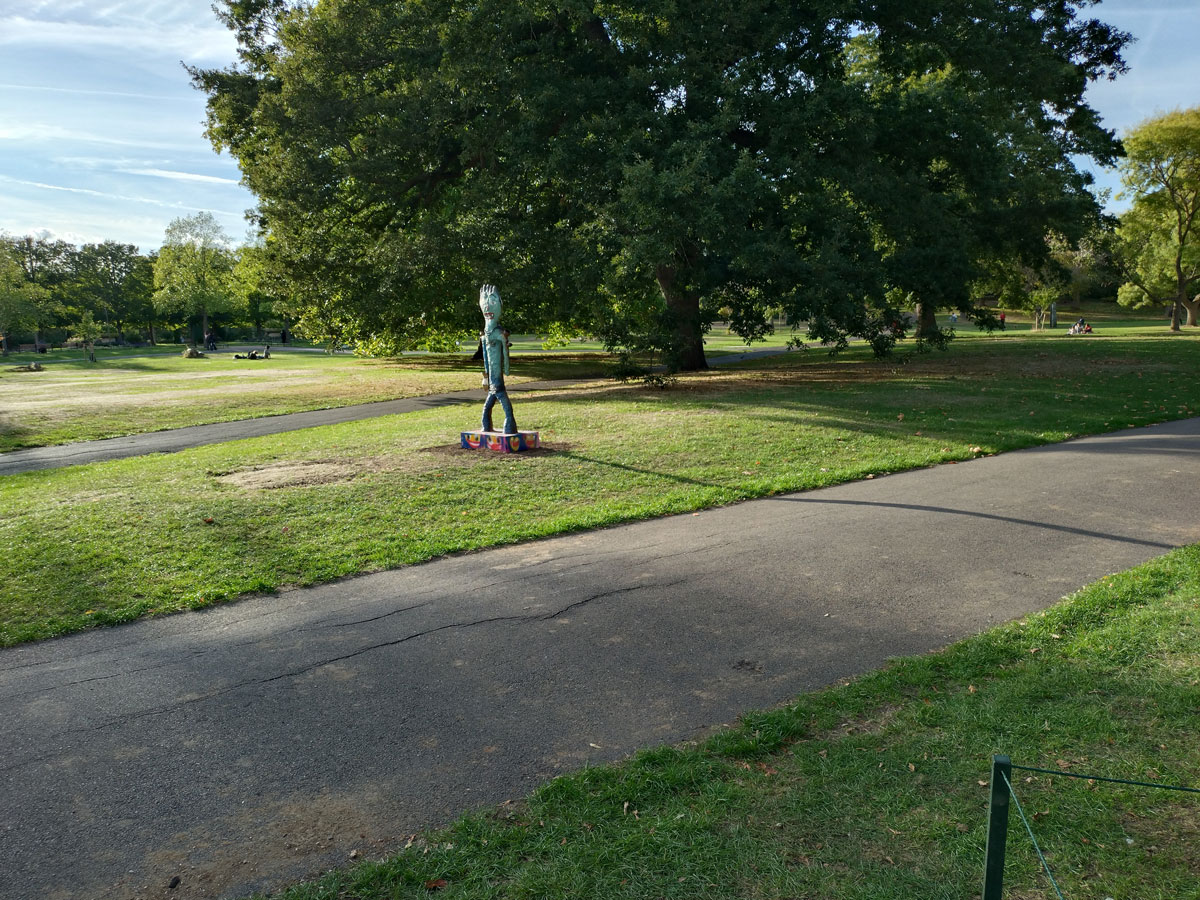
Ramesh Mario Nithiyendran‘s piece, Warrior Figure, 2026 looks like fun in the late afternoon early Autumn sunshine, does it kind of look (a little uncomfortably) out of place standing on that graffiti-scared concrete plinth? Does being out of place add to it? A piece presented by Mumbai’s Jhaveri Contemporary and Sullivan+Strumpf; “one of Asia-Pacific’s leading contemporary art galleries, representing engaging and culturally relevant artists from the region” – they tell us Sri-Lankan born, Ramesh Mario Nithiyendran is a contemporary artist interested in global histories and languages of figurative representation –
“Ramesh Mario Nithiyendran embraces global traditions of figuration, with a focus on South Asian sculptural heritage. Working across ceramics, bronze casting, painting, drawing and immersive installation, he creates hybrid sculptures that investigate idolatry, both secular and non-secular, alongside queer aesthetics, monumentality and autobiography. The two-metre-tall Warrior Figure was hand-built in wet clay by Nithiyendran at full scale before being cast in bronze using the ancient lost-wax process, painted and patinated at Mal Wood Foundry in Melbourne. The work preserves the raw, improvised markings of its original construction” – his piece feels universal, it might have been something seen at the Claremont Road protests in the 90s, it might have been on a politically based slightly crusty punk rock band’s album cover, it might have been something long lost and found in a forest, it might be many things. a global tradition indeed, I kind of like that it is currently here in the London sunshine, I kind of like the possibilities, who care’s what i kind of like, I liked where they places it, that I could just walk past it, that it wanted to at least say hello and maybe say lots more, I rather think I should go back and see, it does encourage engagement, conversation, I wonder where it wil lgo next?
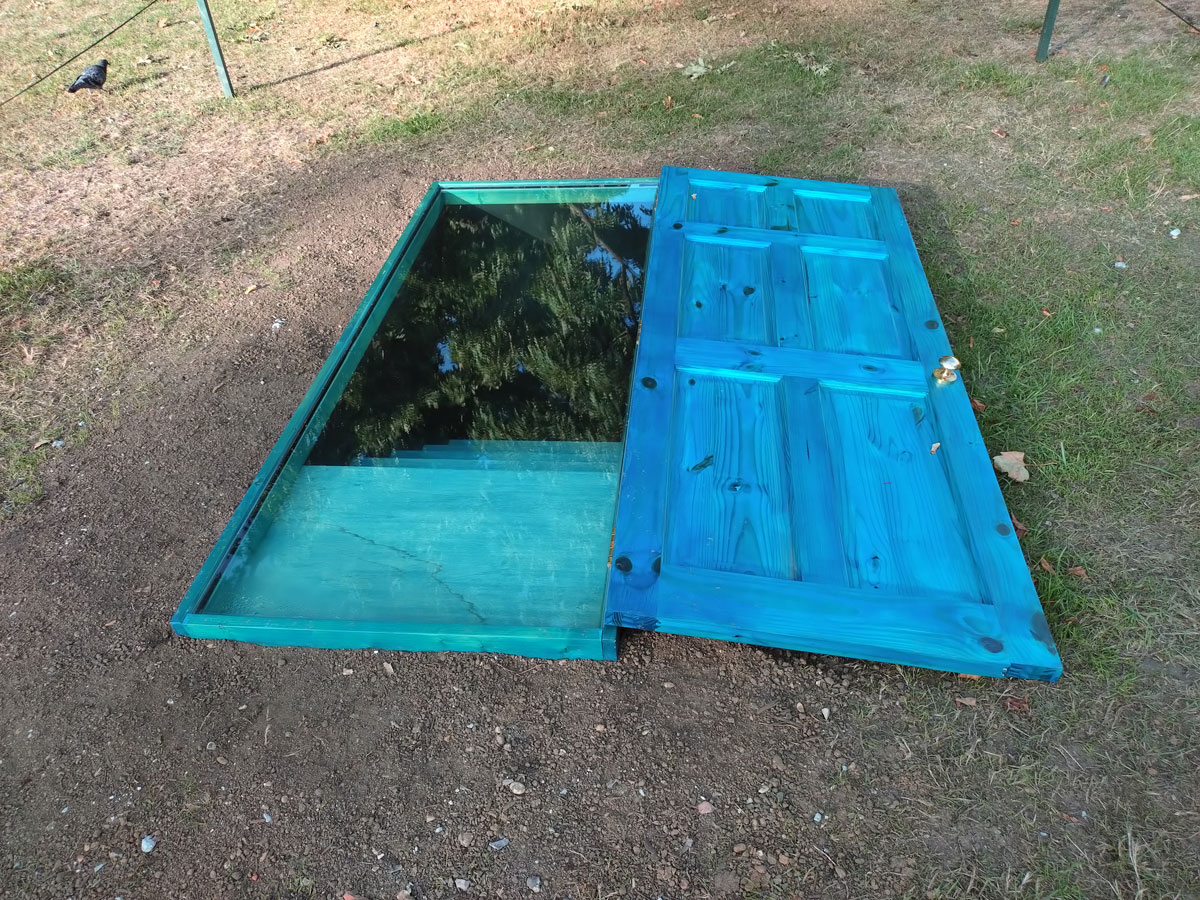
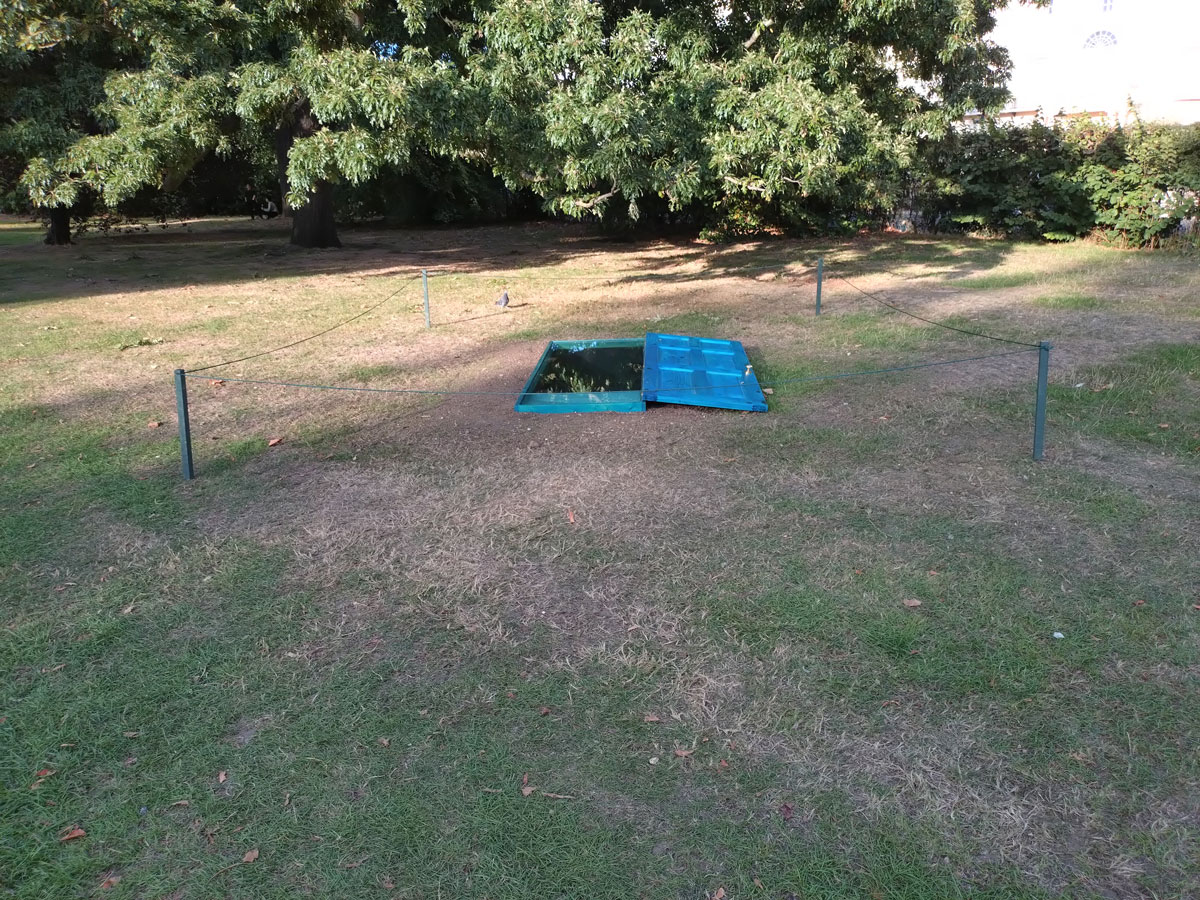
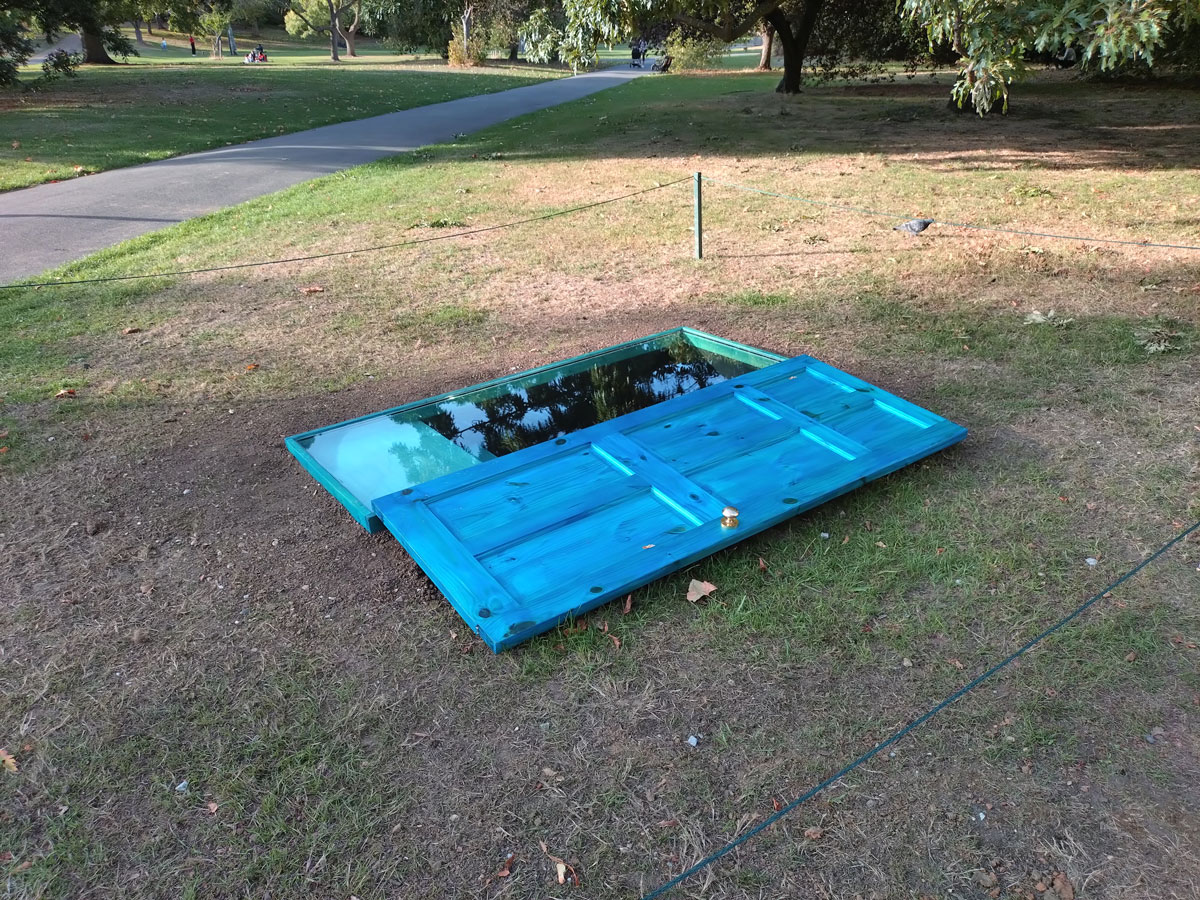
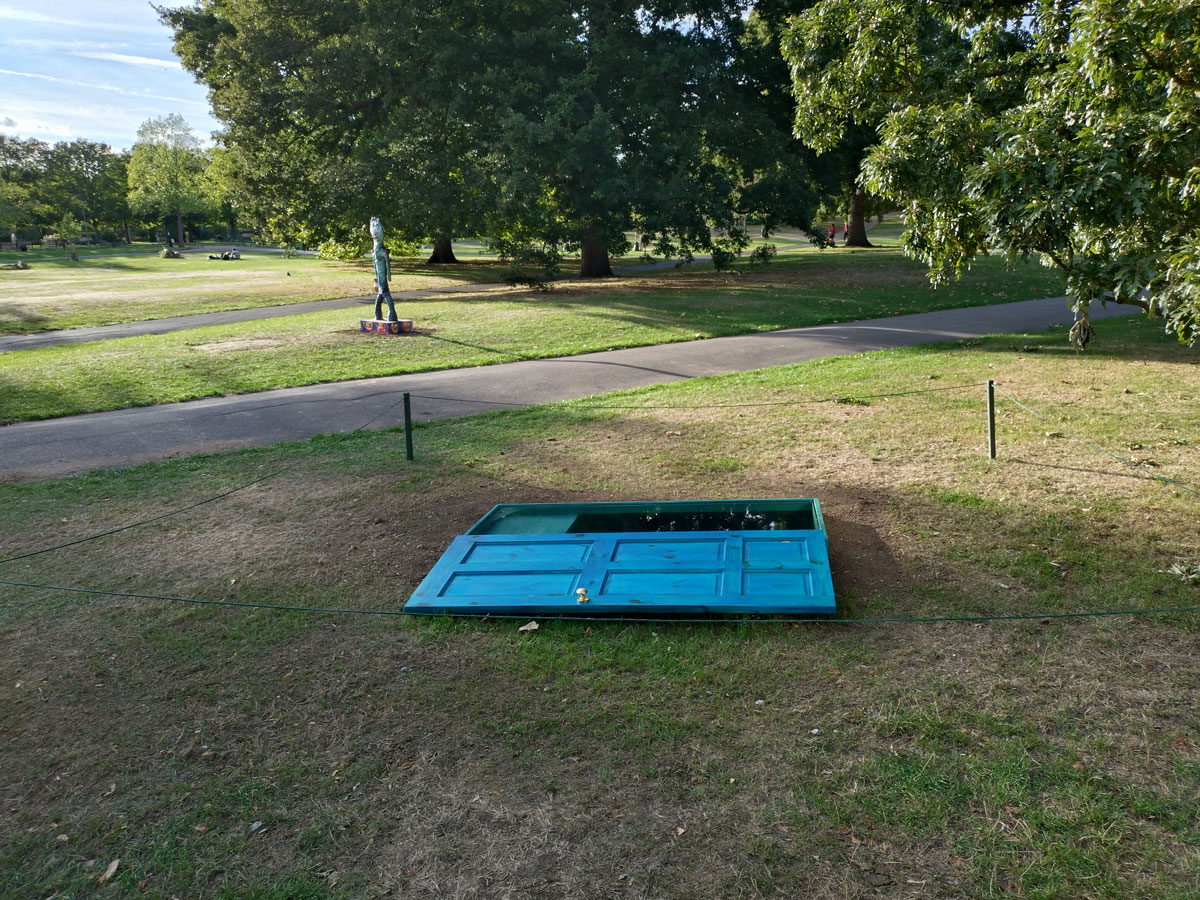
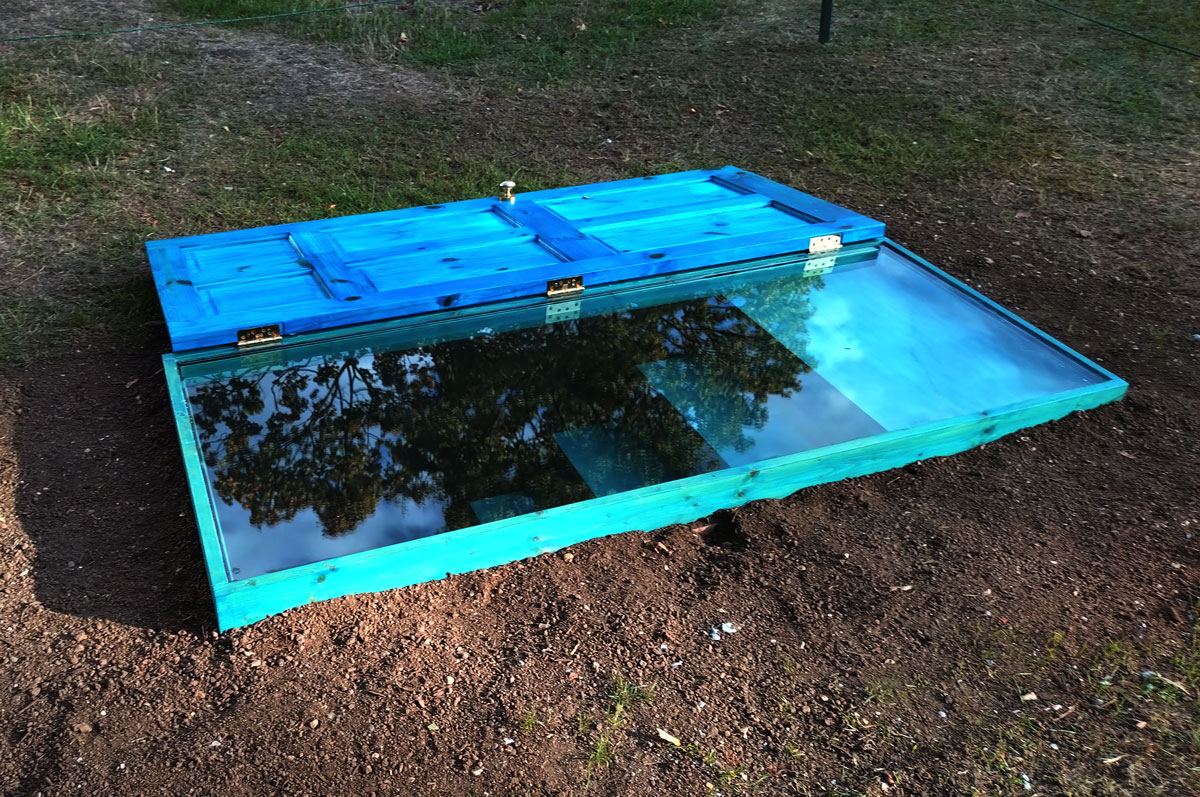
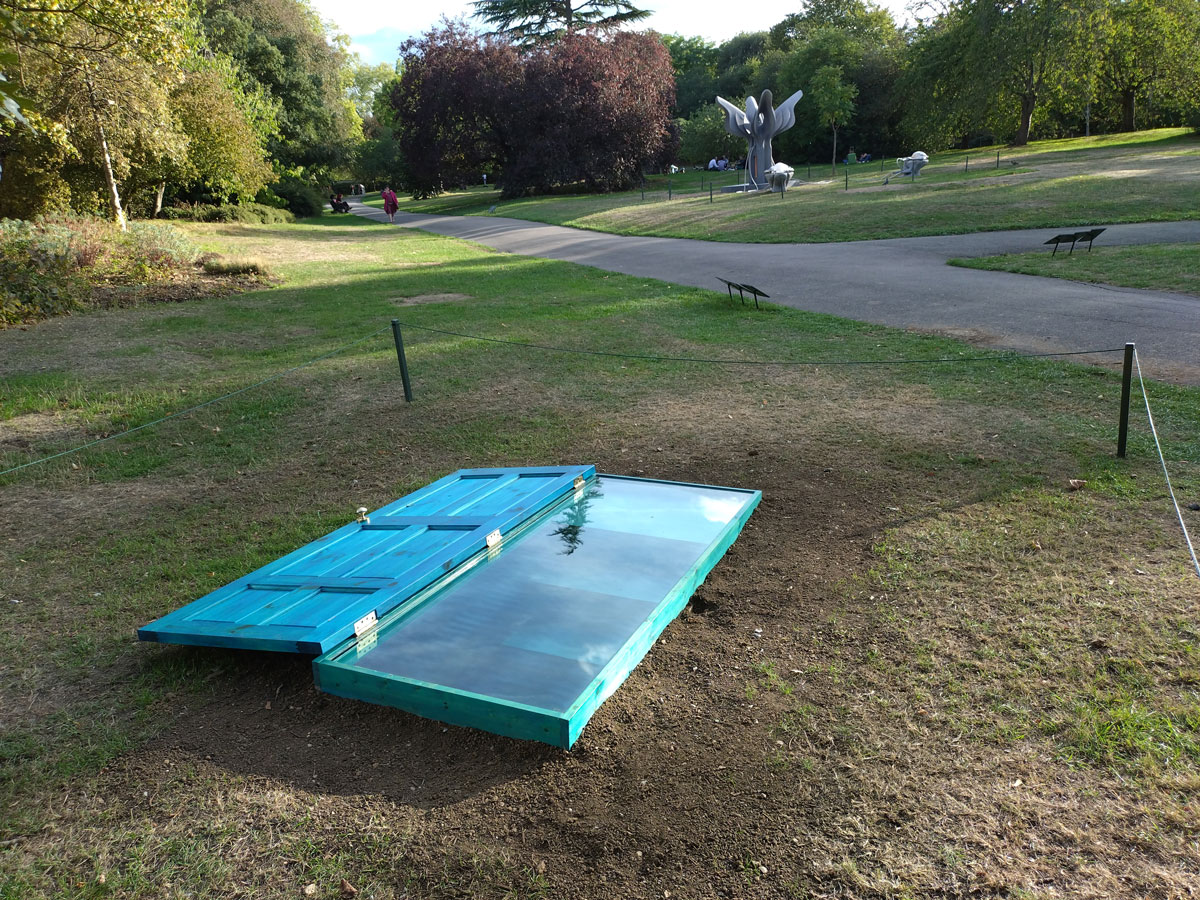
The doorway in the grass feels a little obvious, Angel Otero‘s, Dreams and Salt (2025-2026), it feels nice enough, kind of thing the sixteen year old me might have bought a postcard of. The piece is presented by the rather glossy Hauser & Wirth – “Angel Otero works with themes of memory, material transformation and the shifting nature of place. His practice examines how identity is shaped by movement, distance and return, and his paintings and sculptures often reflect this dynamic by balancing delicate and weightier forms and materials. Dreams and Salt features a plywood door embedded in the earth at an angle, left slightly ajar to reveal a short staircase leading downward. Familiar but dislocated…” and on we go (does it feel too much like an 90s Pink Floyd album cover idea the band rejected? does it feel too slick?)
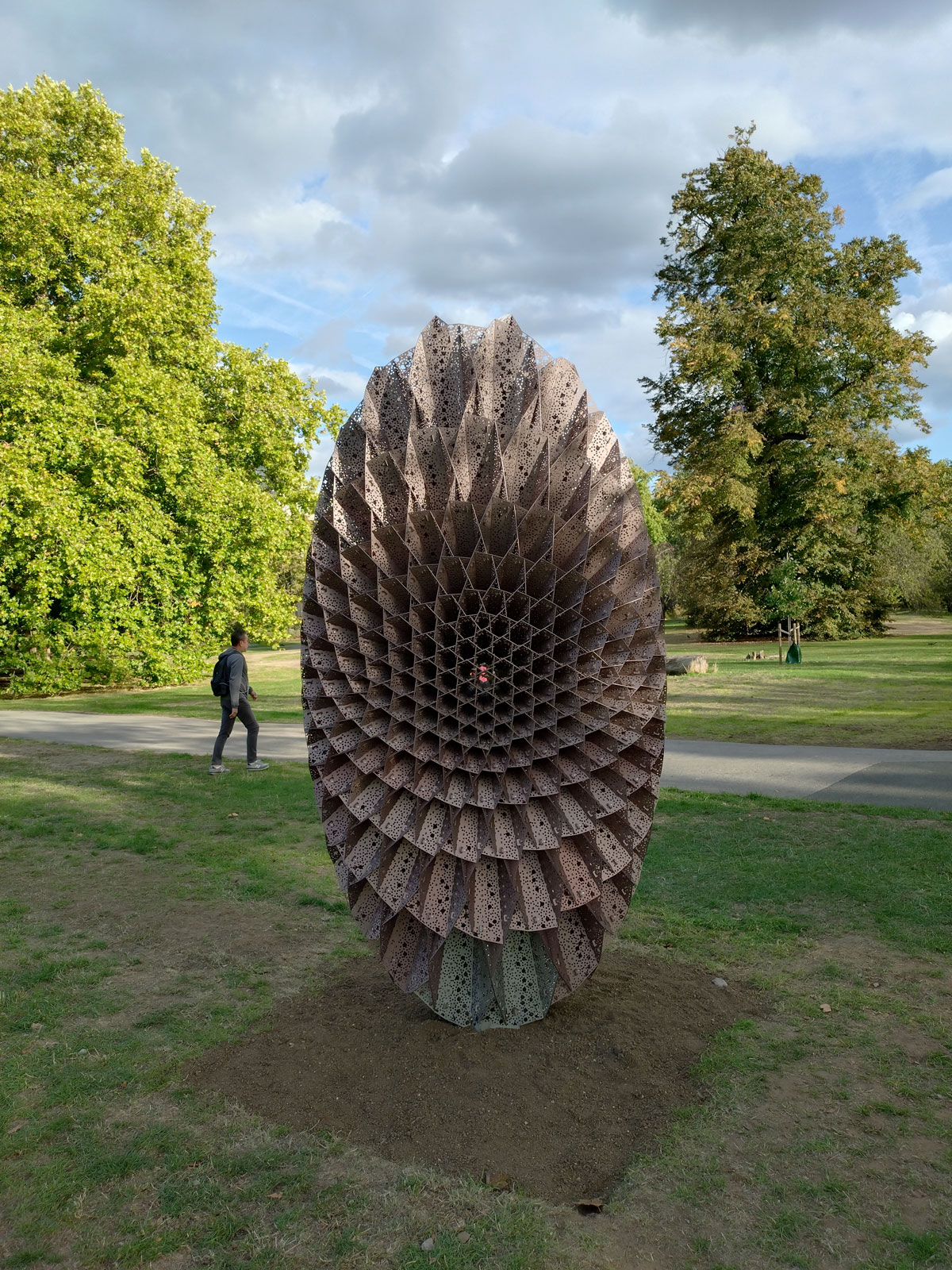
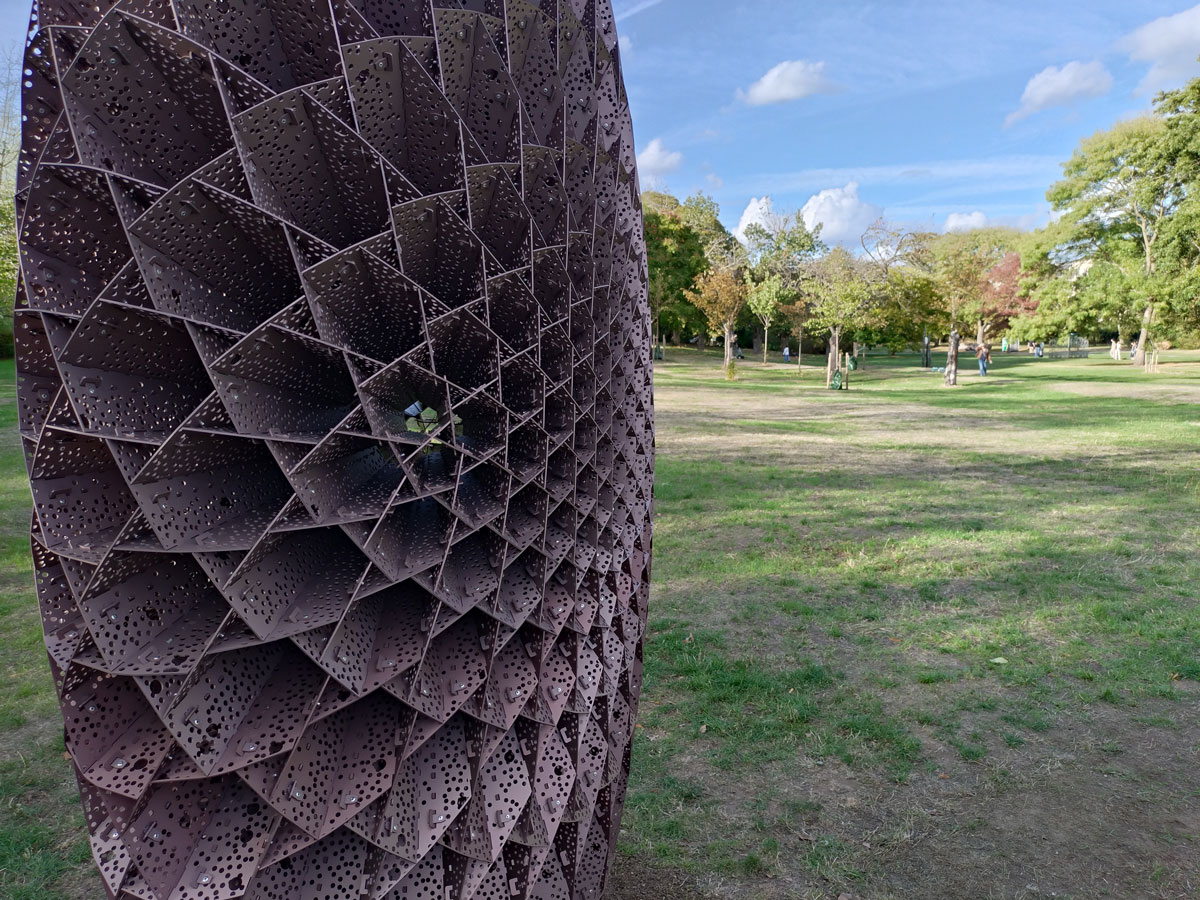
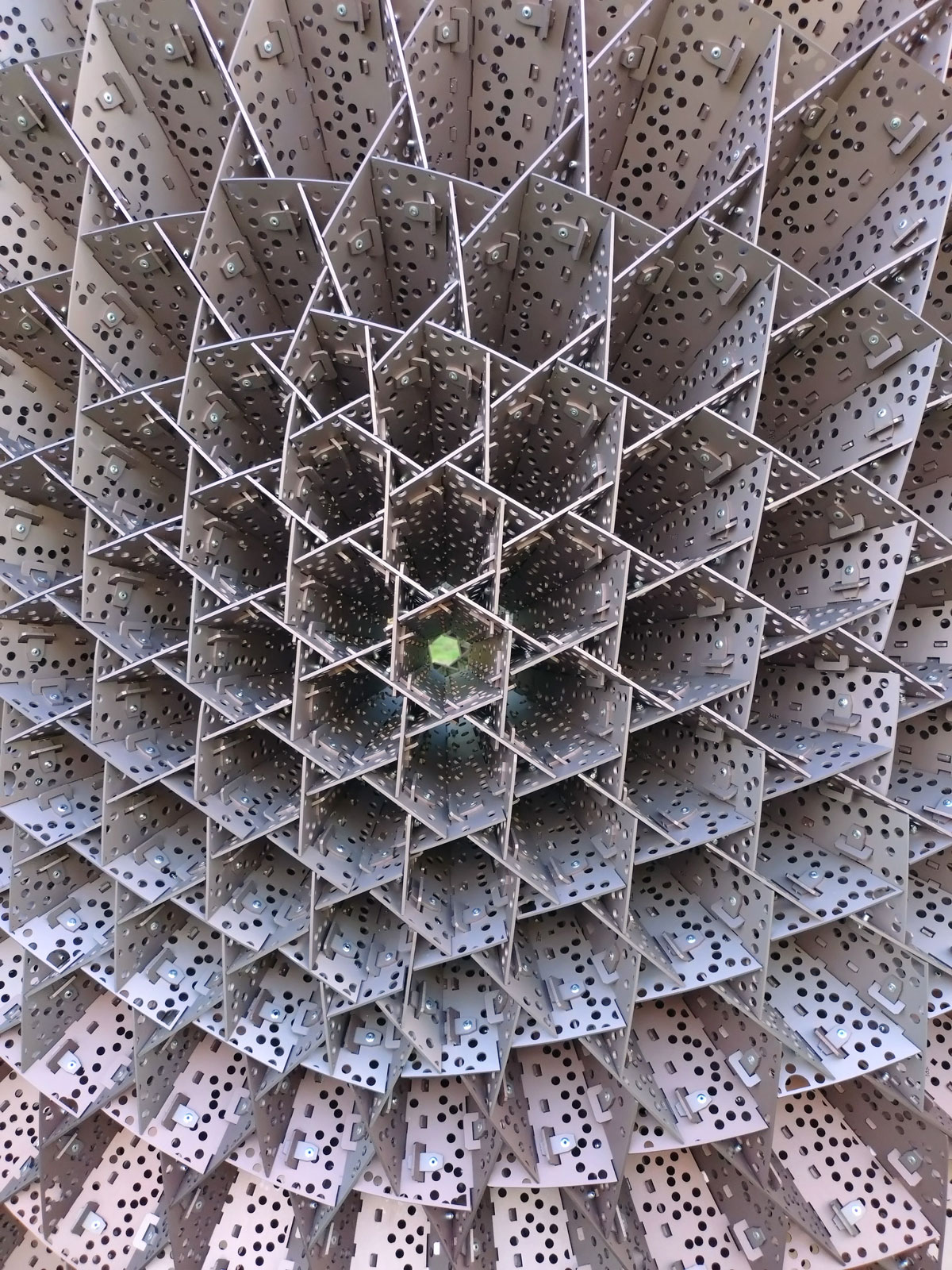
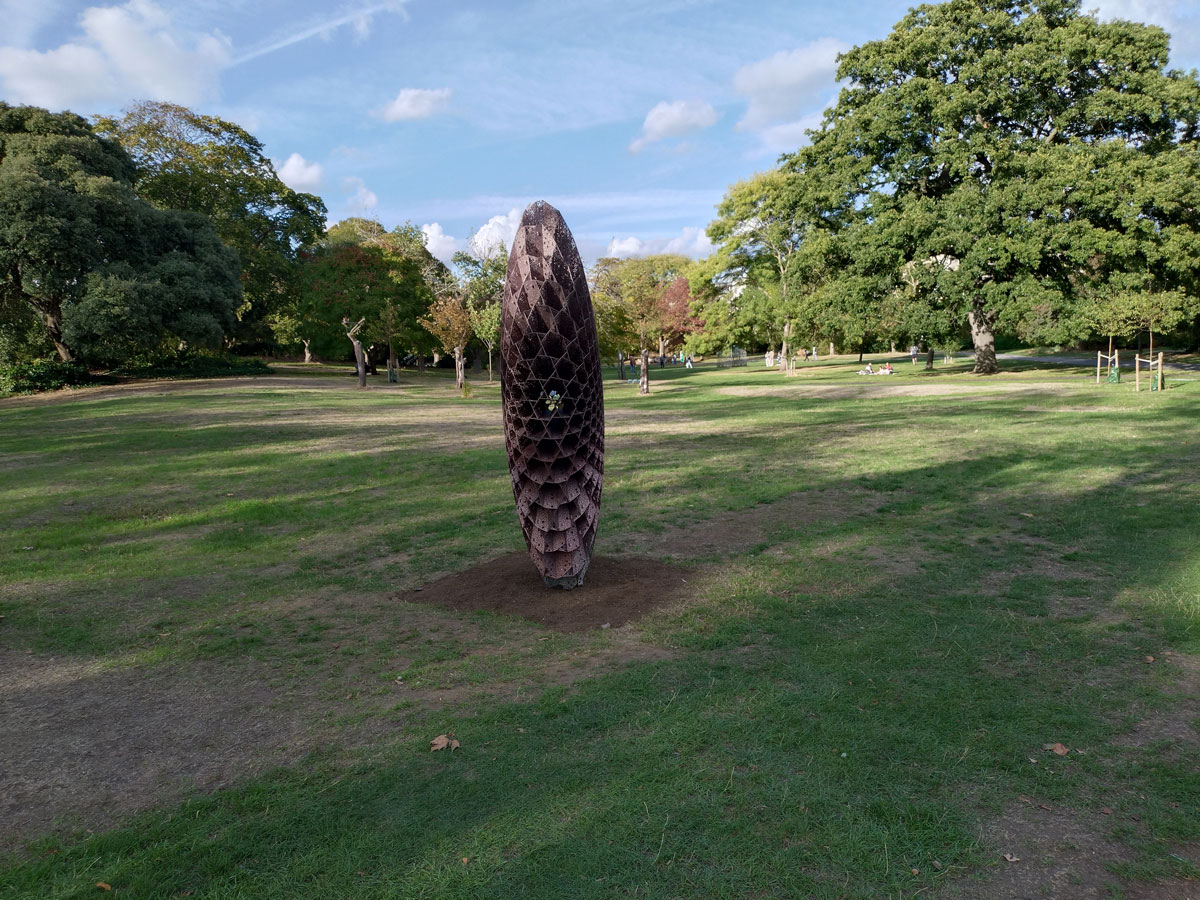
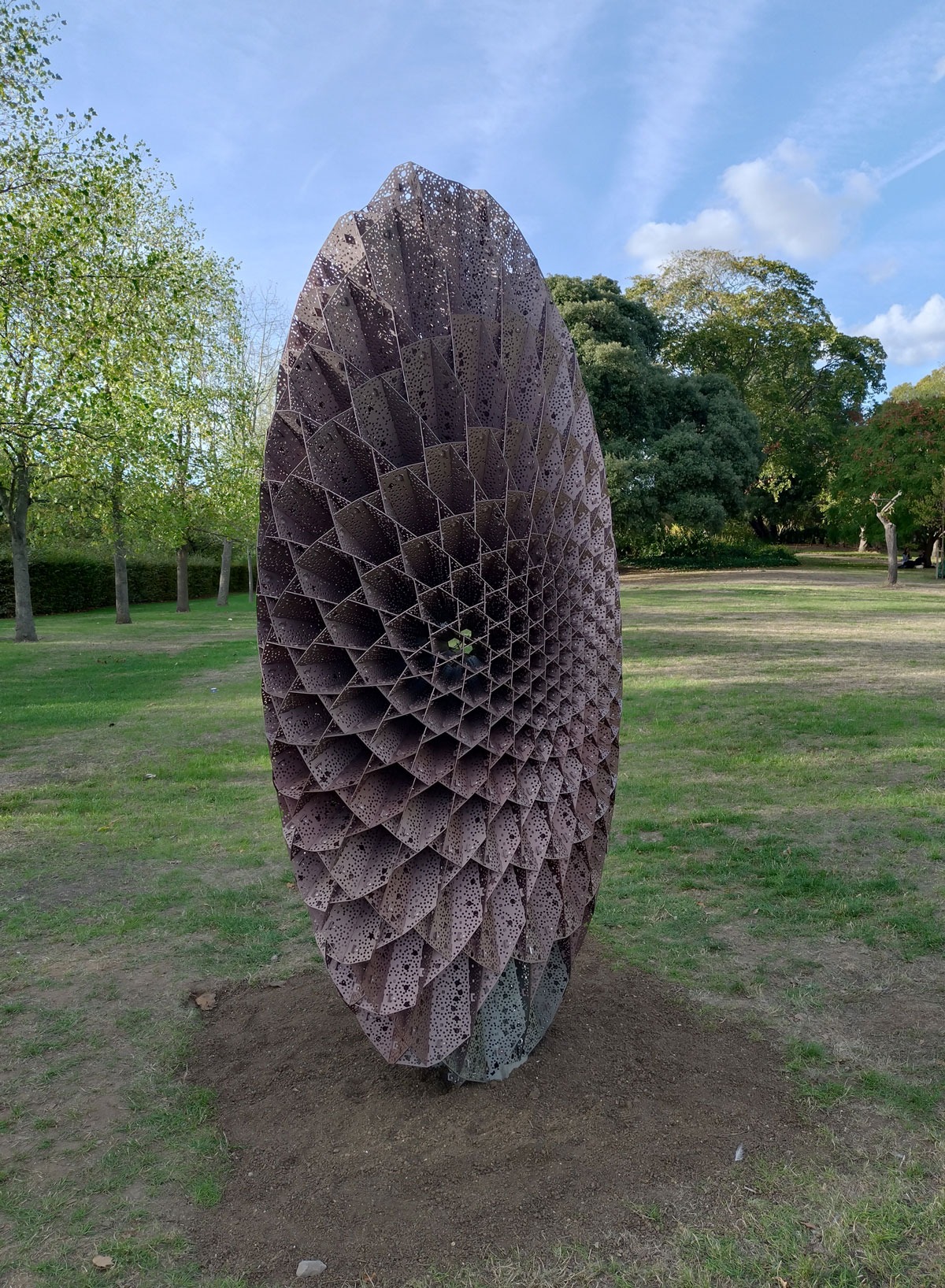
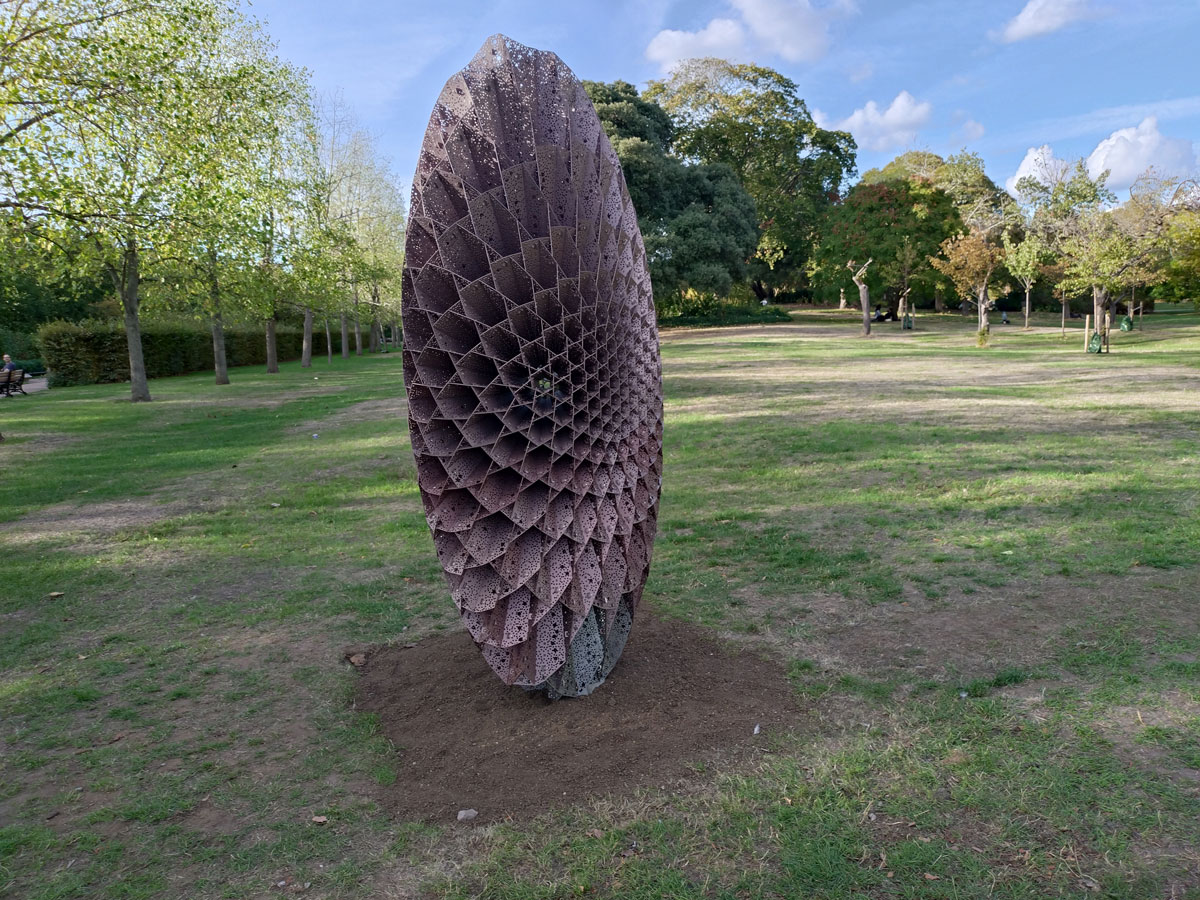
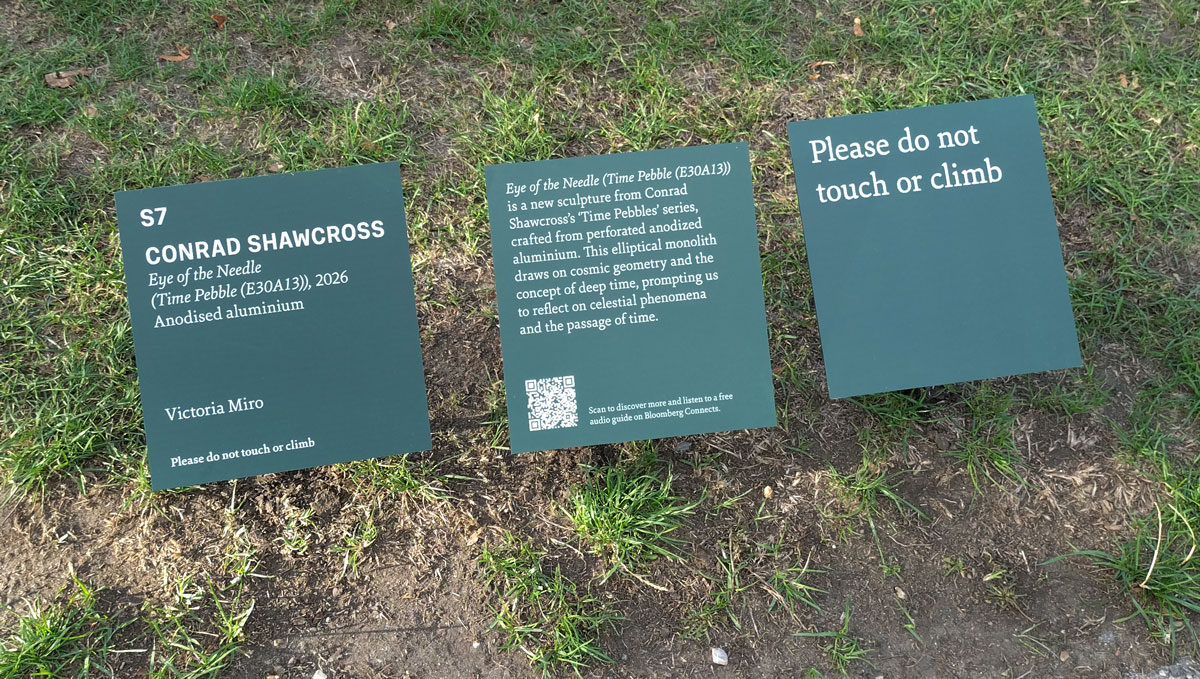
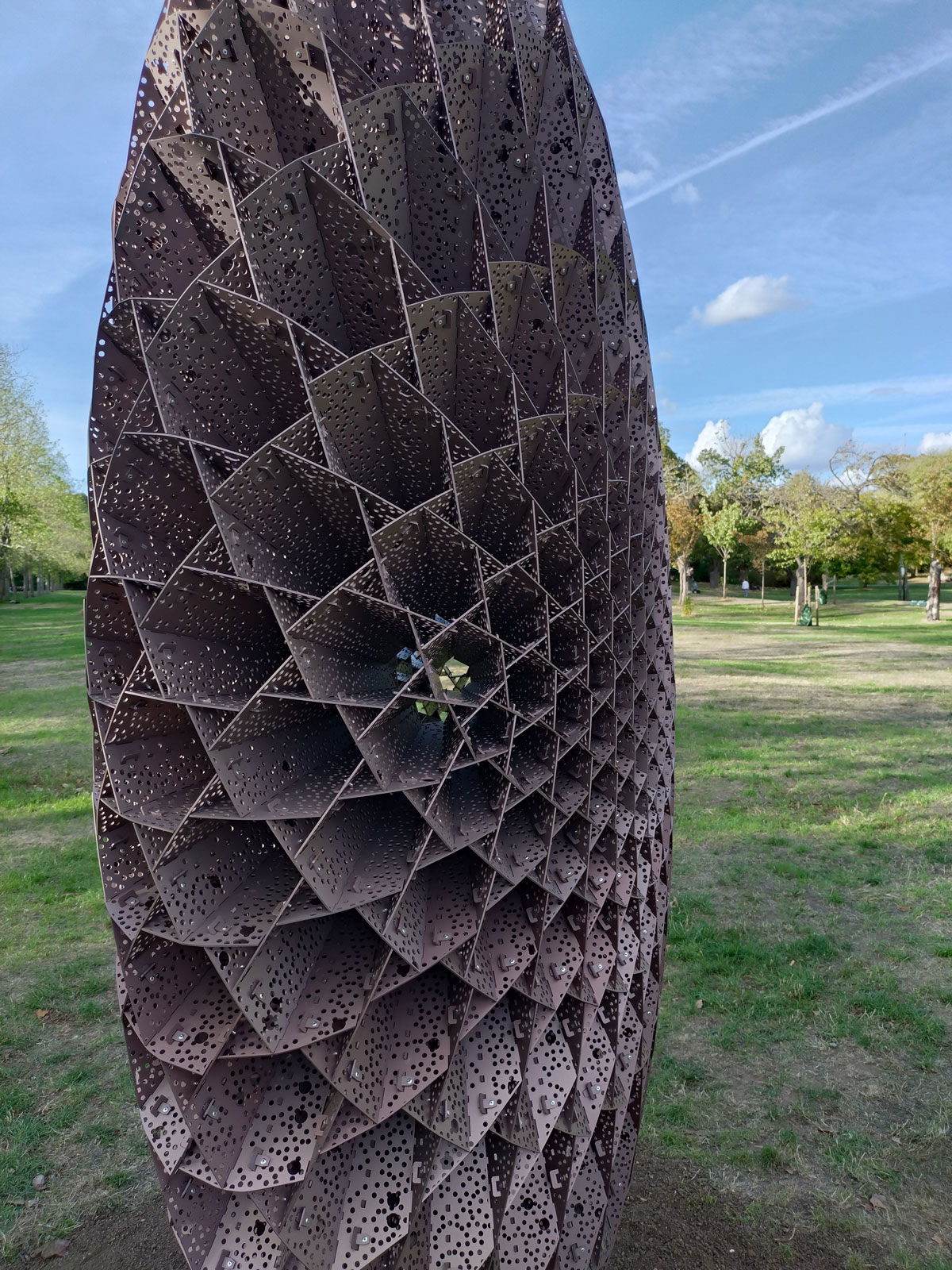
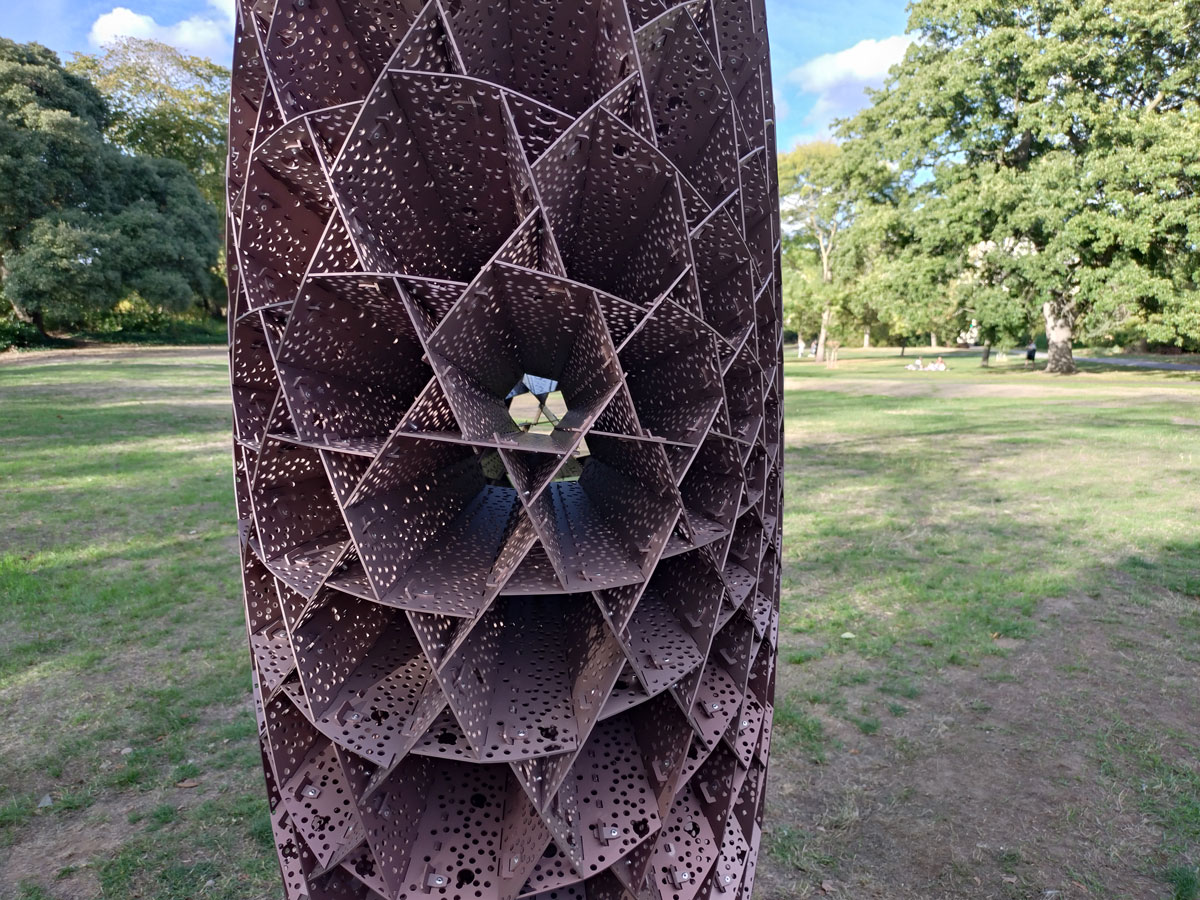
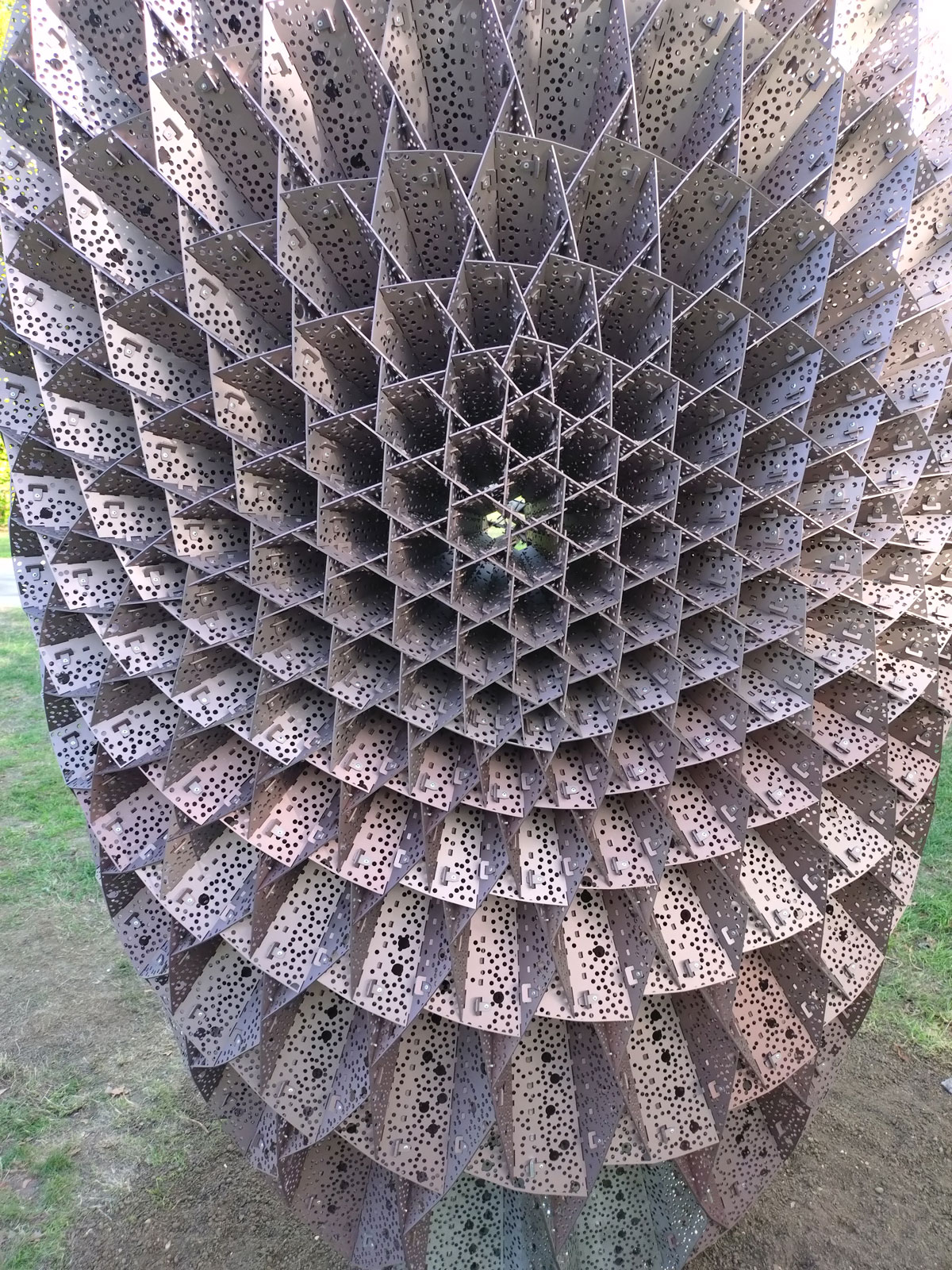
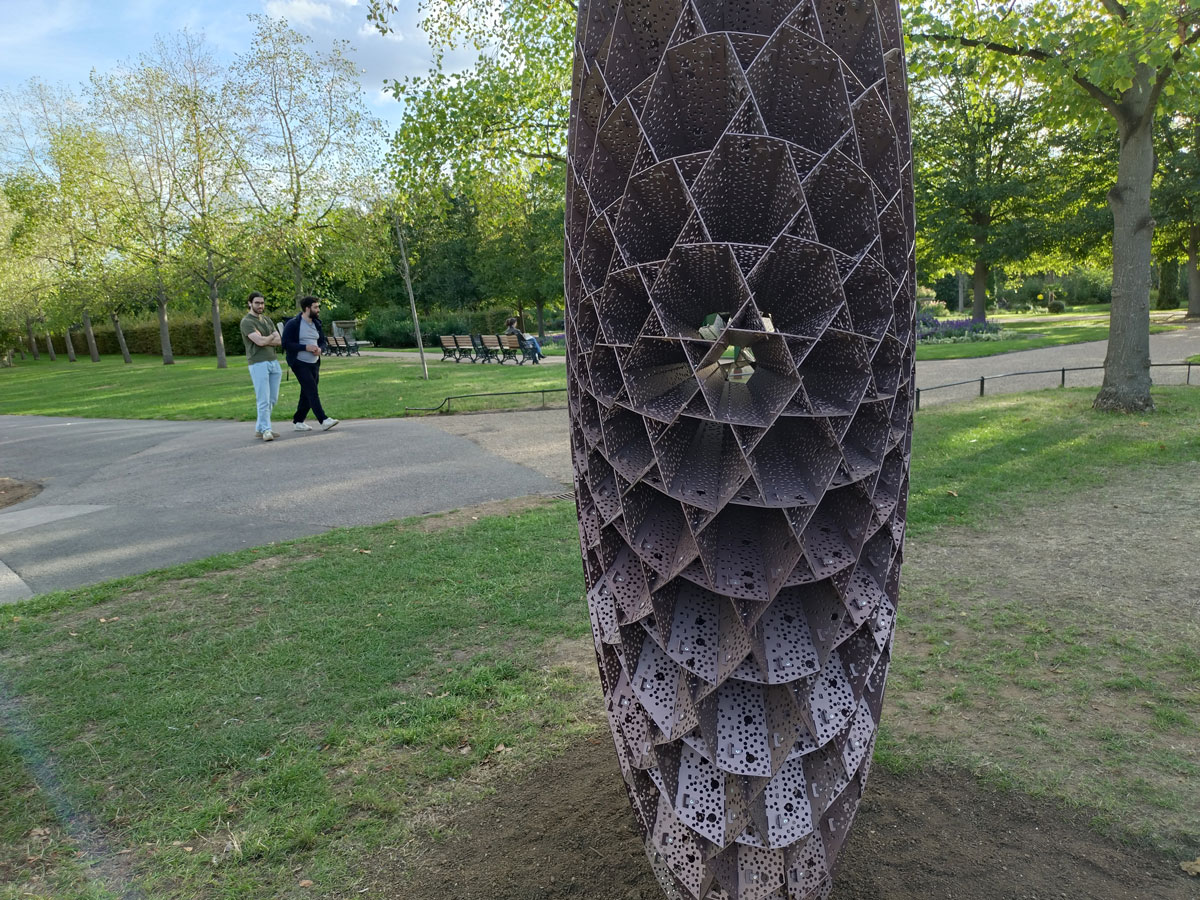
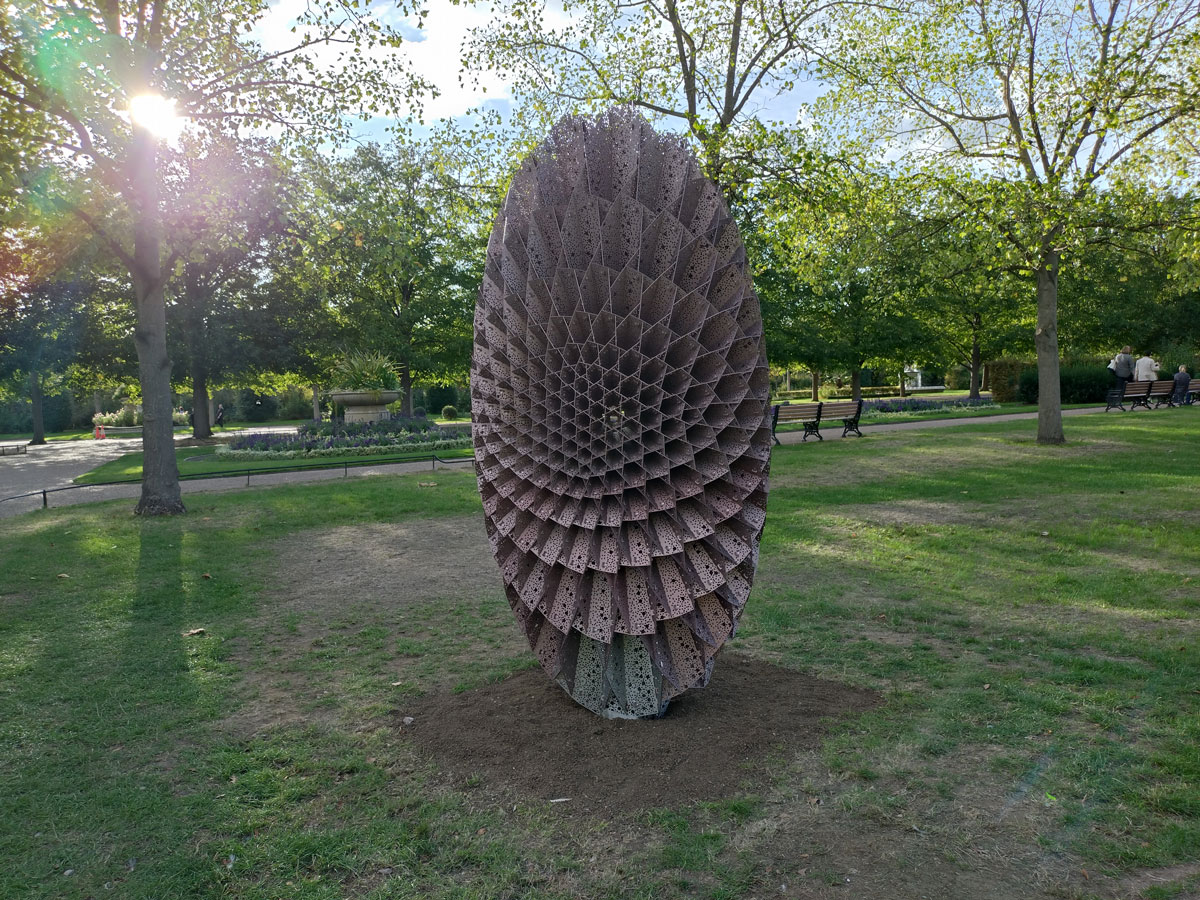
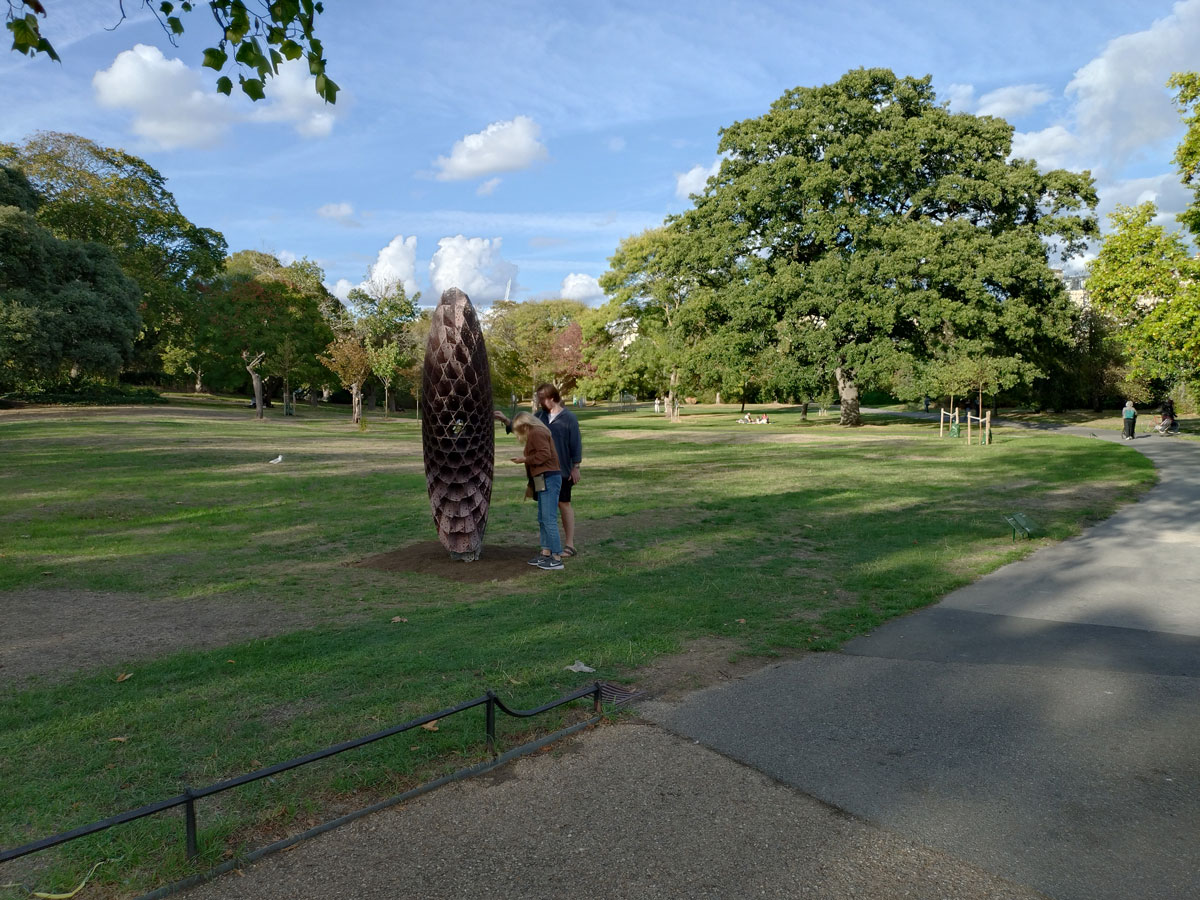
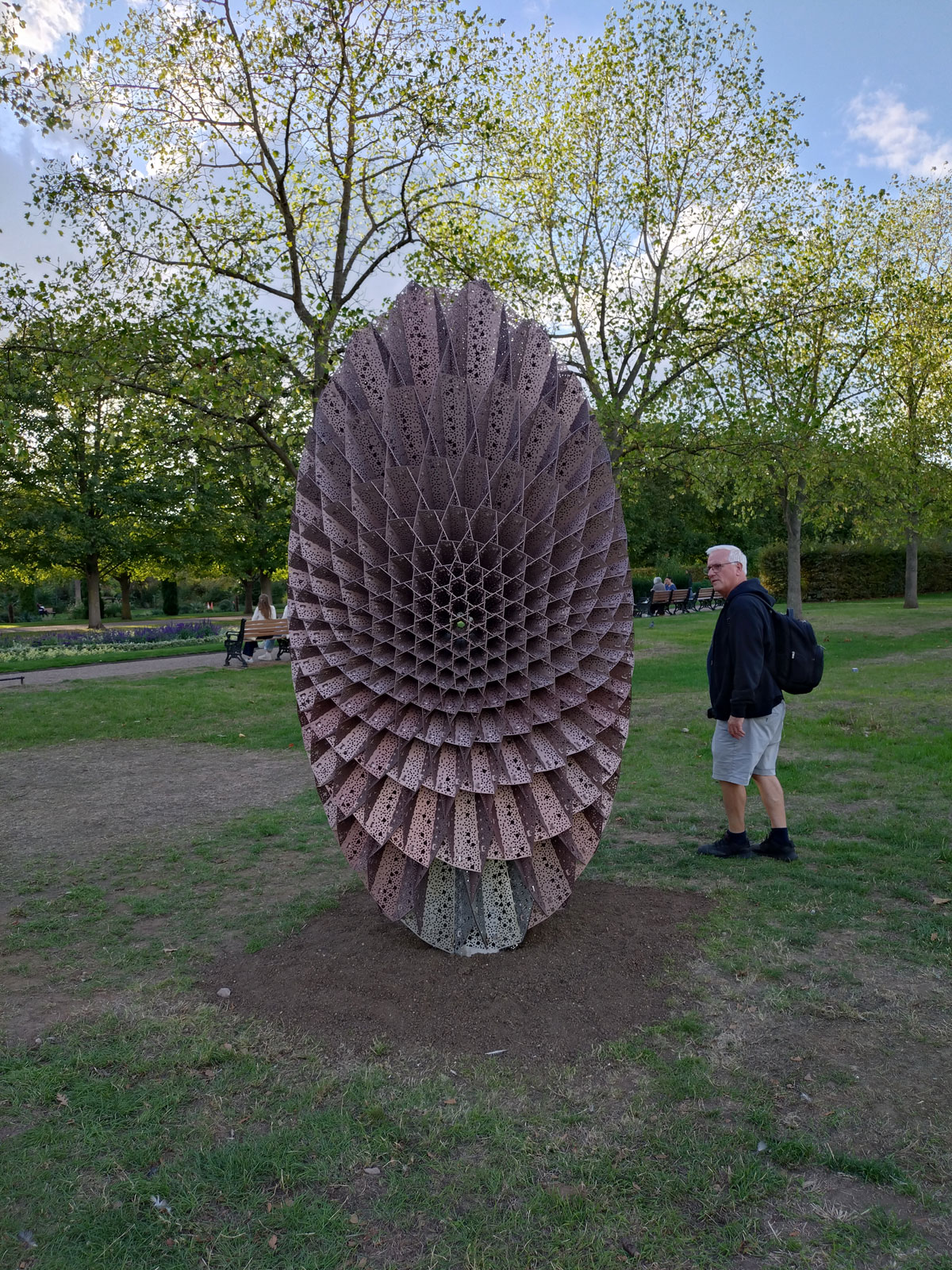
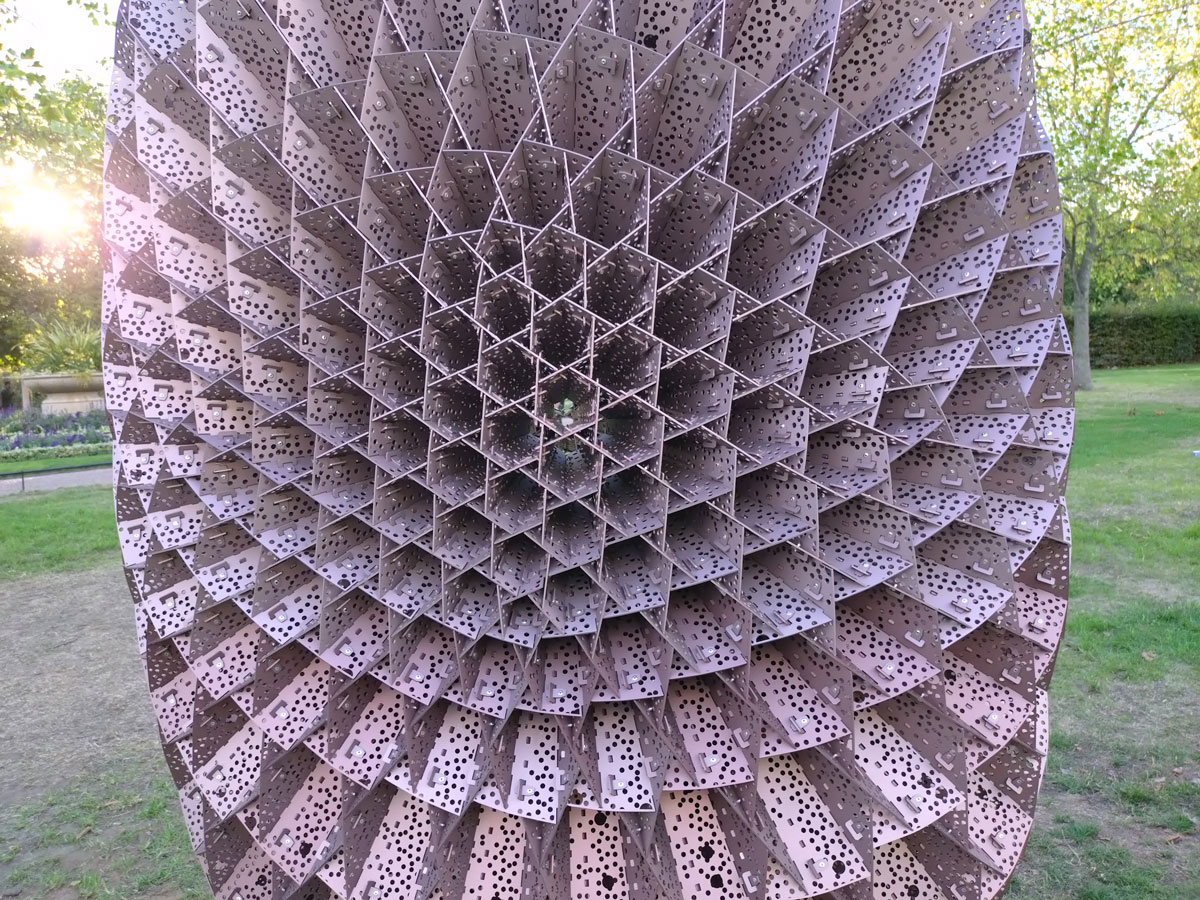
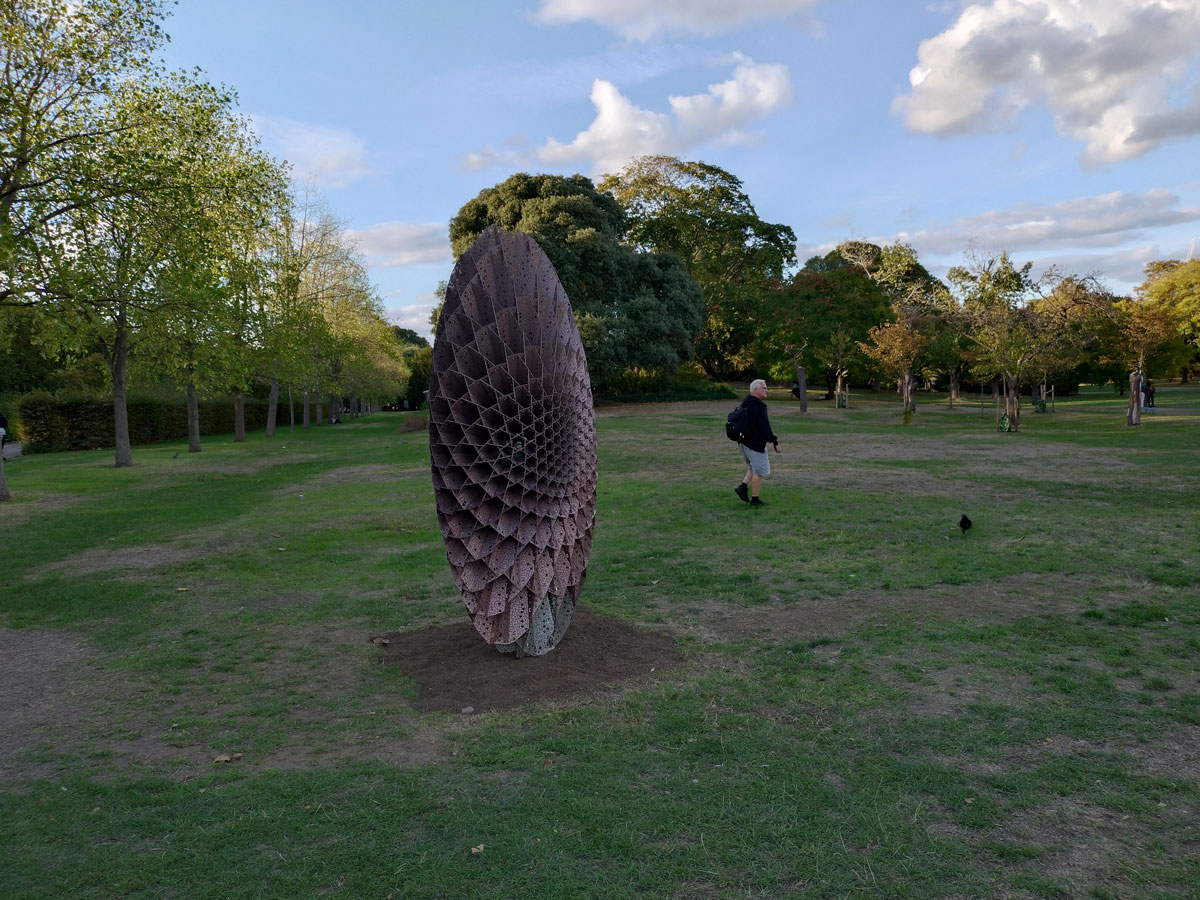
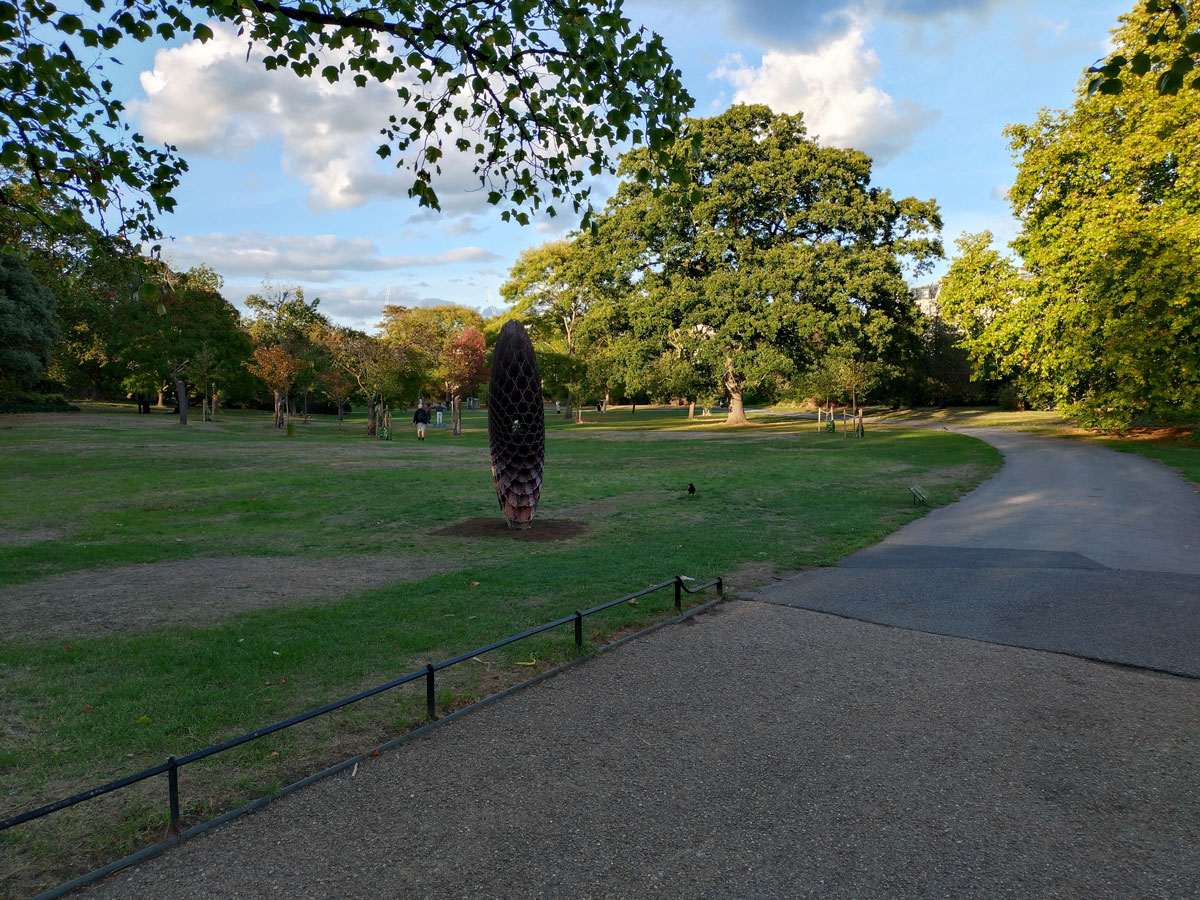
And even though I was trying to follow the map (and not miss anything) I did get drawn into Conrad Shawcross‘ Eye of the Needle (Time Pebble (E30A13)), 2026 a number of times – it is a piece just to enjoy. I don’t know if I care that much about what it says (and know well Victoria Miro, the London Gallery who are presenting this piece couldn’t care less about what I might say on these pages, they have politely told me that much…). On the most basic of levels I do really really like walking around the piece, I like looking though it, stepping right up to it, stepping back from it – “Shawcross continues to explore themes such as the Big Bang and the origins of time through geometry. His installations evoke the ancient mysteries of the cosmos and challenge conventional temporal boundaries through continuously shifting forms. By merging cosmic geometry with dynamic light patterns, the artist transforms our interpretation of cosmic events into a tangible, immersive experience”
– I just kind of like the way it looks, I really really (really) like it, a pretty piece, satisfying, I loved taking photos of it, wonder if it would fit on my coffee table although there is no room for anything like the notion of a coffee table or indeed coffee table art here in the Organ bunker. It was a rather nice piece (someone once said to me if someone calls you art nice then best to just throw it away, I didn’t mean nice as an insult this time)
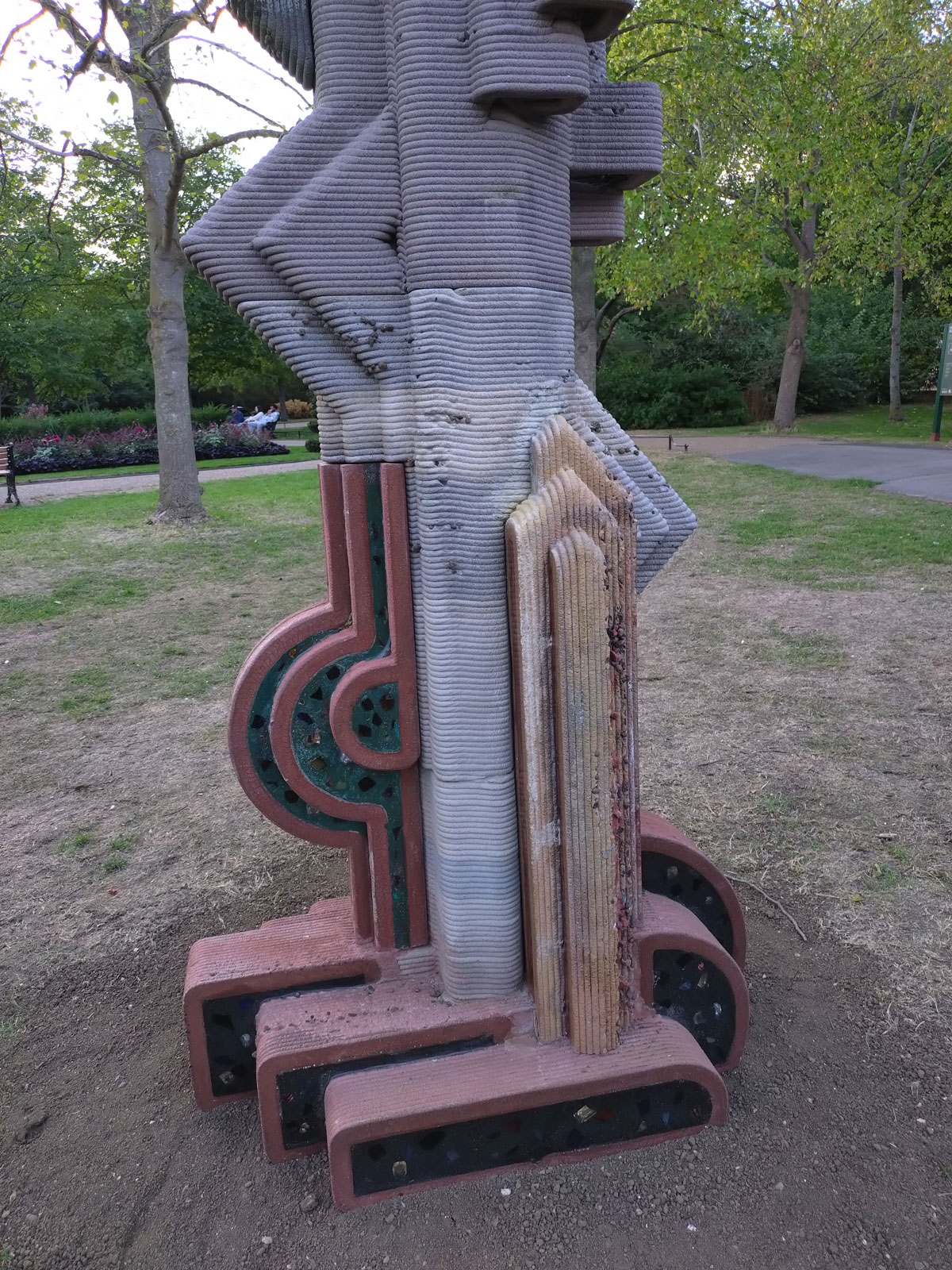
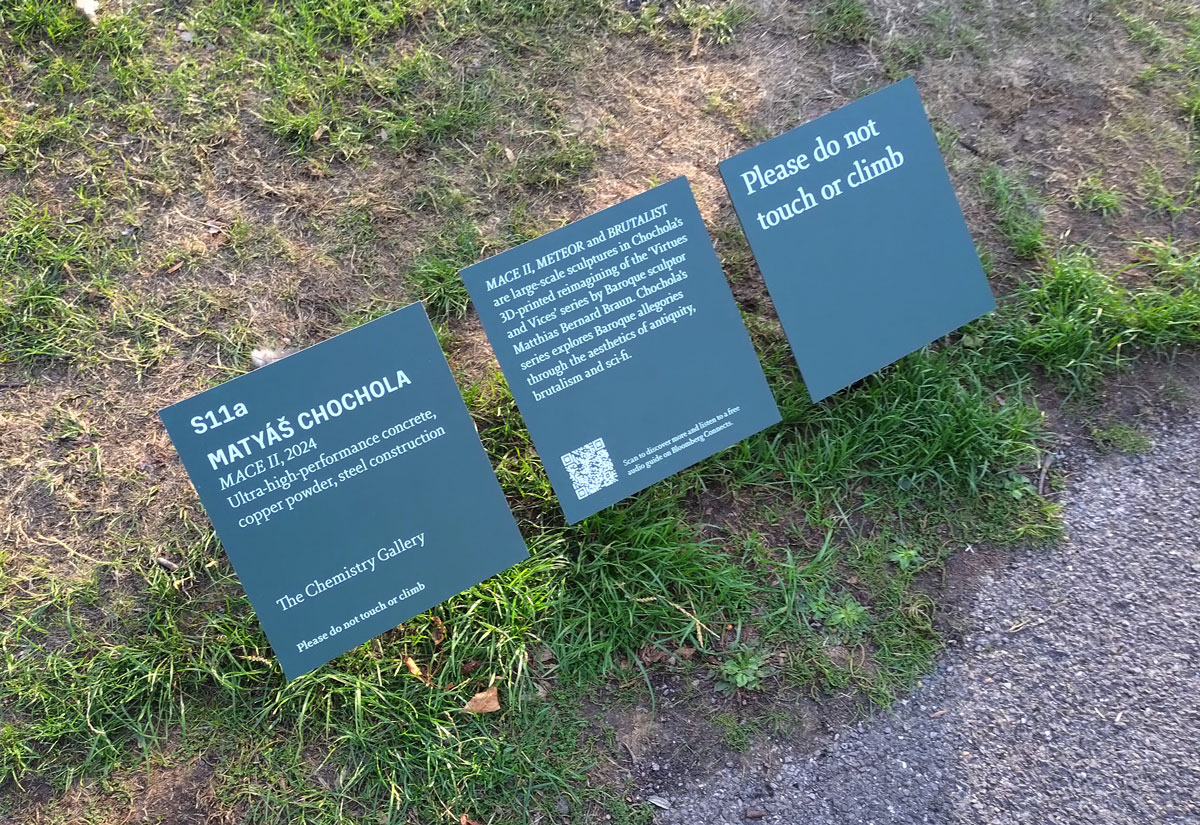
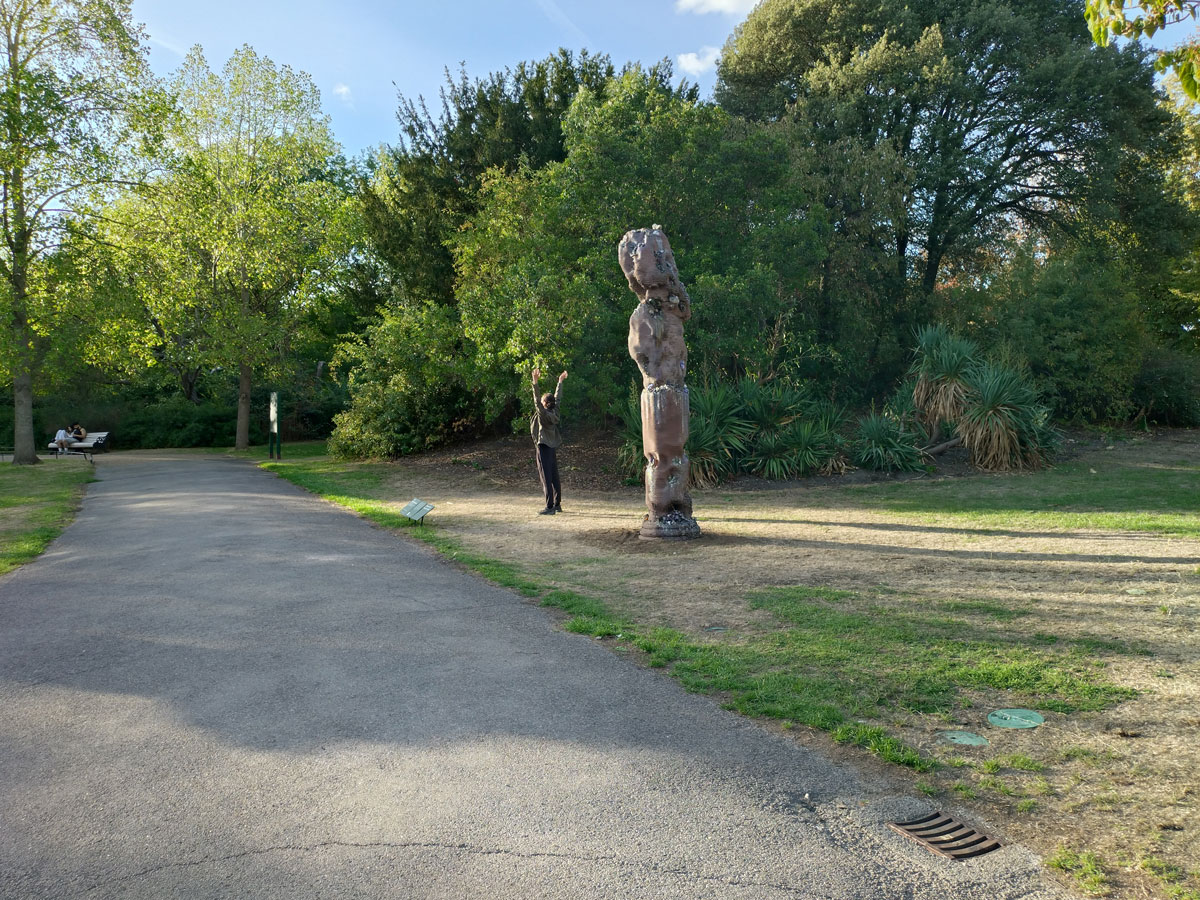
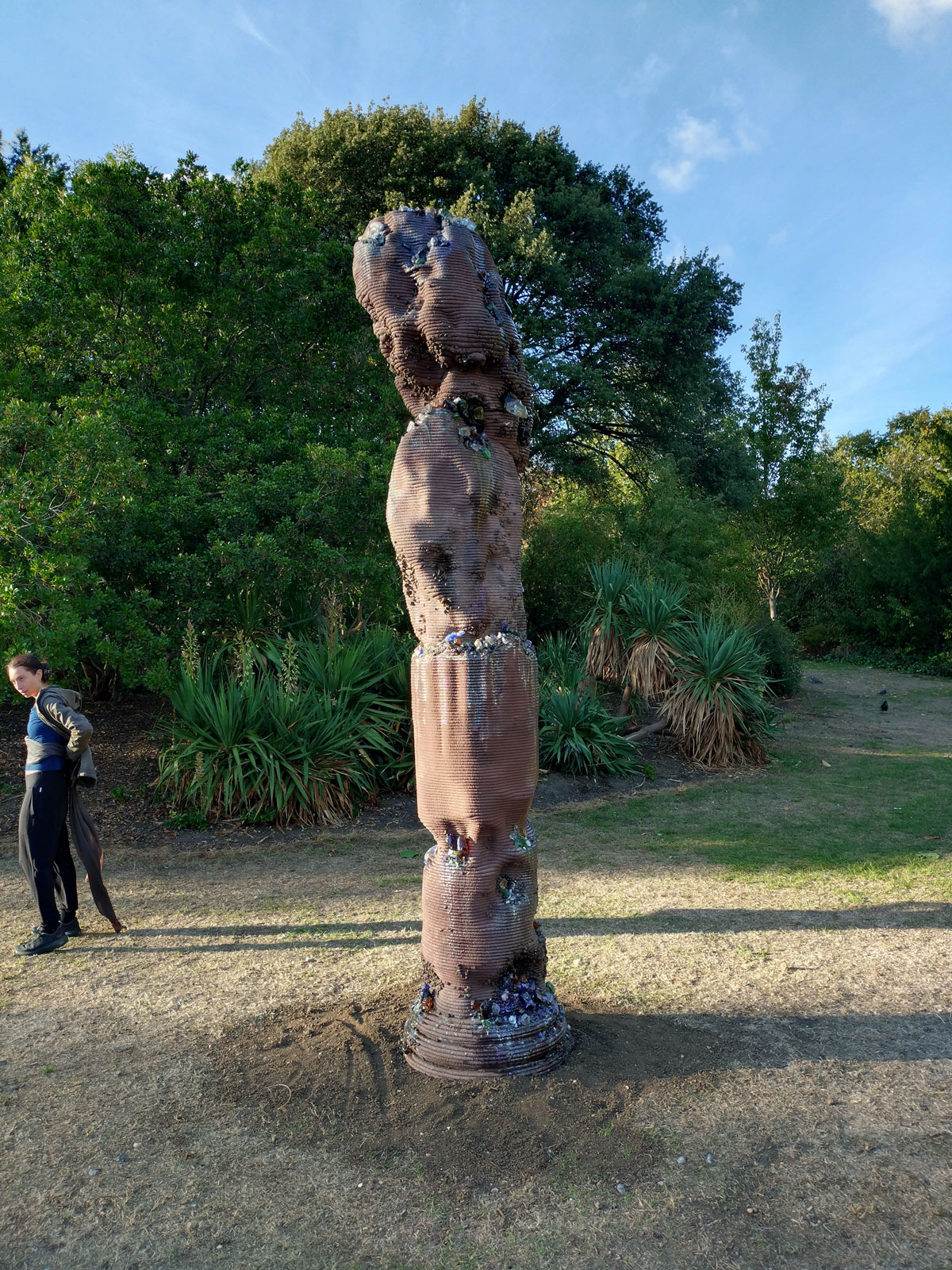
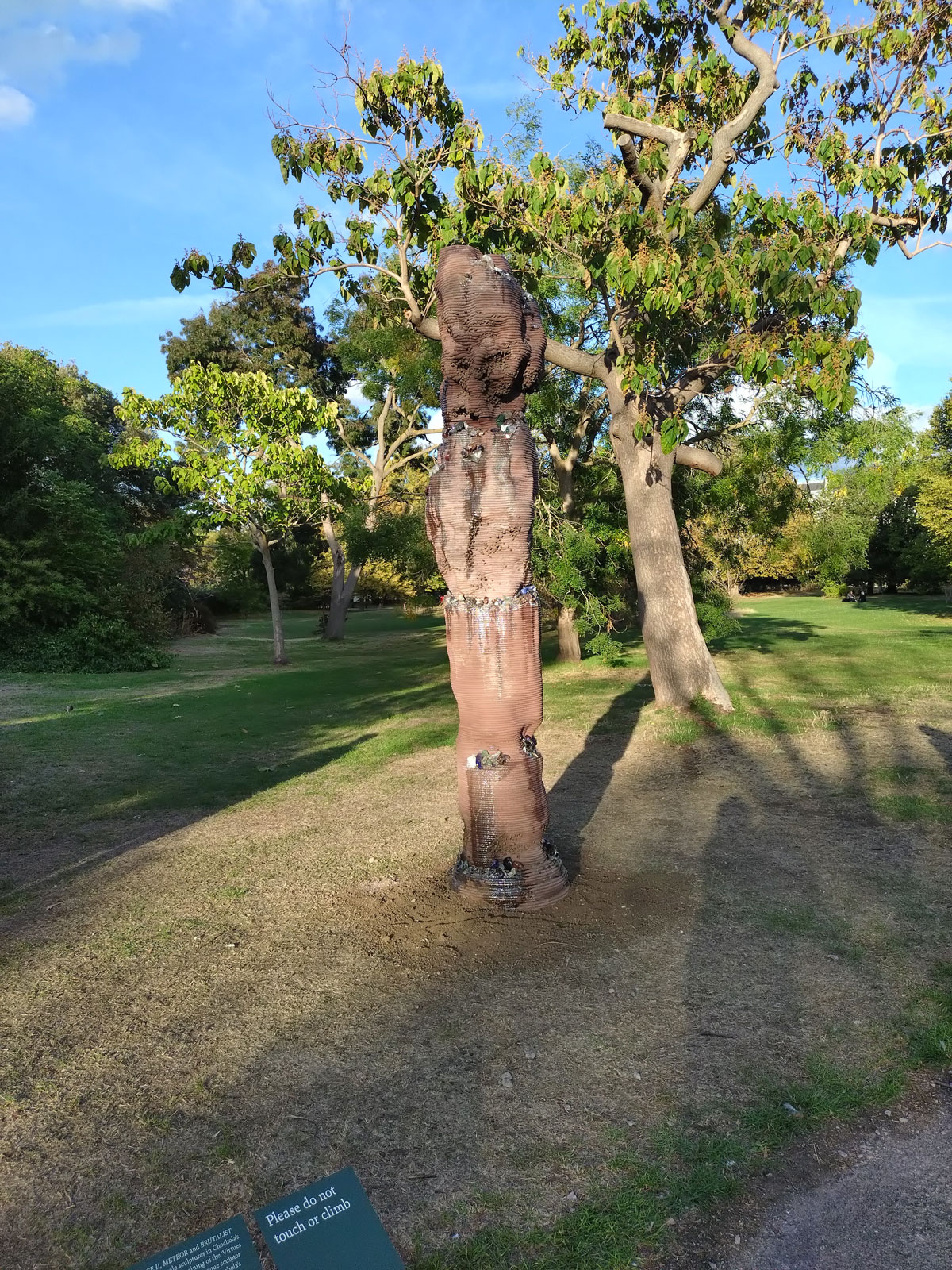
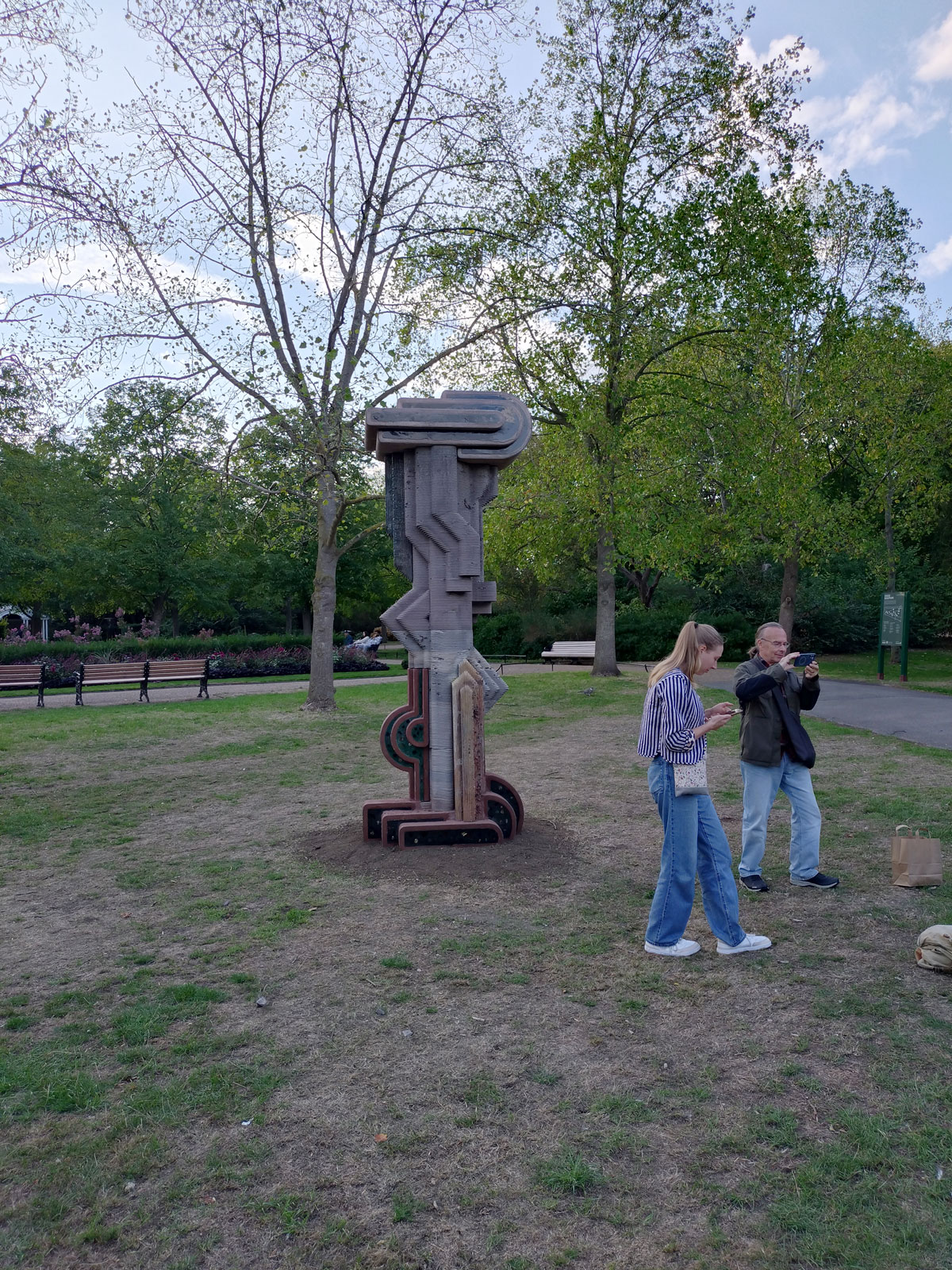
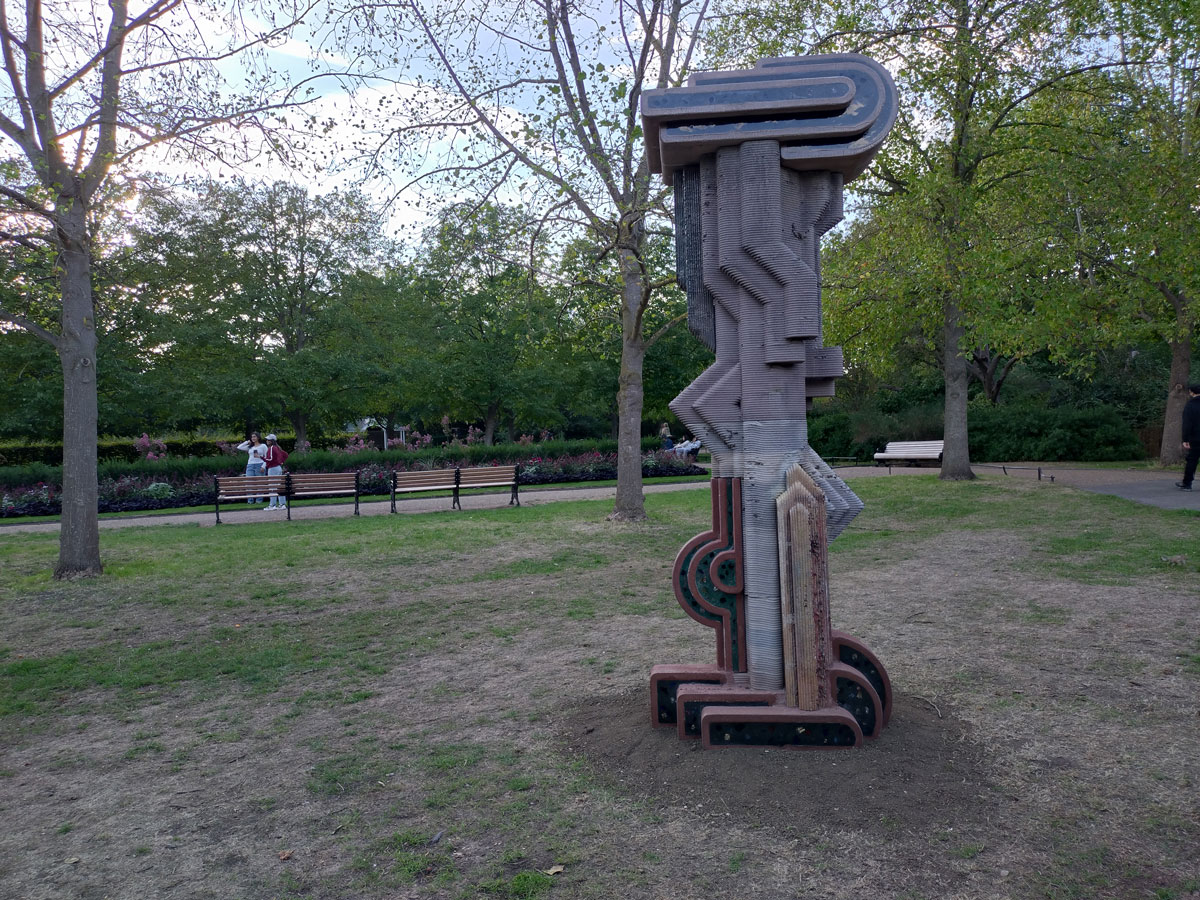
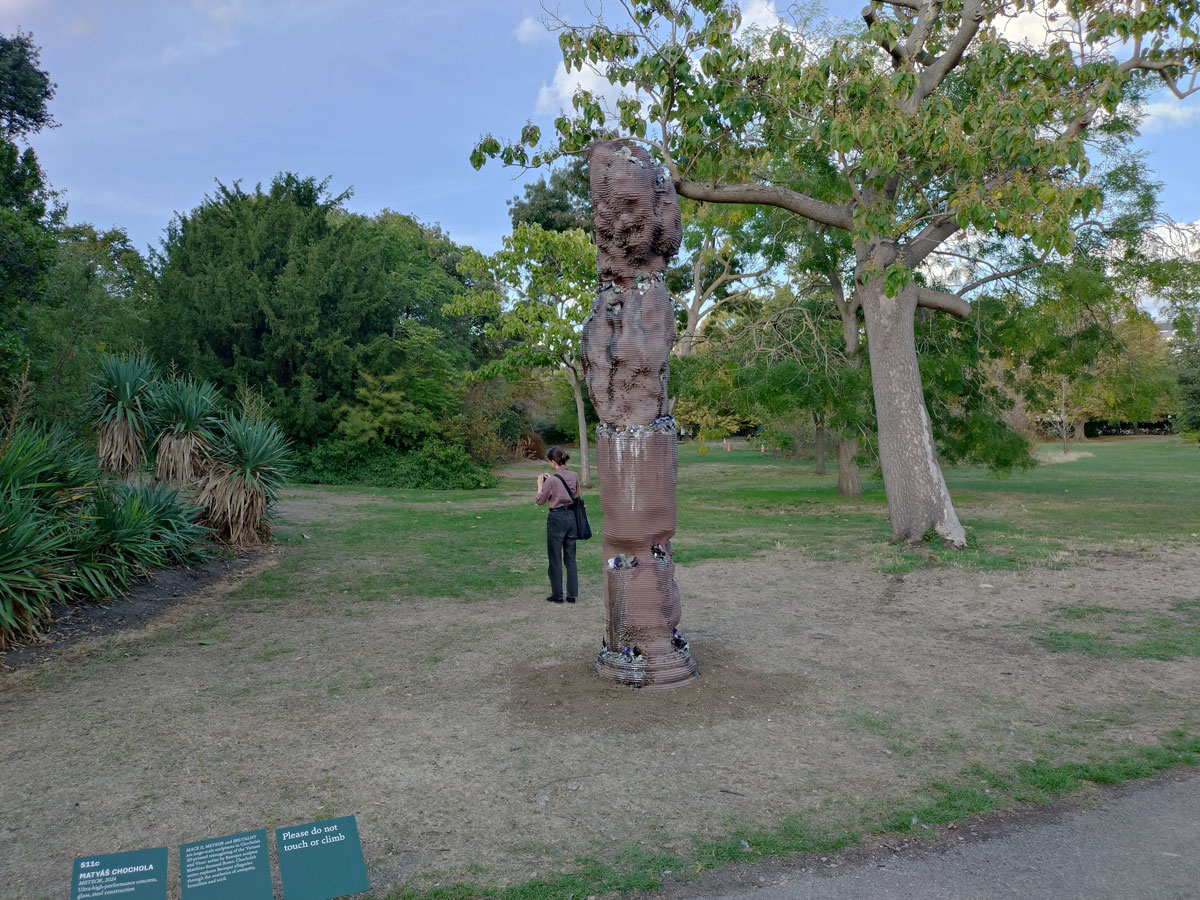
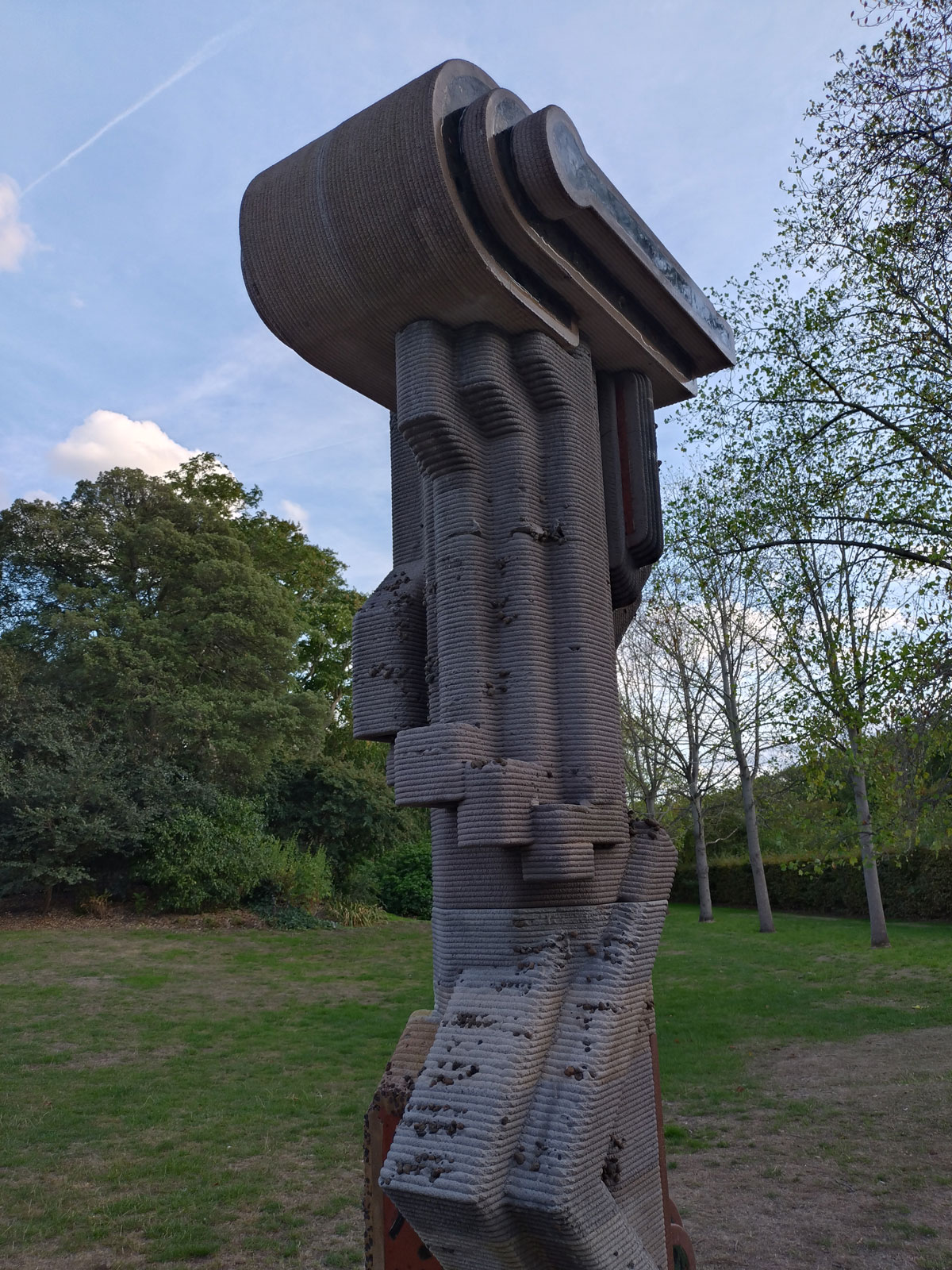
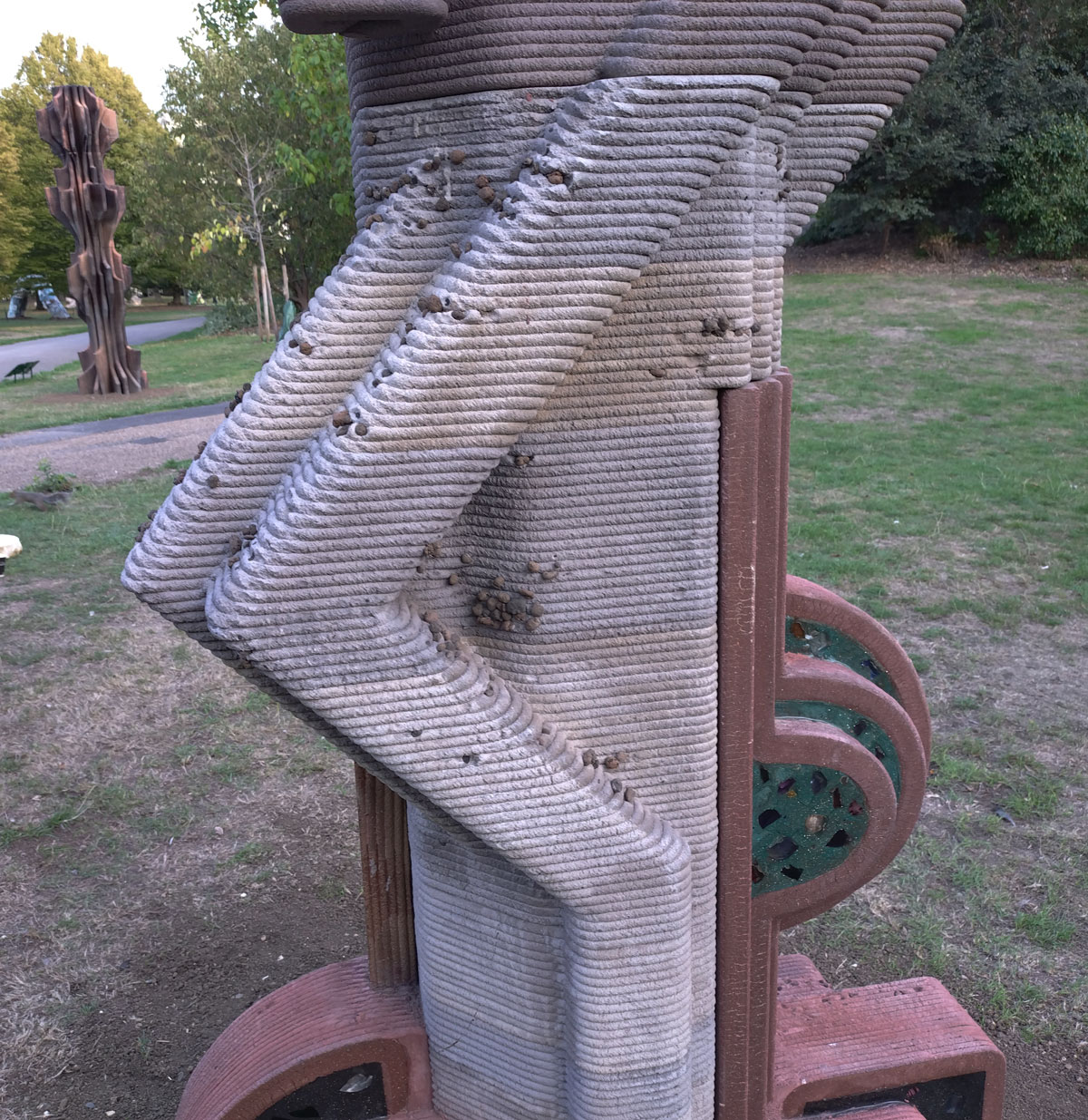
Matyáš Chochola has three pieces at one of the junctions of the concrete paths that take us through the park, Meteor, Brutalist and Mace II date from 2024, part of a series of twelve so he is happy to tell me as the artist (from Prague) politely say hello. There seems to be quite a few people gathered around the three poles, there’s a drummer and a couple of musicians who have decided without invitation that this is the place to be, the artist seems happy with that, there appears to be connections being made.
Presented by The Chemistry Gallery (from Prague, Czech Republic); “These three large-scale sculptures from a series of twelve by Matyáš Chochola were created using an innovative 3D concrete printing technology, developed in collaboration with Czech manufacturing company Voxell. The works were further developed through extensive material and structural experimentation. The series reimagines Matthias Bernard Braun’s 1718–20 Baroque sculptural series Virtues and Vices, turning the originals into an ensemble of cryptic totems, exploring timeless human qualities”. By the time we get to Matyas Chocola pieces the shadows being vast by the trees really are becoming part of things. They are three strong pieces, they are strong as pieces by themselves, you can’t ignore the conversations between the three of them though, they really do engage, I really wanted to touch them, rather glad I didn’t, I am still wonder what touching them would have been like, I kind of like that I don’t know…
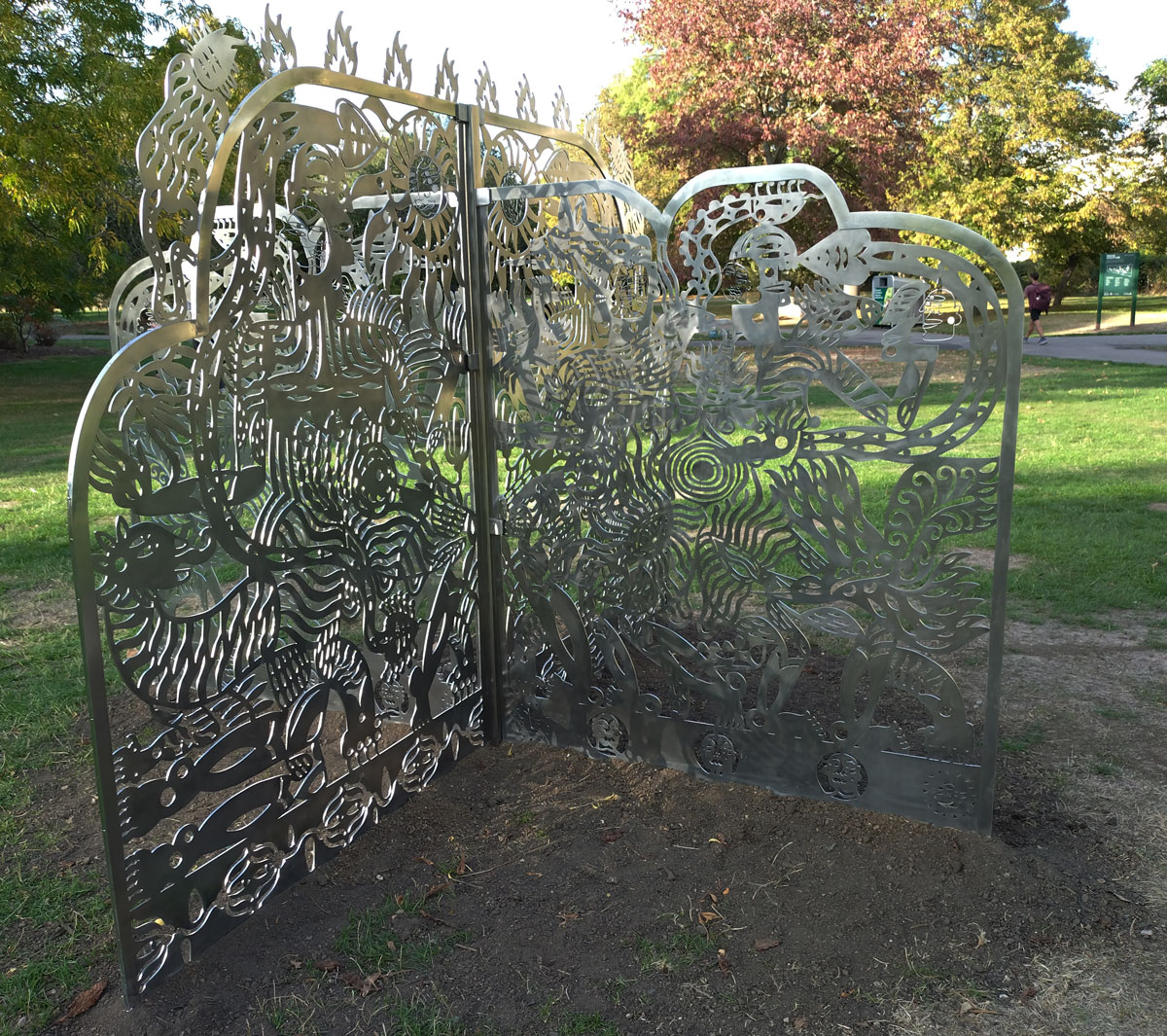
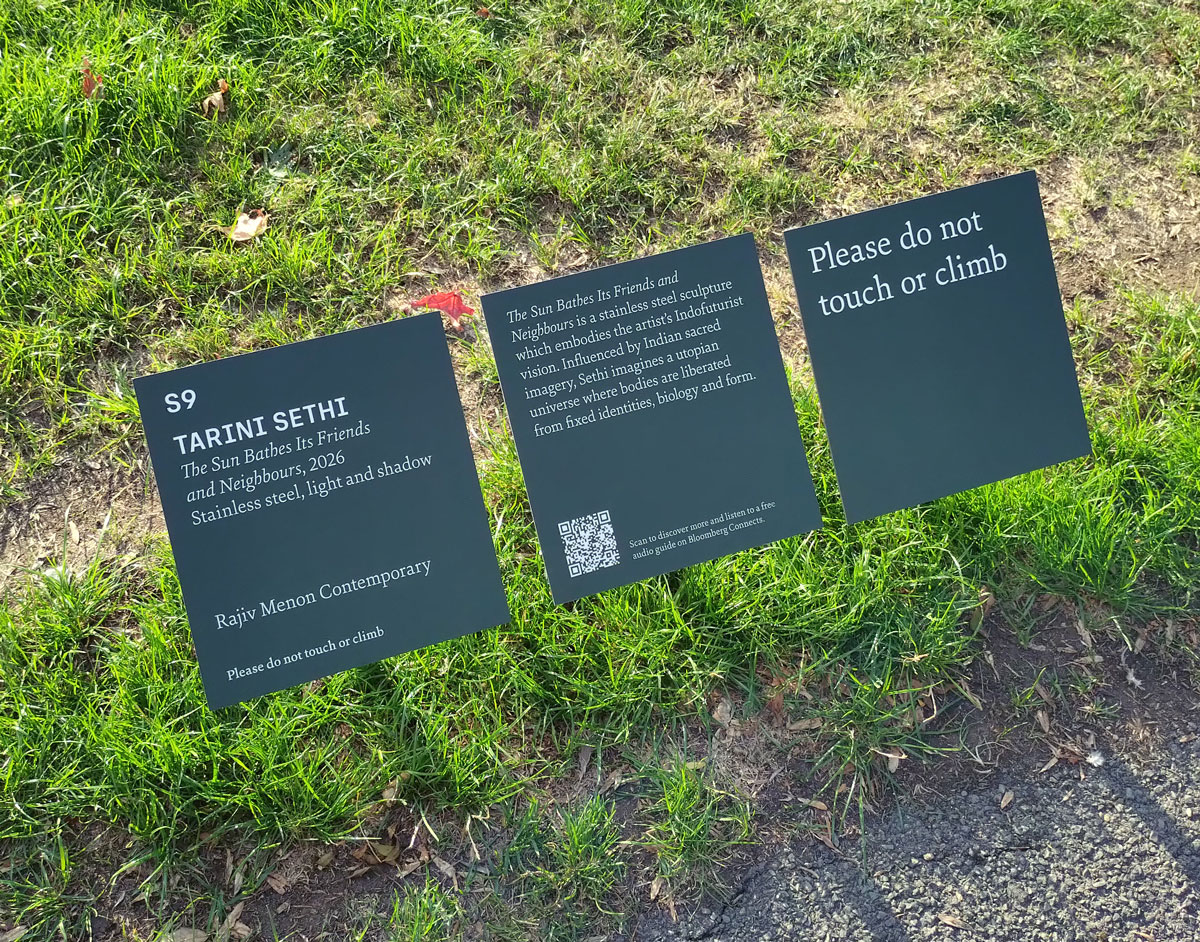
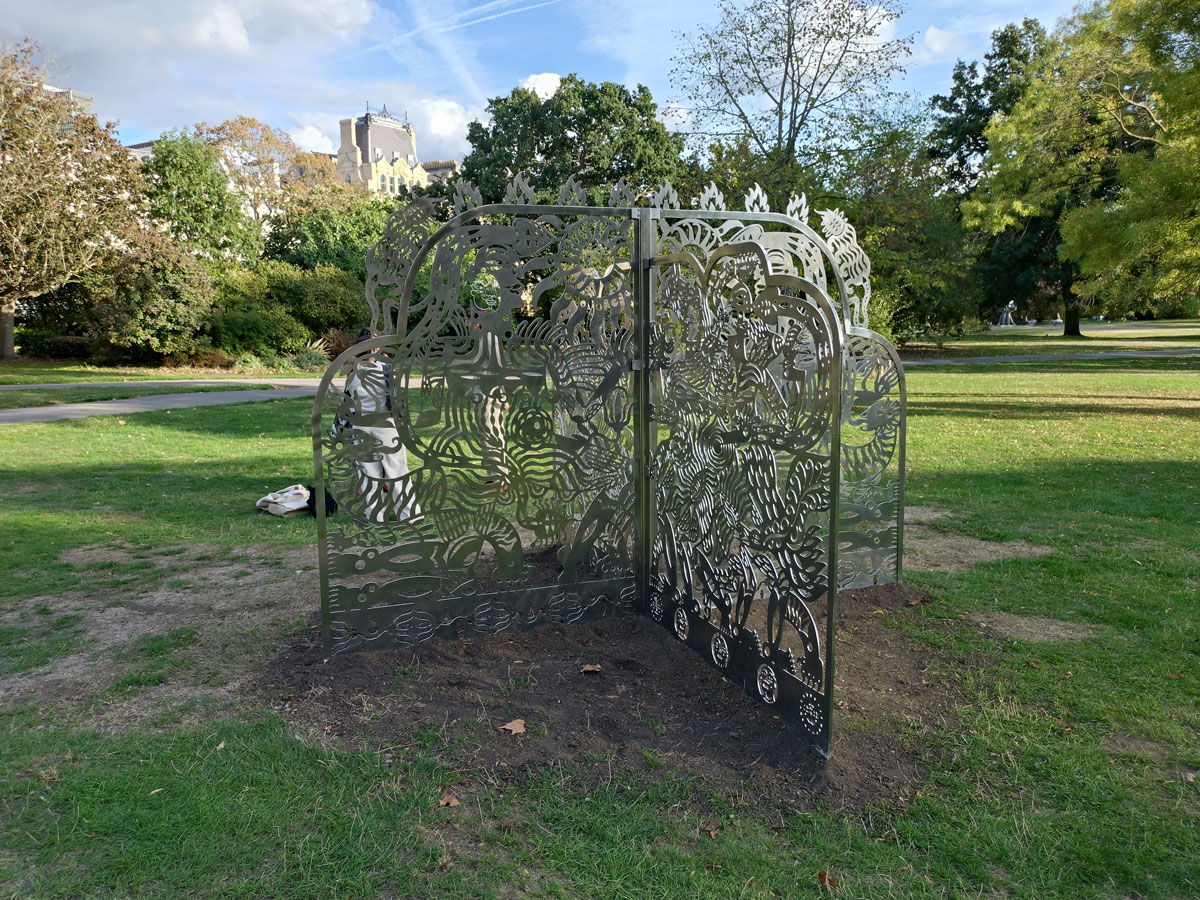
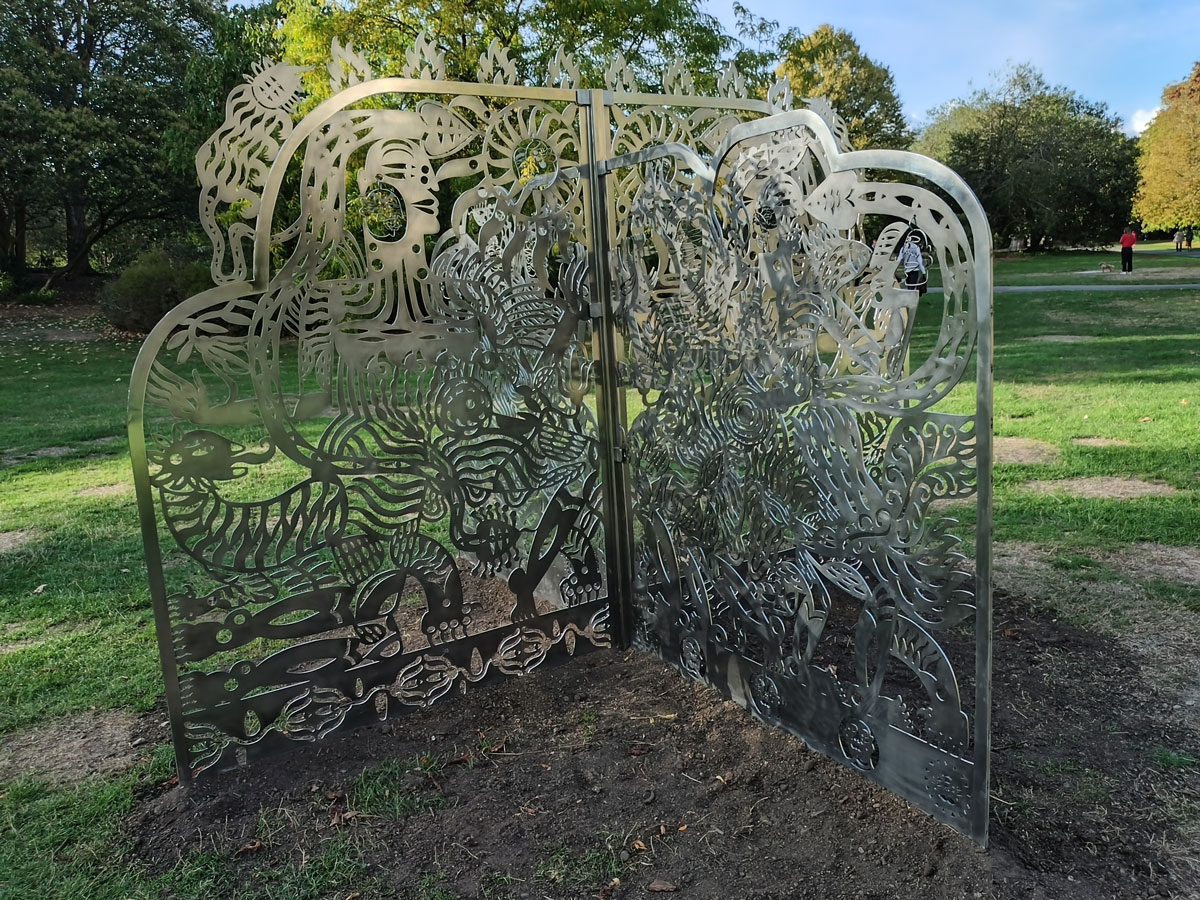
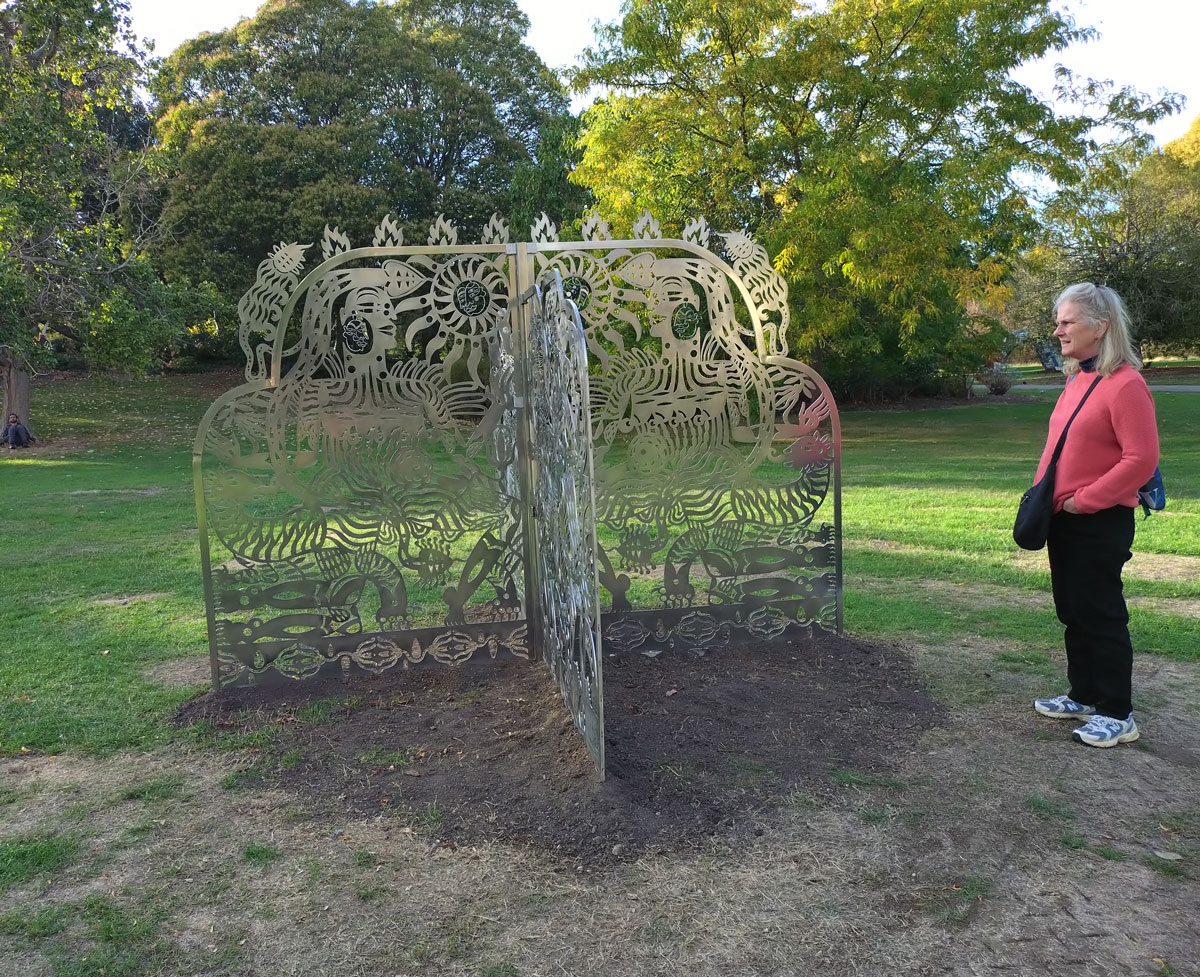
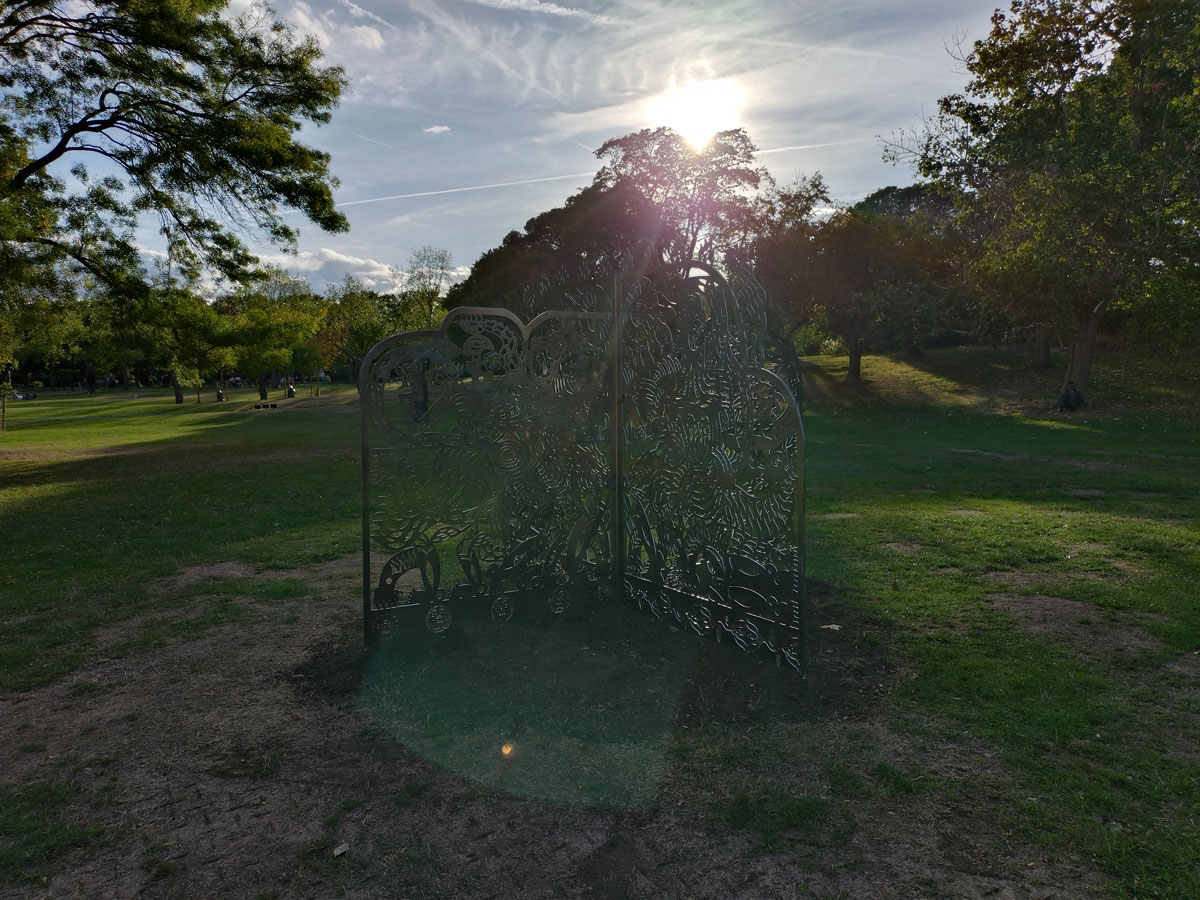
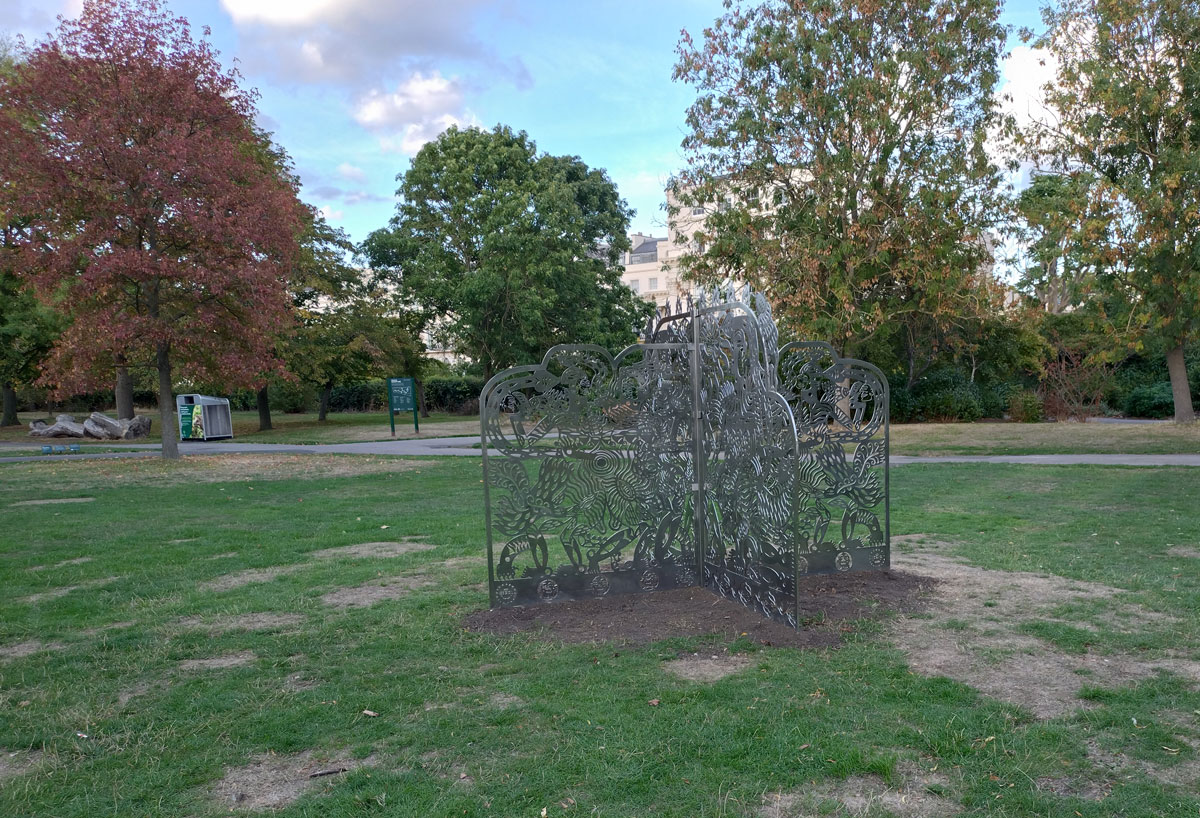
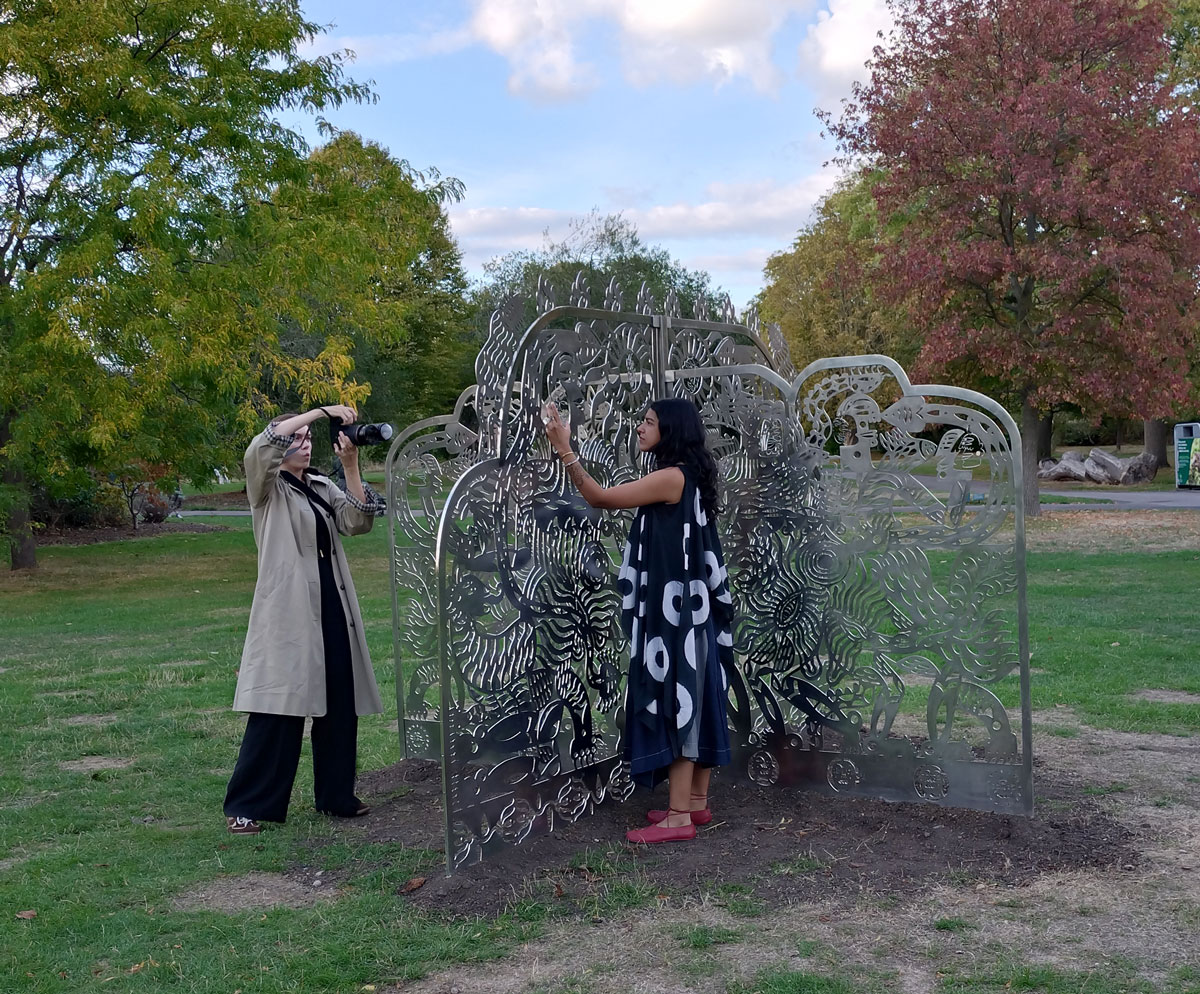
Tarini Sethi‘s The Sun Bathes Its Friends and Neighbours, 2026 is indeed catching the late afternoon sun wonderfully (the piece is presented by Rajiv Menon Contemporary, a Los Angeles based “new art gallery program focused on perspectives from emerging regions and their diasporas…” – “Tarini Sethi creates work centred on mythology, folk narratives, dreamscapes and sexual liberation. In her work, the body is a site of endless possibilities. Drawing from India’s expansive art history, from miniature painting to tribal art, she constructs a universe entirely her own. Influenced by Indian sacred imagery – such as multi-limbed deities and their mounts – she envisions futures where bodies transcend fixed notions of identity, biology and form. The Sun Bathes Its Friends and Neighbours, a four-panelled stainless steel work, presents an Indofuturist vision of a utopian and psychosexual world. Sethi’s compositions intertwine eroticism and abjection, portraying bodies that are simultaneously seductive and confrontational…” – the piece is rather seductive, it does invite engagement, not sure if it really confronts? – “While rooted in the Indian subcontinent’s artistic traditions, Sethi’s work ventures into themes that are universal and primal, exploring the uneasy tensions between power, pleasure, the grotesque and the sacred. Across her works on paper, she uses precise, historically grounded techniques to evoke physicality and sensation…” = this piece feels rather beautiful, yes, primal, a pleasure, maybe that is where the power of the piece is, or maybe that’s far too obvious…
And seems however careful I was, I missed Carolina Aguirre‘s Held, so I do have to go back, which is kind of a good thing, I do want to go back and not just as part of a visit the the aircraft hanger in October.
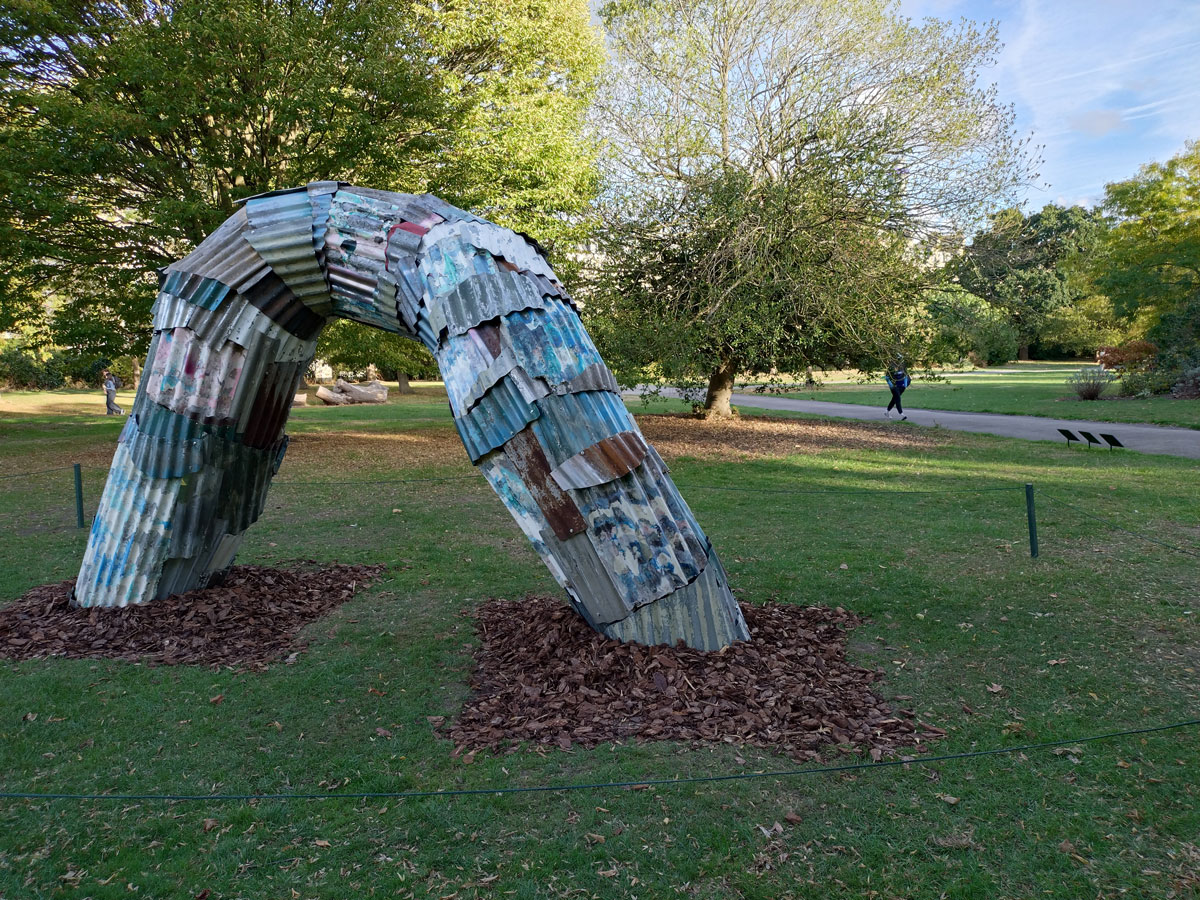
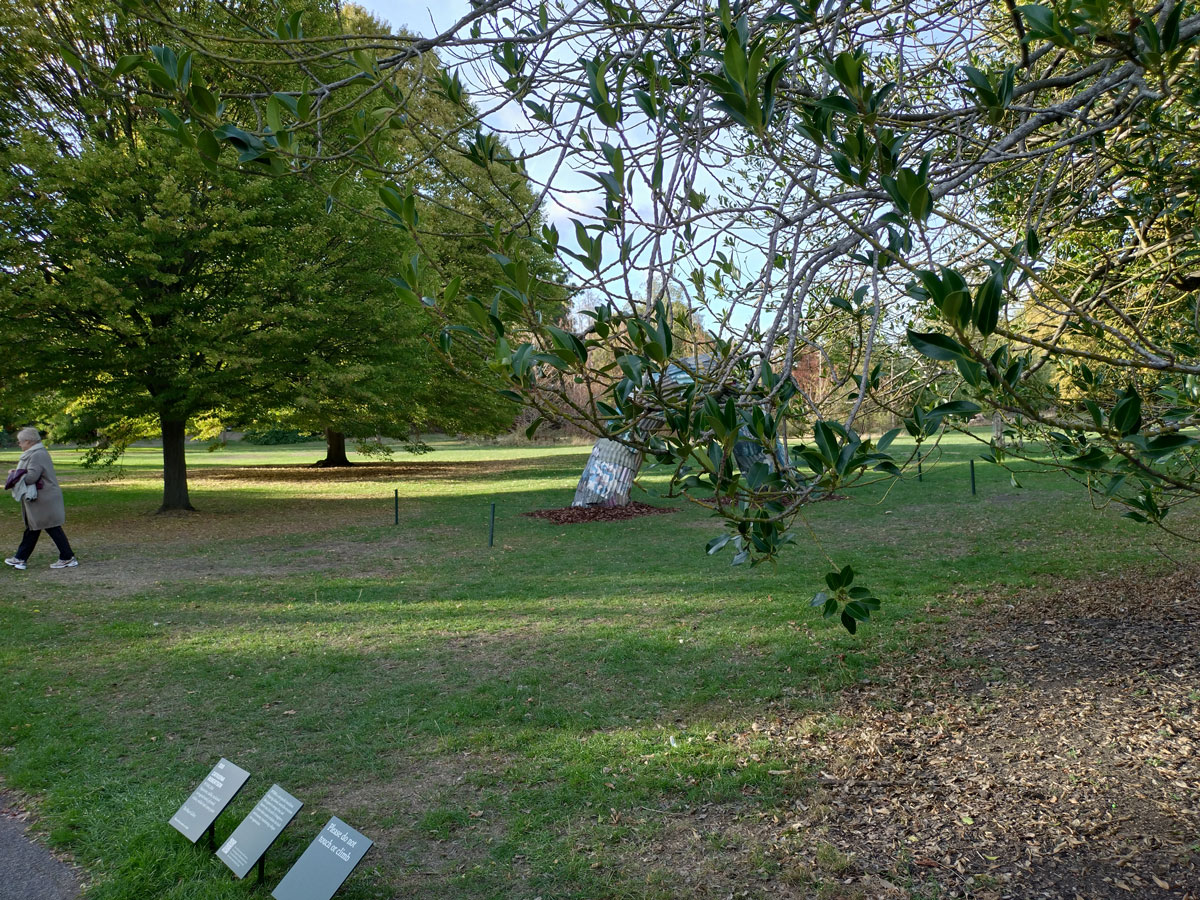
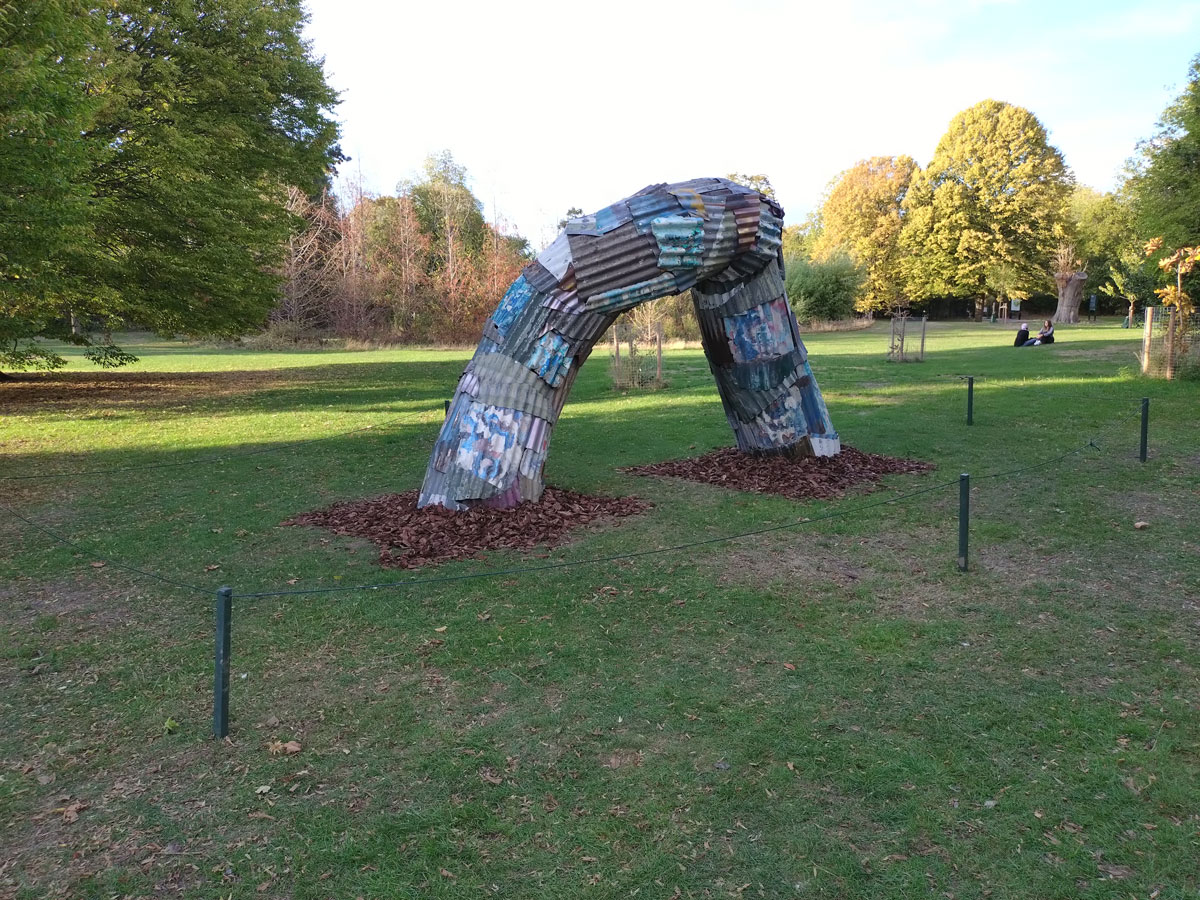
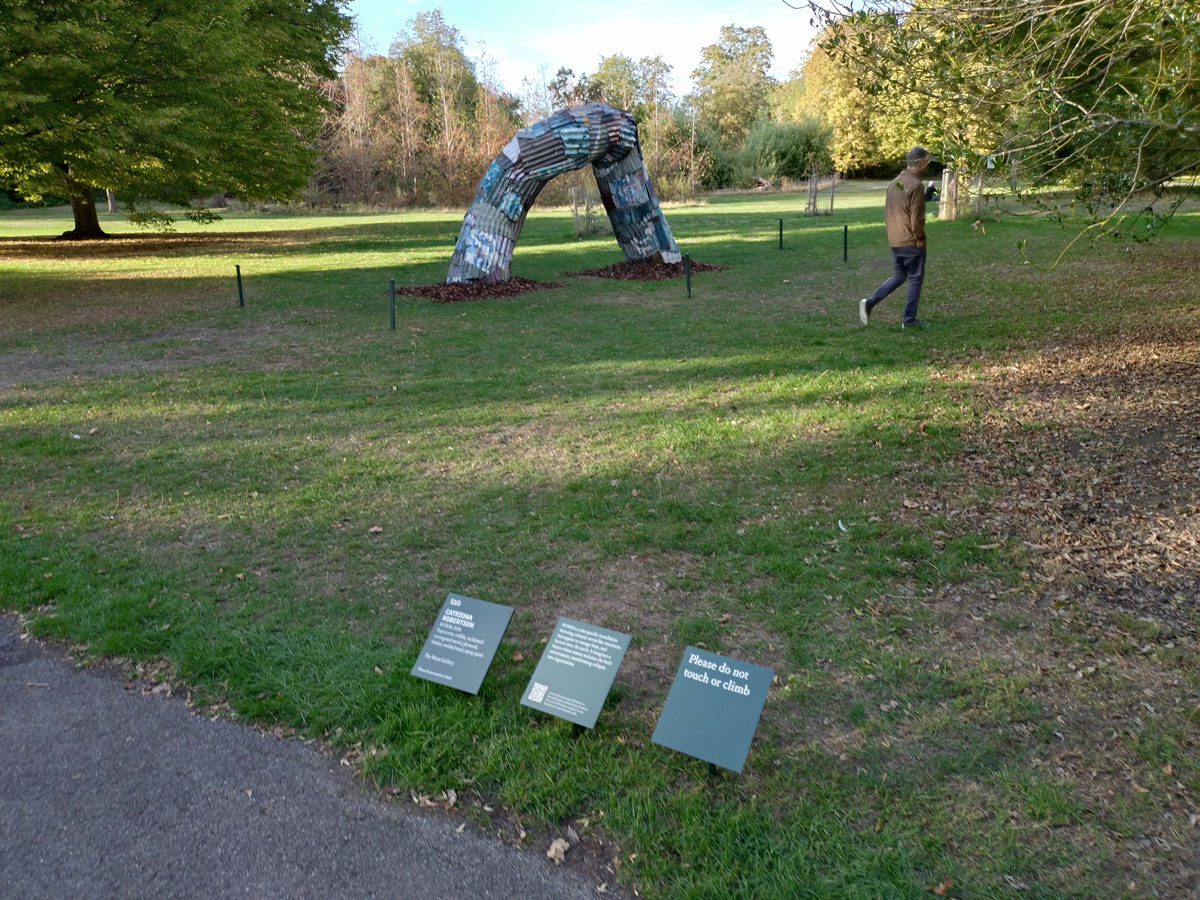
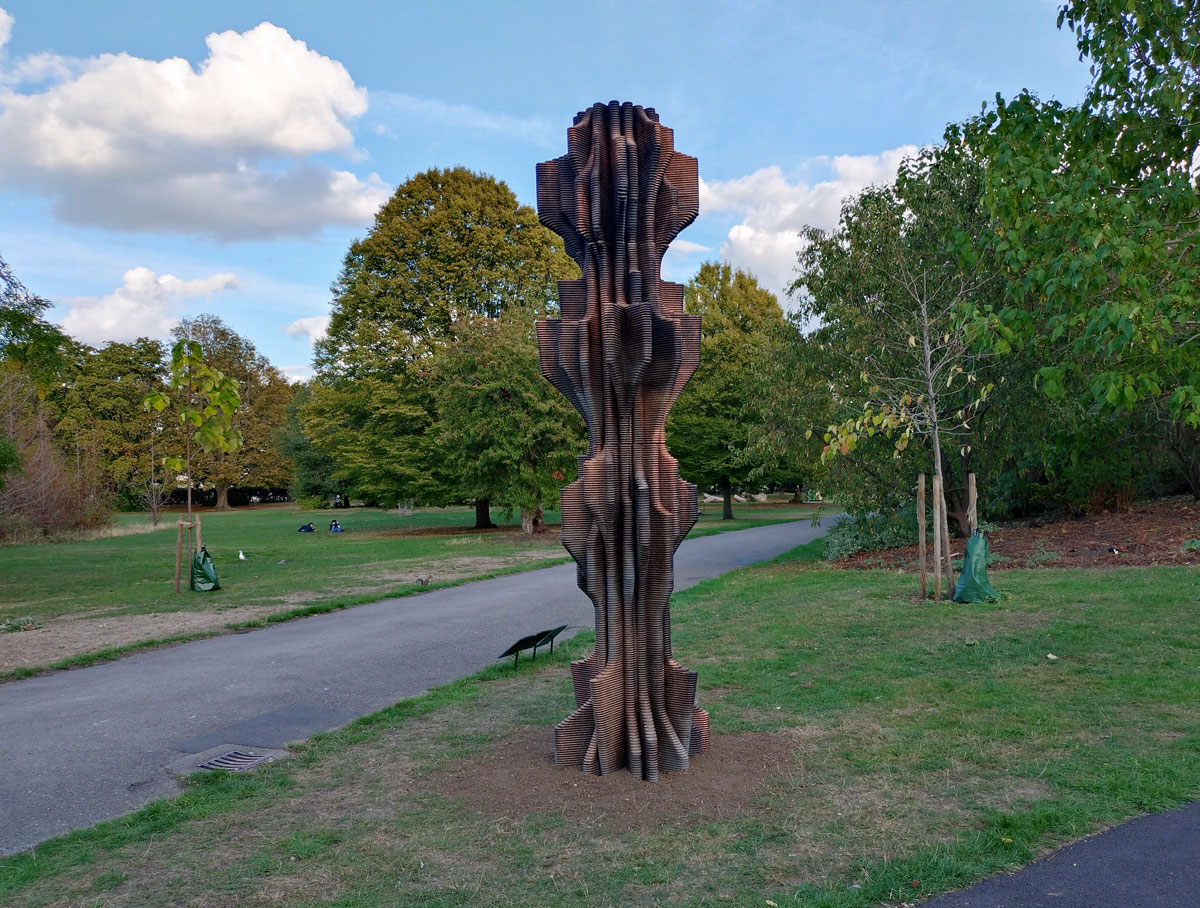
Do like Catriona Robertson‘s WYRM, another 2026 piece – do like that these are all very recent pieces, artists from the here and now – this one is presented by London’s The Muse Gallery, A piece of work that is instantly very likeable; the materials, the textures, the colours, the repurposing of the purpose, the possibility that there might be lots more of the worm-like creature under the ground, under the park, under the city; “Drawing from discarded urban elements like textiles, wood, recycled newspapers and corrugated roofing, Catriona Robertson produces layered sculptural collages. Her process, which she calls a ‘ritual of breakage’, involves a continual cycle of fracturing and rebuilding forms until they achieve a surface quality that appears simultaneously industrial, organic and fossilised….”
And there you have it, it didn’t feels as big as it has been, that might well be a positive thing, there wasn’t a headline grabbing superstar dog of a big horn of a piece this year, that might be another positive, it seemed a little more down to earth this time and now that I think about it there was a lot more to it them I maybe first thought while I was sitting on that tube train home and yes, if you should care what I might think, I think you should go if you get a chance and maybe go before or after all the noise of the fair itself flows out to the sculpture, go enjoy it before or after the (fun of) the fair… (sw)
Previously
Further Frieze London coverage on these pages
As usual please do click on an image to see the whole thing or t orun the slide show (all photos Sean Worrall)


One response to “ORGAN THING: Exploring Frieze Sculpture 2026 over in The Regent’s Park, London. You can do the same for free in the sunshine (or the rain) until the end of October…”
[…] ORGAN THING: Exploring Frieze Sculpture 2026 over in The Regent’s Park, London. You can do the sam… […]