
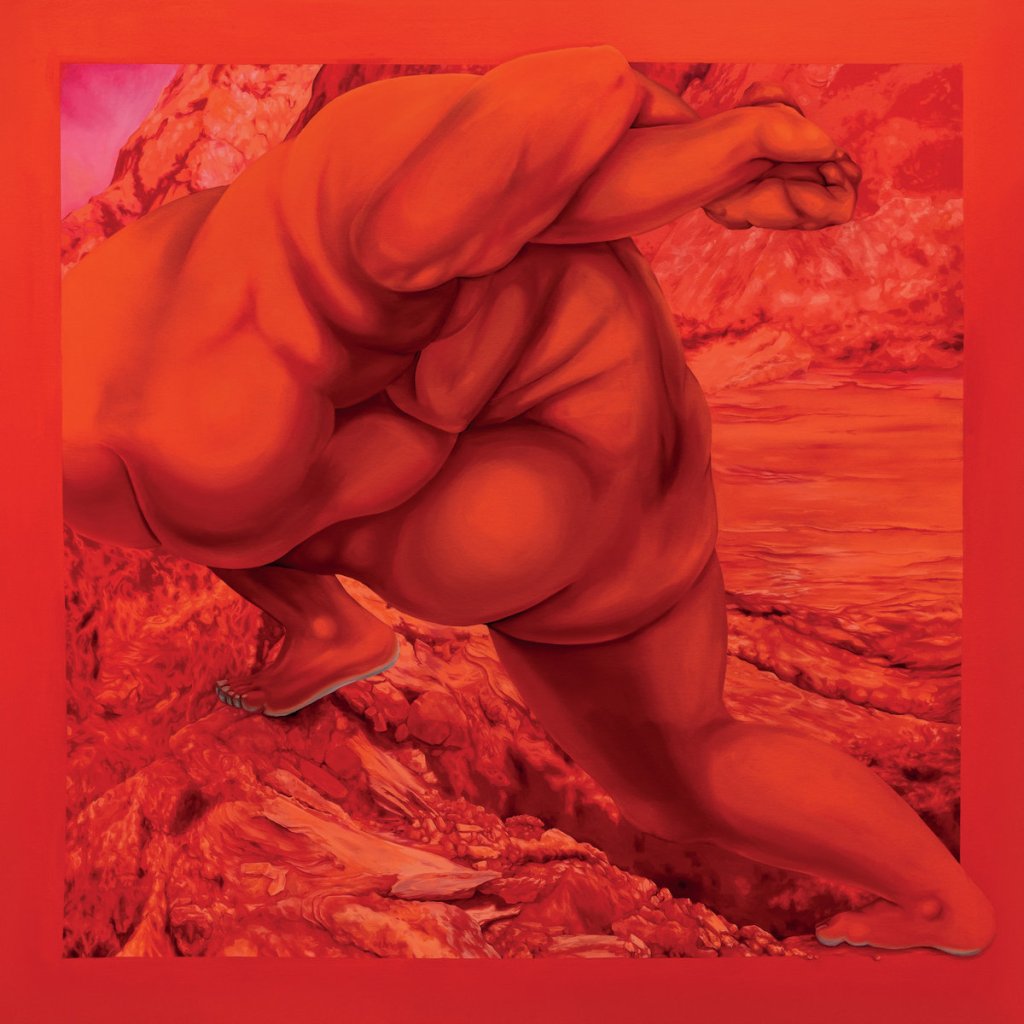
An Organ Thing of The Day for today? Well how about a rather excellent first taste of the new Marina Herlop album Dja Dja, an album the Spanish composer self-releases in Ocrober. This first track from what is said to be her most ambitious album to date is rather thrilling….
“Visionary Catalan composer, vocalist and pianist Marina Herlop reemerges with her most ambitious album to date, Dja Dja. An exultant expression of artistic agency, unfettered imagination, and meticulous refinement, the album represents a strikingly lucid and groundbreaking feat from the classically trained, avant-garde luminary.
After the operatic, piano-led minimalism of her first two albums Nanook and Babasha, and the evolutionary electronic radicalism of her next two LPs Pripyat and Nekkuja – two milestone works released on PAN – Herlop returns to the fore with an extraordinary testament to her unflinching artistry.
Intensely crafted over the last three years, the album is a hard-won, cathartic work driven by reflection, creative struggle, and resilience. Framed and animated by a sense of creative rage, this is music of struggle, but the struggle is not for conquest or ruin, but self-affirmation, for the quiet authority of someone defending their principles without ever needing to name them.
Herlop conceived the album as a single, unbroken body of work, where the whole coheres even as each piece of the puzzle retains its own internal logic. Described as a compelling, labyrinthine opus – “like a giant sudoku” – the album is structured like the archetypal Hero’s Journey. Adapting this foundation, Herlop is guided by an open intent to reconceive the myth and empower the listener, with every interpretation just as true as her own.
Over time, the framework of the Hero’s Journey began to mirror the making of the album itself, as if Herlop were scoring the herculean hardships of fulfilling her vision; a somewhat meta, somewhat ironic process. Nothing this monumental ever comes easy. Yet out of this strangely reflexive sense of adversity, Herlop has created an album that consolidates the surreal splendor of her previous work, while boldly venturing into new territory.
From the stunning, interlaced multiplicity of piano, phased brass, bass, and vocals of Jaque, to the pristine synthesis, capering whistle tones, and rhythmic bass runs of Vas Volant, to the imposing orchestral drama, hypnotic rhythms, and protean vocal prowess of Bliss, Herlop forms an abundant and kaleidoscopic world on Dja Dja. In this, Herlop only depends on the beauty and vitality of her sound. Accordingly, this music stands on its own, like plants grown on a trellis. Herlop describes the narrative structure tied to the music as a kind of borrowed scaffolding, used at first for architectural reasons, and then, once the music had taken its shape, allowed to fall away. The frame is gone; the music stands without it.
With almost all of the album painstakingly made by Herlop at home, the process was organically led by the demands of the music and where the trajectory of inspiration took her. For months a vast cardboard diagram lay on her studio floor, mapping harmony, instrumentation, tempo and meter until private ideas became gradually implemented and collaborators were enlisted. Gamelan parts were recorded in Bali with local musicians, while Herlop’s close and trusted friend Adri González (Adri Goor) played a crucial role, serving as a “score doctor” and regularly advising her on musical decisions, across harmony, instrumentation, structure, timbre, and mixing. Throughout the process, Herlop describes subordinating herself to the music rather than commanding it, following its instructions for as long as it needed her.
Infused with masterfully deferred intensities and new directions in Herlop’s work – like gamelan music and intuitively scored orchestral brass – it’s an album that conjures rich landscapes of sound without ever tipping into excess. Reflective of her Catalonian roots, yet often evoking an otherworldly, fantastical space entirely of her own creation, the music brings to mind the maverick singularity of artists like Fever Ray, Bjork, and Diamanda Galas, as well as the reiterative grandeur of composers like Michael Nyman and Steve Reich. Still, comparisons are mostly superficial in this case; Herlop unequivocally forges her own path.
It’s fitting then, that Dja Dja is Herlop’s first self-released album. A record made with this much autonomy seemed to demand it, and the slow-burn pace of making the album left no room for any concessions to a label or anyone else.
In keeping with a defining sense of independence, the release is austere by design, almost without imagery. Herlop has little appetite for visual ornamentation; she prefers music that is blind and self-sufficient. In an age of visual overload she would rather bestow the listener with their own projected imagery. The only story Herlop asks anyone to follow is the one the music tells; a story that’s mercurial, sublime, and emphatically heroic”.
Previously




One response to “ORGAN THING: A rather thrilling first taste of visionary Catalan composer, vocalist and pianist Marina Herlop’s most ambitious album to date…”
[…] 4: Marina Herlop and more from that forthcoming album, read about it via this link – A rather thrilling first taste of visionary Catalan composer, vocalist and pianist Marina Herlop’s… […]