
We surely don’t need to repeat the bit about the editorial here again do we do we? Another week, another Five London Art Things thing and on with all this endless art coverage? Years of it. Actually this week we probably do need an editorial, or a repeat, we won’t though, there’s no time, and we did say that last time, on with it…
Five art things, five more art things happening somewhere around right now (or any moment now). Five art shows to check out in the coming days as we repeat ourselves. We do aim to make this an (almost) weekly round up of recommended art events, five shows, exhibitions or things we rather think might be worth checking out. Mostly London things for that is where we currently operate and explore, and like we said last time, these five recommendations come with no claims that they are “the best five” or the “Top Five”, we’re not one of those annoying art websites that ignore most things whilst claiming to be covering everything and proclaiming this or that to be the “top seven things” or the “best things this weekend”. This Five Things thing is simply a regular list of five or so recommended art things happening now or coming up very soon that we think you might find as interesting as we think we will…
And we should add, that entry to these recommended exhibitions and events, unless otherwise stated, is free…
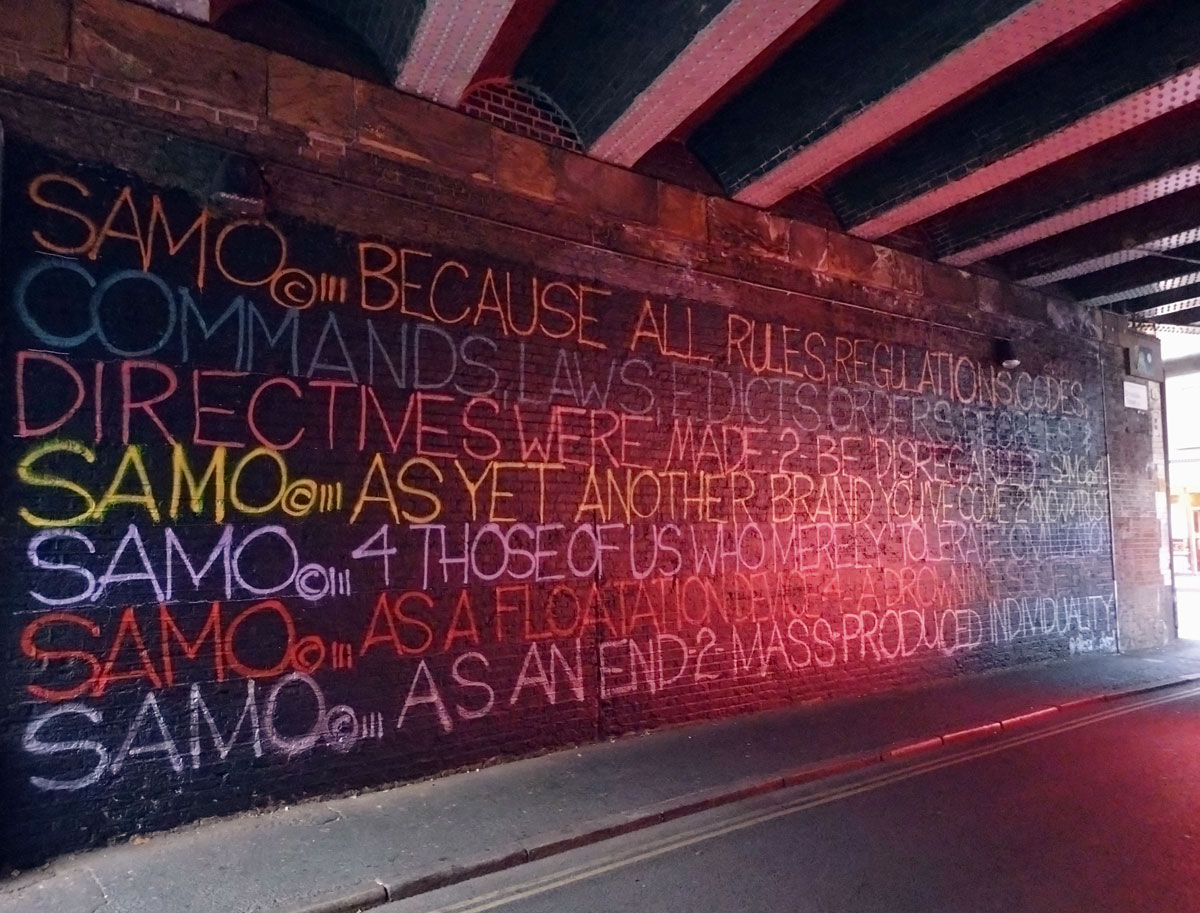
That photo at the top of this pafe is of a just painted wall on Shoreditch, a Samo thing of all things, here’s a word or two on the Al Diaz show that just opened last week – Al Diaz, a New York legend in town, Samo© in Shoreditch, at D’Stassi, as an end to what?
Meanwhile, here’s this week’s takeaway….
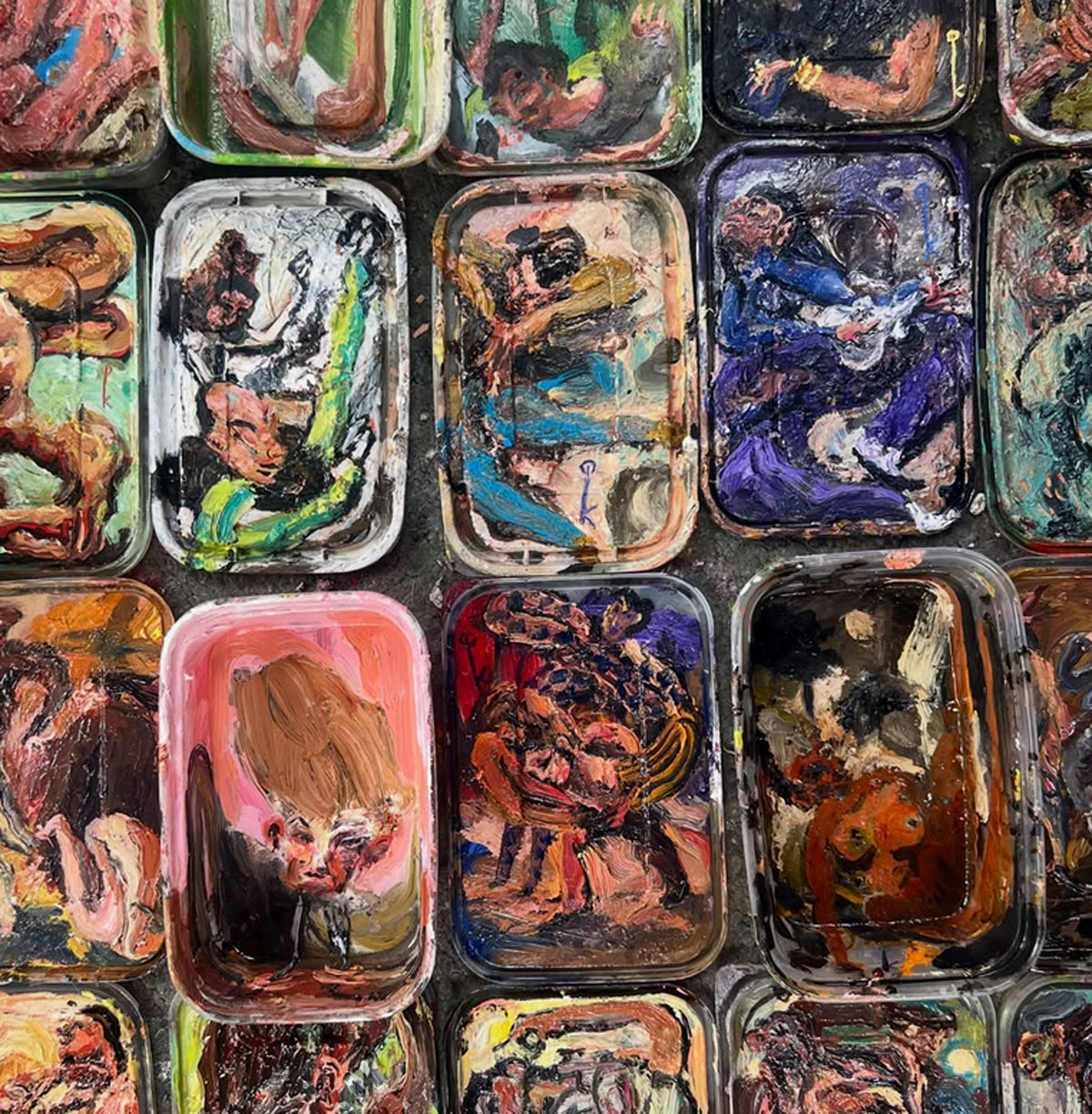
1: Pushka, Takeaway at Canal Boat Contemporary – Opening night Thursday, 1st October, 6-8pm and then on for a couple of weeks I imagine – “The show will function literally as a takeaway, with oil paintings made on takeaway containers available to be taken away there and then. As work goes, Pushka’ll be painting new ‘takeaways’ on the spot to replace them. In that way the show will be an evolving, living thing – and an experiment in impermanence. All paintings are priced affordably at £280” (well now, “affordable” to some maybe, not sure everyone has £280 kicking around in spare change for a painting?)
– “It’s also the last show of the year at Canal Boat Contemporary, and possibly the final boat show ever. If you’ve ever been interested in checking out a canal boat show, this might be your final chance. Come to celebrate the end of the second year of an amazing project!” – It has been a great project. True, we’ve been critical at times, bloody QR Codes and such, but there has been some strong positive shows, some great art, maybe more in the first year than the second but it will be shame to see it all end (if this really is the end).

“Come to drinks on the towpath this Thursday, 1st October, 6-8pm” say the Captain and curator (who just happens to be Pushka) No idea how long the show is on for, it does tend to be a little too much about the opening party and not the whole thing, but hey, it has been a couple of years to mostly celebrate, a couple of years of good shows (maybe more of them in the first year). I expect the show will be on for a couple of weeks (watch this space for an update). The boat does tend to move up and down the Regent’s Canal towpath, right now you find it tied up by the entry to Victoria Park, over on the edges of Hackney, adjacent to Vyner Street for those who remember all that beautiful chaos. Find your way to the canal bridge where Cambridge Heath Road changes to become Mare Street here in London E8. Get yourself on the towpath, head towards the park and away from Broadway Market and find the boat about five minutes along…. And it is all in that glass fronted case on the outside of the boat s oyou can view it 24/7 – “See you at the takeaway!” said the man from the boat.
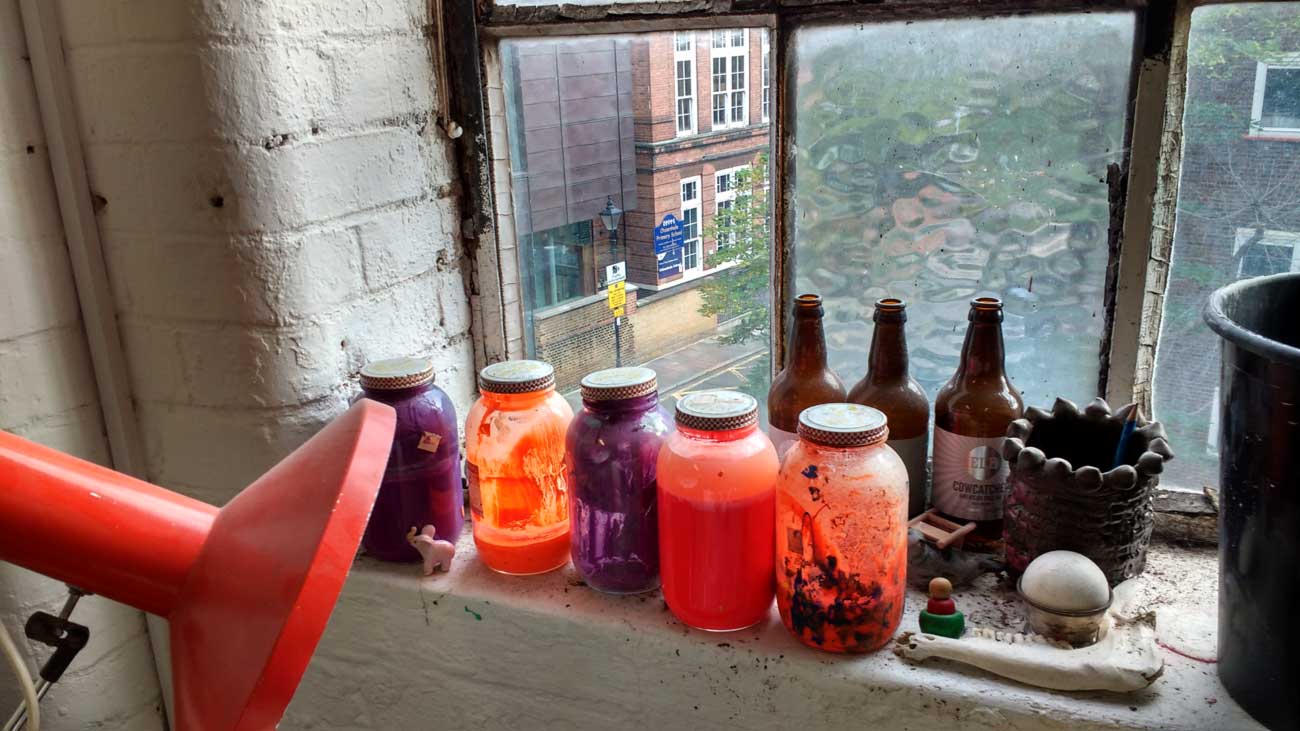
2: Chisenhale Open Studios – happening over the first weekend of October – “Right, you little scamps… come to our Open Studios. Details of address and times below. There are 40+ talented souls in the building. If you want to find me specifically: ground floor, studio 39, (which uncannily rhymes with wine) and which is shared with the exceptional photographic artist John Peter Askew. Also buy things, our rents have gone up. See you this weekend! X” said Lee Maelzer. We rather like the way Lee paints around here and we rather like all the history to be found both within the walls and the actual walls of East London’s Chisenhale studios. Open studios give you a lot of things you don’t get anywhere else, things you don’t get at exhibitions or art fairs or other than you do in a studio where the marks can be seen, the scars, where conversations can happen, you maybe see a touch more of an honest view of an artist (if they haven’t cleaned up their space and turned it into a mini gallery for the weekend that is)
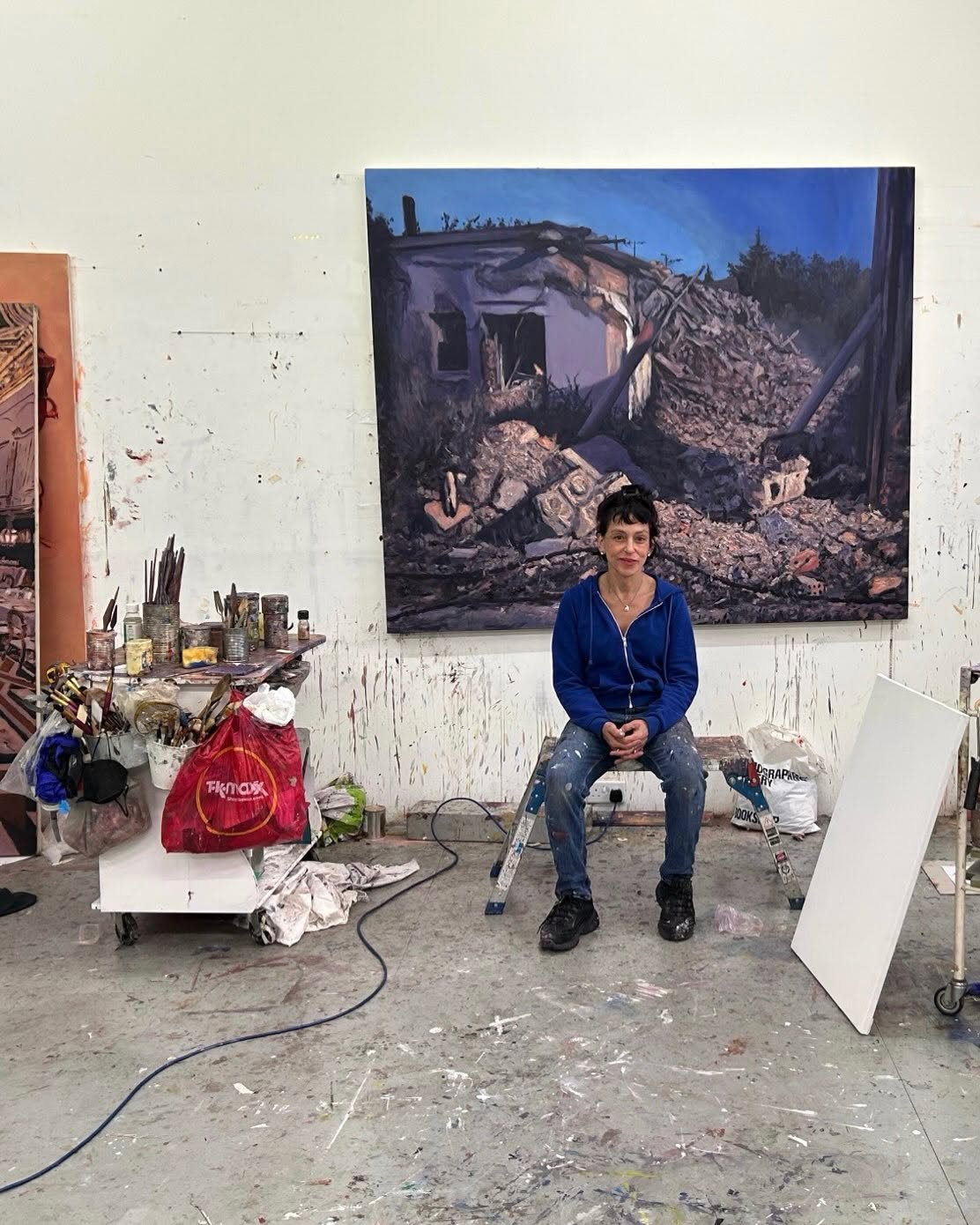
Chisenhale Studios are found at 64–84 Chisenhale Road, London, E3 5QZ. The space is open on Friday October 2nd 6-9pm, Saturday 3rd 12-5pm, Sunday 4th 12-5pm
Previously on these pages –
ORGAN: Cultivate Presents The Accidental Marks Made While Making Art, an on-line exhibition
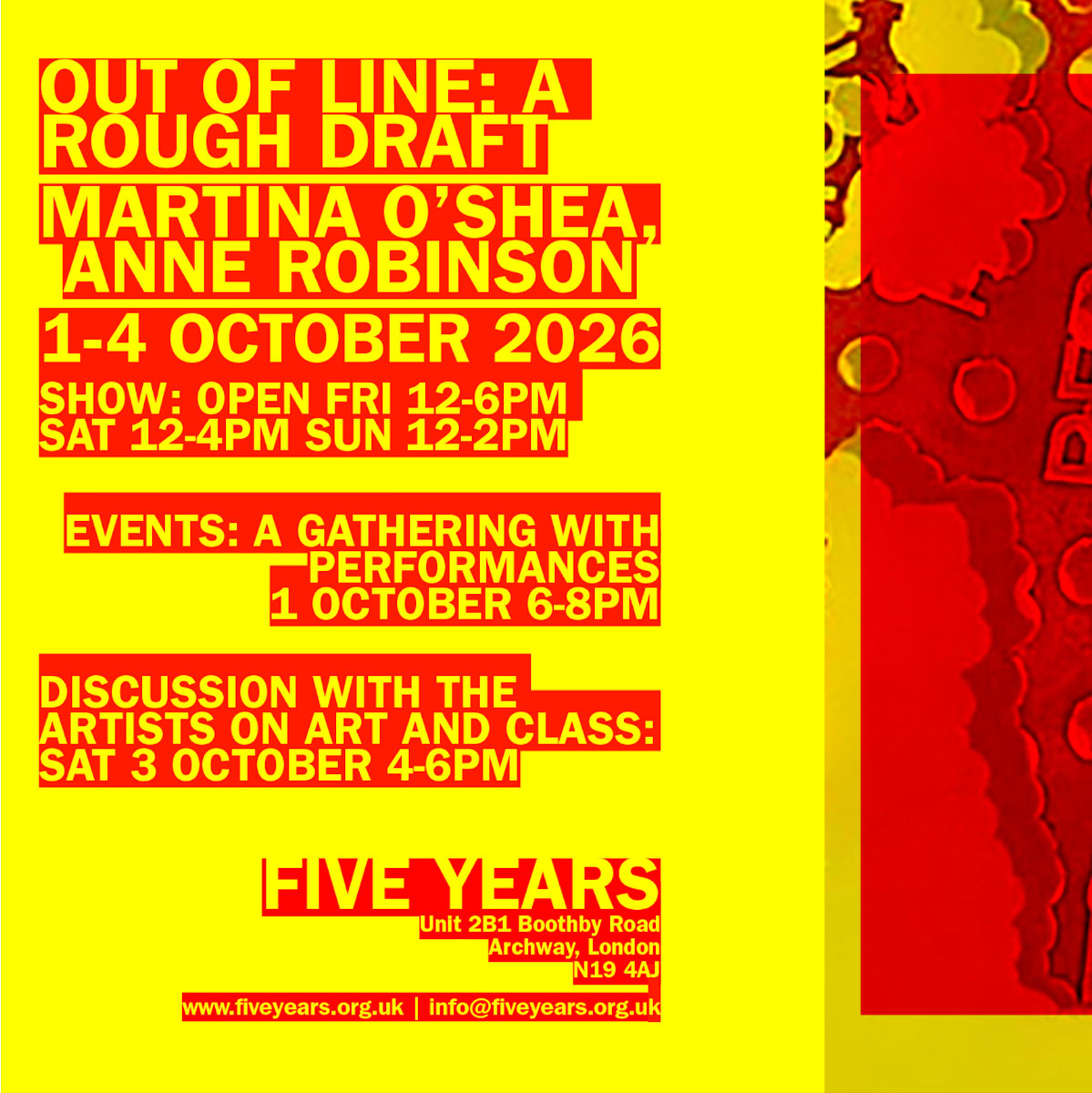
3: Martina O’Shea, Anne Robinson, Out of Line: A Rough Draft at Five Years – 1st to 4th October 2026 – Now Anne is always interesting, an artist who walks it rather than just talks it (which so often isn’t the case these days).
“Both Anne and Martina are London based working class Celtic queer artists of different generations. After many conversations they found multiple connections in their practices and wanted to collaborate to see what happens when the can of work is opened. The places constructed for poor bodies to ‘rest’ have never been comfortable. Historically, from the metal beds of the workhouses to the hard plastic chairs of modern-day canteens, from workhouse dormitories to hostels, night buses, and gig-economy, they are a pretence. Work-house/Poorhouse. Work: invented and maintained to keep bodies active and the rich, rich. Working bodies must never be allowed to rest. As working class artists we live in the shadows of paupers: on the Pauper’s Road in Kerry, Ireland and the Poorhouse in Ayr, Scotland and wonder where we are now. Reaching back in history to present day working conditions of unrest”.
The work: Martina O’Shea: A cast marble and metal pillow sculpture holding two arm bands, alongside a new shrine made from a selection of ‘no’ signs from a canteen. Anne Robinson: Seven digital prints showing a ‘poorhouse’ bed, intentionally made to disallow ‘rest’ to make it uncomfortable to sleep on, overlaid on to a ‘Poor’s Roll’ from 19th century Scotland recording cash and demise.
ARTIST BIOS: Anne’s art practice is multidisciplinary and often collaborative: concerned with the perception and politics of time passing, ’queering’ technologies’, working speculatively with archives to ‘listen to the past’ and experiment with fictioning, in film, songs, printmaking, drawing and text. Martina is from Kerry, where an inch is a mile. Tis what it is. A rural landscape that shaped her and since her departure she has developed an interest in stages, windows and craft. Her experimental practice moves between sculpture, sound, installation and zine-making. In her recent show Alterity Altar (2026), staged in a window gallery in Hackney, Martina invited nine friends to alter the exhibition over the course of four weeks; an experiment in duration and accumulation with a publication documenting the process forthcoming.
Five Years is found at Unit 2B1 Boothby Road, London N19 4AJ. The space is open: Friday 12-6pm, Saturday 12-4pm, Sunday 12-2pm. EVENTS: A Gathering: Thursday 1 October 6-8pm. Discussion with the artists on Art and Class: Saturday 3 October 4-6pm, Find the artists on Instabloodygram if you must: @anrobs / @martinaoshea (find Organ on Instabloodygram if you want to but we really don’t bother using it much, the damn dominates the way art works far too much for my liking)
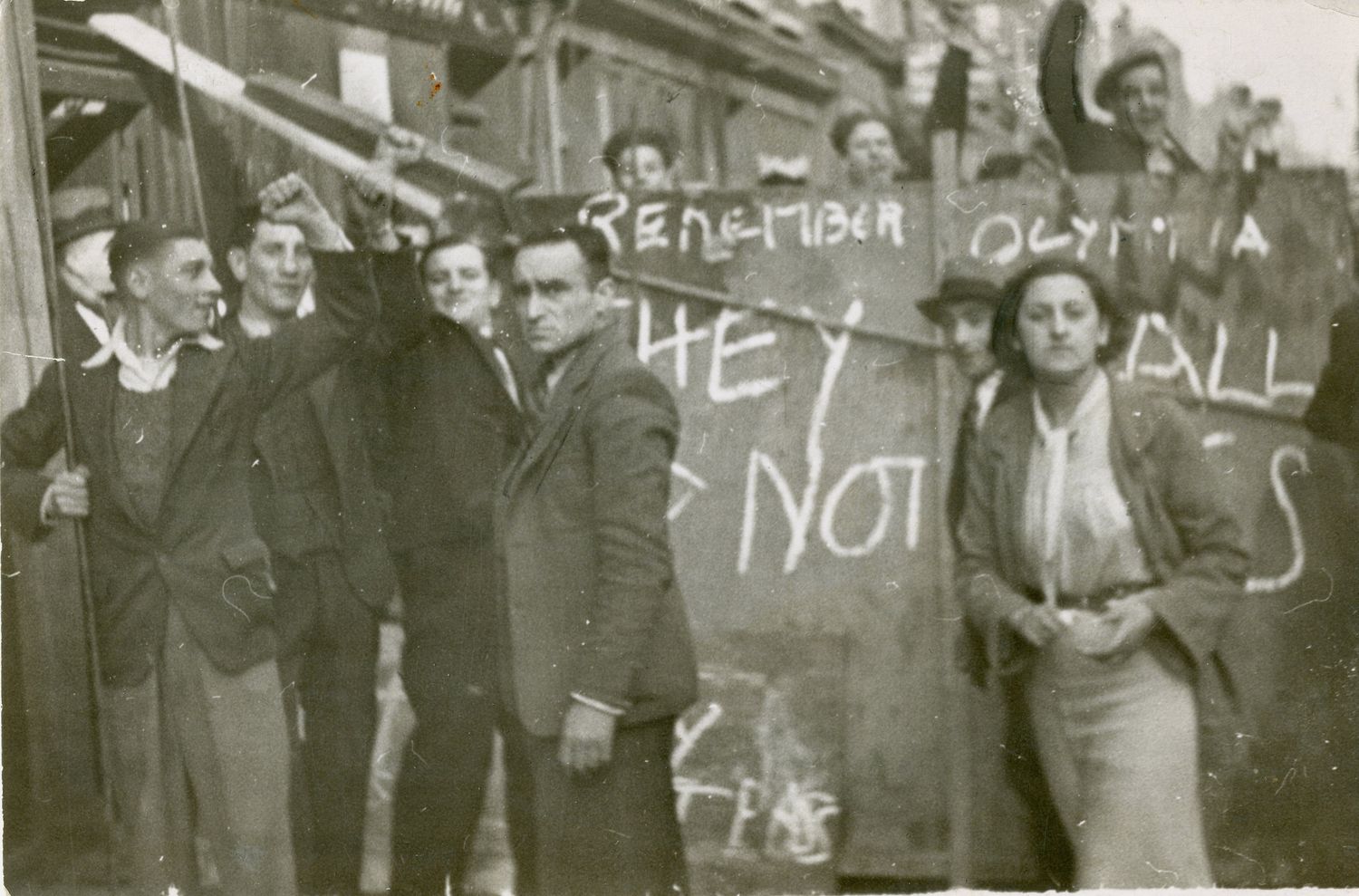
4: Solidarity on the Streets at Four Corners – Over in Bethnal Green and running from 2nd Oct until 31st Oct 2026 with an opening night on Thursday 1st 6pm until 8pm. This is a rather timely and rather important exhibition, especially considering the current climate and the sickening sight of idiots dress in black on our streets again. An “exhibition documenting East Enders’ enduring resistance to racial hatred and intolerance, exploring a century of collective action against racism, fascism and exclusion”.
“On the eve of the 90th anniversary of the Battle of Cable Street, this exhibition explores a century of collective action against racism, fascism and exclusion. London’s East End has been a refuge for migrant communities fleeing poverty and persecution for over 500 years, from Irish migrants and French Huguenots to Eastern European Jews and South-Asian Bengalis.
On 4th October 1936, the people of East London stopped Oswald Mosley’s fascist Blackshirts from marching at the ‘Battle of Cable Street’. Local people, Jewish and non-Jewish alike, Irish dockers and anti-fascists united against hatred with the slogan ‘They Shall Not Pass’!
Forty years later, young Bengali activists mobilised against National Front racist violence. By the 1990s, a new generation were campaigning against discriminatory immigration and housing policies, overturning the election of the first British National Party (BNP) local councillor. Today, the East End is again a target for far-right, Islamophobic, and populist forces, from T**my R*binson to the UK Independence Party. Solidarity on the Streets marks the anti-racist legacy of Cable Street, and seeks inspiration for our own troubled times.
The exhibition includes photographs by Mayar Akash, Lloyd Gee, Sheila Gray, David Hoffman, Jess Hurd, Tom Learmonth, and Paul Trevor, with artwork by Dan Jones, archive film and documents. It includes five short films, created by Shirin Begum, Fela Callahan, Hester Gallen, George Ritchie, and Nileema Yesmin.
This show is part of Together on Cable Street, a programme of events marking the 90th anniversary of the Battle of Cable Street. Visitors will also be able to view the current exhibition London Memoirs, in the main gallery”.
Four Corners is at 121 Roman Road, Bethnal Green, London, E2 0QN. The space is open Wednesday through to Saturday, 10am to 6pm
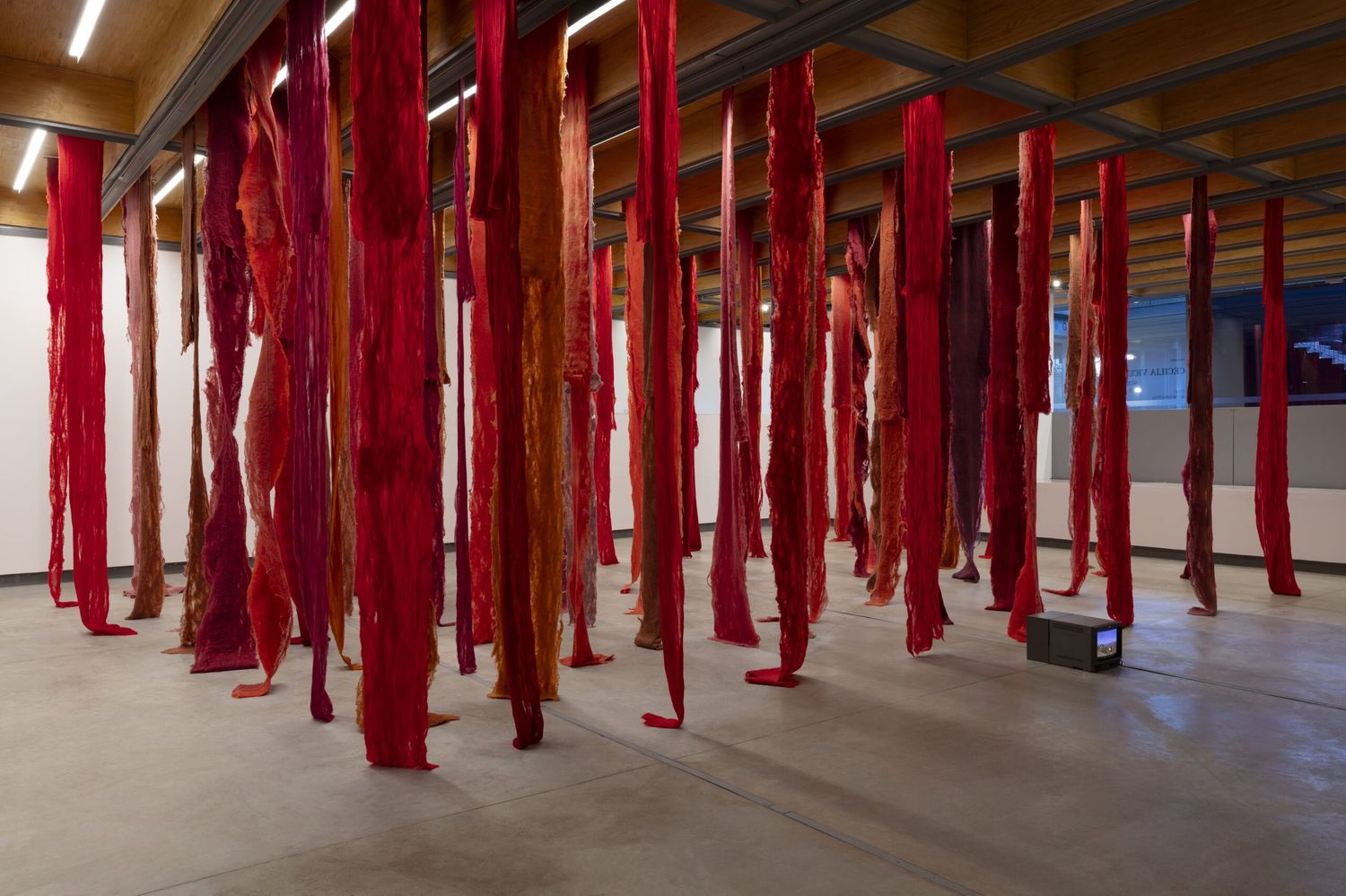
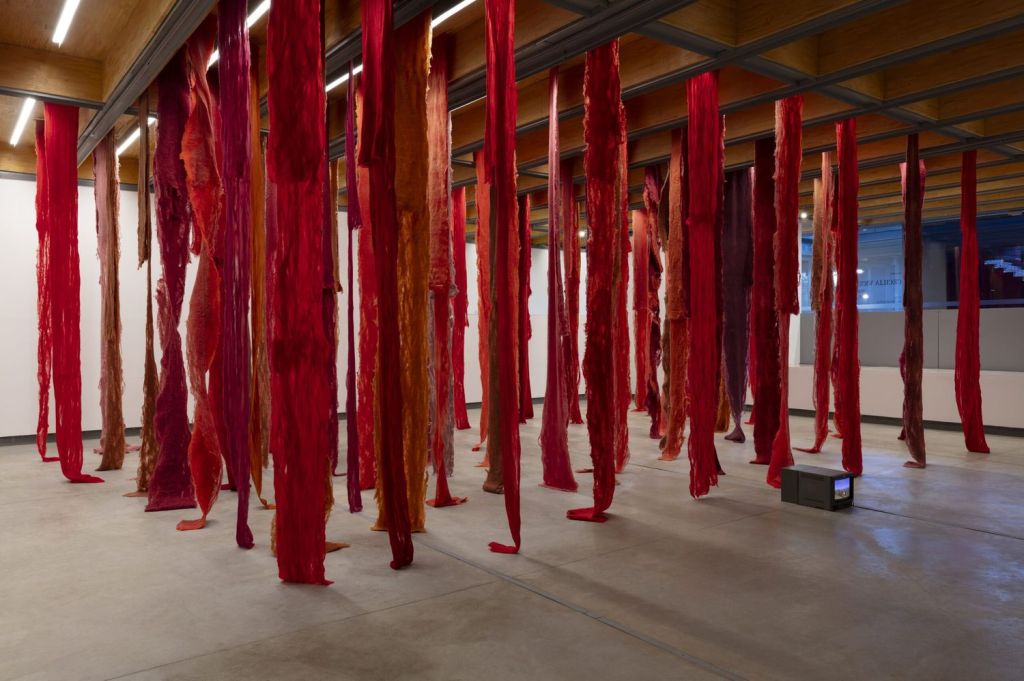
5: Cecilia Vicuña, Living Threads at Whitechapel Gallery – 7th October 2026 until 14th February 2027 – Bit of a major one this and yes, we do try to be focussed on the smaller shows and the more alternative art things, the ones that the mainstream art press tend to not be bothered with or maybe think are beneath them, this one does look like it is going to be rather special though – “The first major UK exhibition of Cecilia Vicuña, one of Latin America’s most internationally renowned artists, poets, and feminist activists, spanning six decades of interdisciplinary practice”.
“This extensive exhibition marks the first major UK exhibition of Cecilia Vicuña (b.1948, Santiago, Chile) – one of Latin America’s most internationally renowned artists, poets, and feminist activists. Spanning six decades, the presentation provides a unique opportunity to explore Vicuña’s interdisciplinary practice, which intentionally dissolves the boundaries between visual art, poetry, performance, ritual and activism, and encompasses works across painting, textile, photography, installation and film.
Born and raised in Santiago, Vicuña came to London to study at Slade School of Art in the early 1970s, and self-exiled after the violent military coup against President Salvador Allende in 1973. As a creative and personal response to the situation in Chile, Vicuña’s practice became more explicitly political during the Allende period (1970-73), a process that intensified in London reflecting her experience of displacement, loss, political violence and instability. The exhibition includes a dedicated display on Artists for Democracy (AFD), the organisation Vicuña co-founded in London in 1974 with David Medalla, John Dugger and Guy Brett in solidarity with Chile and other liberation struggles worldwide, and brings together never-before-seen documents, photographs and printed materials.
Another key facet of Vicuña’s work, evident from the 1960s onwards, is her deep commitment to honouring and preserving ecosystems and indigenous systems of knowledge. Many of her installations function as acts of remembrance for cultures, languages and ways of being that have been suppressed by dominant Western models and colonial systems. The exhibition brings together key emblematic works from across her career including the spectacular Quipu Menstrual (2006–2024), a dense sculptural installation of unspun wool in vivid shades of red and brown suspended from the ceiling. Vicuña has been creating quipus (knots) for over 50 years as striking embodiments of an ancestral, non-alphabetic communication system rooted in Andean culture. Also on display will be the only surviving work from her precarios series she made during her time in London, as well as documentation of the 400 lost works from that same collection. Vicuña began making precarious in the mid-1960s. There small sculptures, crafted from papers, prints, fabric, feathers and other found materials are defined by their ephemerality and challenge conventional understandings of sculpture as fixed or permanent.
The presentation features a selection of paintings from Vicuña’s time in London in the 1970s, as well as work from her acclaimed Palabrarmas series, which she began during her time in London, and a series of works dedicated to Vicuña’s performances and interventions in public spaces”.
Whitechapel Gallery is found at 77-82 Whitechapel High St, London, E1 7QX (right by the Tube Station)
Previously…


One response to “ORGAN: Five Recommended London Art Things – Martina O’Shea and Anne Robinson get Out of Line at Five Years, Pushka’s Takeaway at Canal Boat Contemporary, Chisenhale Open Studios, Solidarity on the Streets at Four Corners, Cecilia Vicuña at Whitechapel Gallery and…”
[…] 1st October 2026 – ORGAN: Five Recommended London Art Things – Martina O’Shea and Anne Robinson get Out of Line at … […]